.png)
.png)
.png)
.png)
By Ronald Kapper
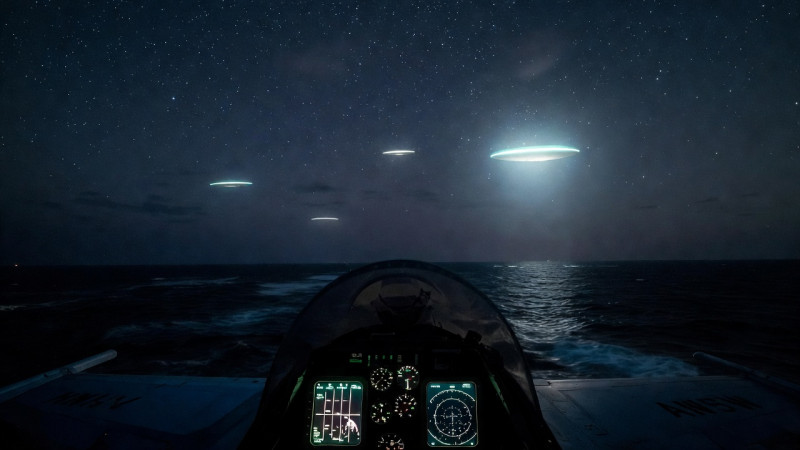
UFO sightings are no longer whispered stories shared on late-night radio shows. They are now discussed in congressional hearings, analyzed by scientists, and logged in official government databases. Every year, the numbers climb higher. From commercial pilots to military radar operators, more people are reporting strange objects in the sky than ever before.
So what’s really happening? Is something new entering our airspace—or are we finally paying attention?
Scientists and officials from the U.S. Department of Defense say the answer is far more complex—and far more interesting—than simple alien speculation.

The numbers don’t lie, but they need context
According to Pentagon data, hundreds of Unidentified Anomalous Phenomena (UAPs) are now reported every single year. One of the most cited reporting periods covers May 1, 2023 to June 1, 2024, during which 757 new UAP incidents were formally recorded by the government. Many occurred at specific times during military training exercises or routine patrol flights, often between 2004 and the present, with a noticeable acceleration after 2017.
Civilian databases also show sharp annual increases, especially since 2020. But experts warn that rising numbers do not automatically mean more unknown craft are appearing.
Instead, they point to a major shift in how sightings are detected, reported, and taken seriously.
Better sensors are changing everything
Modern skies are watched more closely than at any time in human history. Advanced radar systems, infrared targeting pods, satellite tracking, and high-definition cockpit cameras now capture things that older systems would have ignored or filtered out.
Military pilots have repeatedly stated that objects once dismissed as “sensor noise” are now clearly visible on multiple systems at the same time. That includes infrared heat signatures, radar returns, and visual confirmation.
NASA scientists have openly acknowledged that many older UAP reports were likely missed simply because the technology to detect them did not exist. In other words, some of these objects may have always been there—we just couldn’t see them clearly.
Stigma is gone, reporting is up
For decades, pilots avoided reporting UFO sightings out of fear they would damage their careers. That changed dramatically after 2017, when official acknowledgment of UAP investigations became public.
The Pentagon introduced standardized reporting channels, encouraging military and civilian aviators to document unusual encounters without ridicule or penalty. This single change caused an immediate spike in reports.
Officials emphasize that this cultural shift alone explains a large portion of the yearly increase. When people feel safe reporting what they see, the data grows rapidly.

Famous incidents that changed the conversation
Several well-documented encounters pushed UFOs into the mainstream:
- November 14, 2004, around 2:00 PM local time: U.S. Navy pilots off the coast of California tracked a fast-moving object later known as the “Tic Tac” incident. Multiple radar systems confirmed the event.
- 2014–2015: East Coast Navy pilots repeatedly encountered unknown objects during training missions, often at similar altitudes and times.
- July 26, 2023: A former intelligence officer testified under oath before Congress, claiming the U.S. possessed recovered non-human technology—a claim still unverified but highly influential.
Each incident increased public awareness and led to more people watching the skies.
What scientists actually think
NASA’s independent UAP study team has been clear: most sightings eventually turn out to be balloons, drones, birds, atmospheric effects, or sensor misidentifications.
However, a small percentage remain unexplained, even after thorough review. Scientists stress that “unexplained” does not mean extraterrestrial—it means there is not enough high-quality data to reach a conclusion.
Poor angles, missing metadata, single-sensor recordings, and human perception errors still limit analysis.
The Pentagon’s position is cautious—but serious
The Pentagon maintains that UAPs are primarily a flight safety and national security issue. Objects that move unpredictably near military aircraft demand investigation, regardless of origin.
Officials have repeatedly stated there is no confirmed evidence of alien technology, but they also admit that dozens of cases defy current explanation.
This balance—neither dismissive nor sensational—is why the topic has gained credibility in scientific circles.
Why sightings will keep increasing
Experts agree the trend is unlikely to reverse. More sensors, more transparency, and more public engagement mean more reports.
Artificial intelligence is now being tested to analyze patterns across thousands of sightings, potentially identifying new atmospheric phenomena or foreign surveillance technologies.
Ironically, as detection improves, the mystery may shrink—but a few stubborn cases will likely remain.
The real takeaway
UFO sightings are increasing every year not because the universe suddenly got busier—but because humanity finally started looking properly.
What was once ignored is now recorded. What was once mocked is now studied. And while most answers turn out to be ordinary, a handful still challenge our understanding of the sky above us.
That unanswered fraction is what keeps the conversation alive.
References :
- U.S. Department of Defense – All-domain Anomaly Resolution Office (AARO) Report, covering May 1, 2023 to June 1, 2024
https://www.defense.gov - NASA – Independent Study Team on Unidentified Anomalous Phenomena (Final Report)
https://www.nasa.gov - Office of the Director of National Intelligence – Annual UAP Assessment Reports
https://www.dni.gov - National UFO Reporting Center – Annual and Monthly Sighting Statistics
https://nuforc.org - U.S. Congressional Hearing on UAPs – July 26, 2023, Washington D.C.
https://www.congress.gov