.png)
.png)
.png)
.png)
By Ronald Kapper
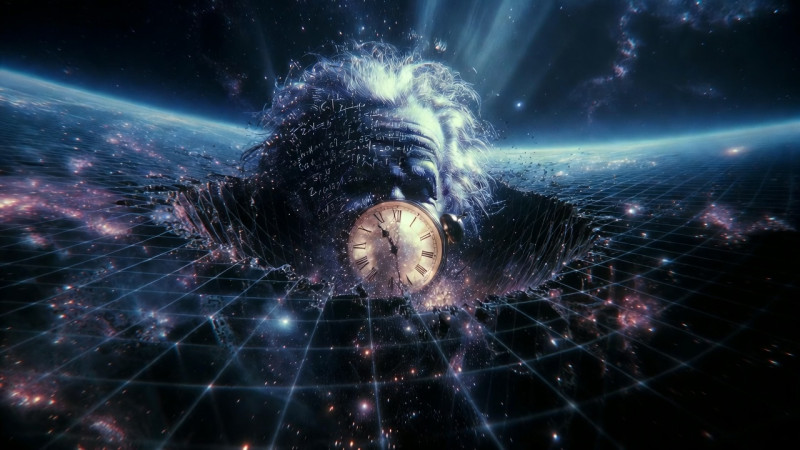
Imagine waking up and discovering the familiar flow of time is a costume — a stitched-together illusion that keeps us moving in tidy lines from yesterday to tomorrow. That’s not silly sci-fi anymore. Over the last decade, experiments and bold theories have quietly chipped away at the idea that time is a single, unstoppable river. What if Einstein — brilliant, daring, world-changing — was right about a great deal, but wrong about the ultimate nature of time? What if time is not a basic ingredient of reality but an emergent trick produced by deeper laws?

Einstein taught us that time and space are fused into a fabric called spacetime, and that massive objects bend that fabric. This picture is spectacularly successful: satellites in orbit must correct their clocks using relativity or our navigation would fail. The Global Positioning System depends on those corrections every day. Without relativistic time adjustments, GPS location errors accumulate rapidly. NASA+1
But physics is a growing conversation, not a sealed verdict. In labs and thought experiments, physicists are asking: could time itself be a large-scale effect that arises from more primitive, timeless rules? One line of attack comes from researchers probing quantum matter that repeats in time. In 2017, teams built the first “time crystals,” a new phase of matter where a system exhibits repeating behavior in time without energy input — a phenomenon Frank Wilczek proposed in 2012 and which stunned the community when realized in separate labs. Time crystals don’t overturn Einstein, but they show that time-like order can appear in exotic, unexpected ways. Nature+1

Then there’s the deep, unsettling work by quantum gravity researchers. Thinkers like Carlo Rovelli argue that in a complete quantum theory of gravity, the variable we call time may vanish from the basic equations. In Rovelli’s view, time might be a secondary concept — a bookkeeping device that emerges when large, interacting systems are coarse-grained into thermodynamic variables. In plain language: time could be what we experience when we ignore microscopic details. That idea has been explored and explained in accessible forums and interviews — not as a rejection of Einstein’s relativity but as a deeper layer that changes how we interpret “before” and “after.” Quanta Magazine
Hard evidence anchors this speculative conversation. The Laser Interferometer Gravitational-Wave Observatory (LIGO) recorded a tiny, unmistakable ripple in spacetime on 14 September 2015 at 09:50:45 UTC — GW150914. That signal matched Einstein’s century-old prediction about gravitational waves and reinforced relativity’s power. Yet scientists still treat such confirmations as part of a larger puzzle: accurate at certain scales, possibly incomplete at the Planckian depths where quantum gravity rules. The point is not to tear Einstein down; it’s to build on his work and ask what lies underneath it. LIGO Lab | Caltech+1
If time is emergent, reality would feel both familiar and oddly plastic. Cause and effect could still govern everyday life, but the origin of that causality would be statistical, thermodynamic, or relational. Memory, entropy, and large-scale correlations might be the sculptors that carve a directional “arrow” of time from fundamentally timeless laws. This view also gives a fresh perspective on long-standing paradoxes: why does time flow only one way? Why is the past fixed but the future open? If flow is emergent, those asymmetries become problems of boundary conditions and information rather than of elementary dynamics.

Why does this matter beyond philosophy? Because the idea spawns testable predictions. Quantum experiments that control and entangle ever-larger systems may show when time-like descriptions break down. Advances in quantum computing, matter-wave interferometry, and condensed matter (time crystals are one example) are the arenas where a new conception of time would first reveal itself. These are not abstract debates locked in ivory towers — they feed into technologies that power navigation, communications, and precision measurement.
So, is Einstein “wrong”? Not in the sense of being useless. His theories remain astonishingly accurate in GPS satellites, black-hole physics, and gravitational waves. But science advances by confronting the edges of its theories. History shows that great models survive as approximations within wider frameworks. Newtonian mechanics still works for everyday motion even though relativity and quantum mechanics refine its domain. It’s possible — and thrilling — that Einstein’s spacetime will sit within a still wider picture where time, as we feel it, is an emergent artifact.
If this is true, the human story gets wilder. We’d still age, remember, and plan. But we would also be living inside a universe where “before” and “after” are emergent, where time’s flow is a statistical trick born from complexity. That realization would be as humbling as it is liberating: the cosmos would be stranger and more beautiful than even Einstein imagined.