.png)
.png)
.png)
.png)
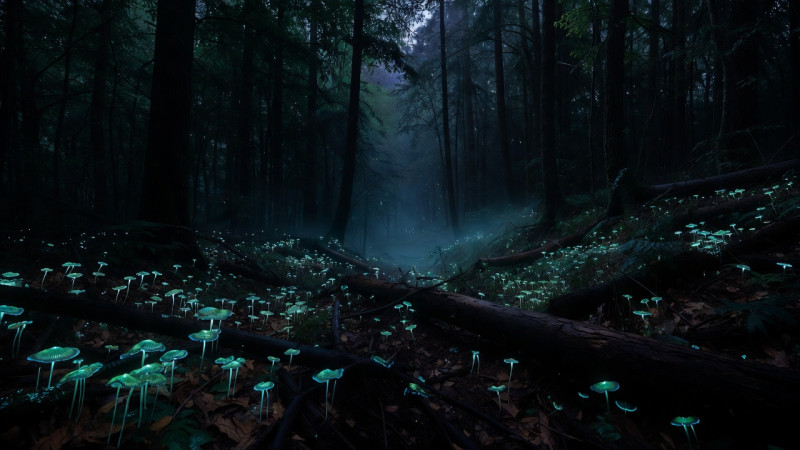
Real forests emit light—but scientists are divided on how common this is.
By Ronald Kapper
Imagine walking beneath a dense forest canopy after dusk and suddenly spotting a soft greenish light emanating from tree trunks, leaf litter or patches of the forest floor. No lamps. No lanterns. Just soft, shimmering illumination as though the woods had become a natural nightlight. For centuries this kind of scene appeared in folklore and travel tales. Today science confirms that bioluminescence—the ability of living organisms to produce light—is real, but exactly how often trees or forests glow remains a subject of lively debate among naturalists and researchers.

The Mystery of Bioluminescence in Forests
Bioluminescence occurs when certain living things generate light through a chemical reaction inside their cells. This reaction typically involves a molecule known as luciferin reacting with oxygen under the influence of an enzyme called luciferase. The result is that eerie glow that seems to come from nowhere. While it’s common among sea creatures like jellyfish and some insects on land, plants including trees do not naturally produce such light on their own.
So what are observers really seeing when forests seem to glow? In most cases it’s not the trees themselves, but organisms living on or around them that shine in the dark. One of the best known is bioluminescent fungi—often called foxfire or fairy fire—which thrive on dead wood and leaf litter. These fungi emit a soft bluish-green glow that can make entire sections of forest floor appear to emit light after sunset.
Real Glowing Forests Around the World
Across the globe, a number of forests shine at night thanks to bioluminescent organisms. In the Western Ghats of India, especially in the monsoon months, dense patches of Mycena mushrooms and other glowing fungi turn tree bases, fallen logs and damp soil into surreal, glowing scenery. Nearby in Goa’s forests, guided night trails are organised because the phenomenon attracts nature lovers eager to see this rare natural spectacle.
In Japan’s Shikoku region, forests draped in darkness during rainy seasons reveal patches of blue-green light, again from Mycena lux-coeli, sometimes called the “heavenly light mushroom.” Visitors who time their trips during humid spells are rewarded with small, soft glimmers embedded among roots and leaf litter.
Beyond Asia, the Amazon Rainforest in Brazil hosts its own bioluminescent fungi on rotting wood, and parts of Congaree National Park in the United States come alive with glowing fireflies that produce rhythmic flashes of golden light against the backdrop of tree silhouettes.

Recorded Sighting — A Night to Remember
A noteworthy instance of glowing bioluminescence was documented by local naturalists and forest guides near Goa during the monsoon nights of September 2025, with the first sightings around 9:00 p.m. local time on September 18, 2025, when groups of hikers reported the forest floor shining with green light that lasted several hours until roughly midnight. These reports were backed by video footage and photographs shared with regional biodiversity researchers, who confirmed the presence of bioluminescent fungi on decaying logs rather than light coming from the trees themselves.
Why Trees Don’t Truly Glow (Yet)
Despite breathtaking natural displays, scientists are clear: trees themselves do not naturally emit light. Studies and botanical records confirm that no known tree species has evolved the biochemical machinery necessary for sustained bioluminescence on its own. What lights up a forest at night is the collective glow of smaller organisms thriving in moist, shaded environments.

That said, human ingenuity is now blurring the line between nature’s light shows and engineered illumination. Biotechnologists have been experimenting with genetic techniques that introduce bioluminescent genes from fungi, bacteria and even fireflies into plants. These engineered plants can produce a gentle luminescent effect, and in 2023 a firm brought to market the first bioluminescent houseplant that glows softly in the dark, marking a new era where glowing flora might become common in human settings.
In Japan, research teams at several universities began exploring ways to enable tree-like plants to emit light without external power. While the light is currently too faint to replace street lamps, their early experiments suggest a future where urban parks at night might be lit by trees with genetically enhanced glowing traits.

The Science and the Wonder
The division among scientists isn’t whether glowing forests exist—clearly they do—but how to best describe them without overselling the role of trees themselves. The magic lies not in the wood of the trees, but in the living tapestry of life that clings to them: fungi, insects, bacteria and more. Each contributes tiny bursts of light that, when accumulated across a dark forest floor, achieve an almost mythical glow.
For observers, the experience remains transformative. Whether you’re wandering through the Western Ghats after sunset or exploring humid woodland paths in Japan, the soft bioluminescence that seems to seep from the earth offers a moment to pause and reflect on the hidden marvels of our natural world.
References / Source Links
https://www.jagranjosh.com/general-knowledge/forests-in-the-world-that-glow-in-dark-1820003151-1
https://timesofindia.indiatimes.com/travel/web-stories/8-naturally-glowing-forests-around-the-world-you-need-to-see/photostory/122264908.cms
https://konkantravelclub.com/bioluminescent-glowing-forest-trail-goa-dodamarg/
https://www.indulgexpress.com/life-style/travel/2024/Oct/24/bioluminescent-forests-in-india-a-magical-sight
https://en.wikipedia.org/wiki/Foxfire