.png)
.png)
.png)
.png)
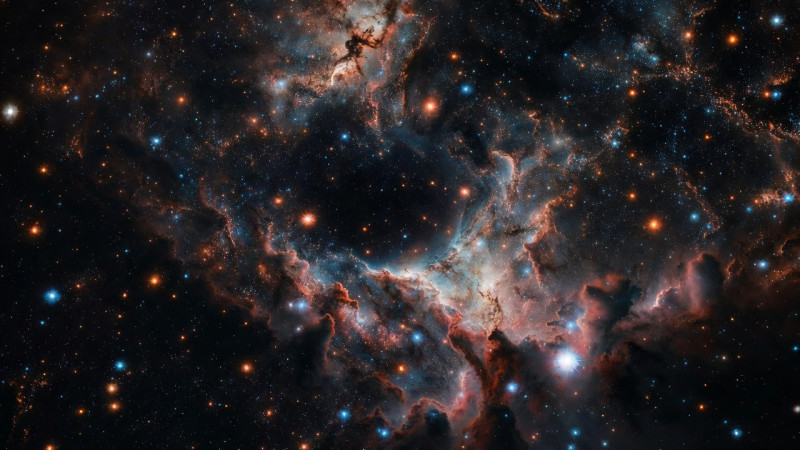
Space is supposed to be noisy.
Not in sound, of course, but in activity. Radiation constantly streams through the cosmos. Particles crash into each other at unimaginable speeds. Energy fields ripple across vast distances. From Earth’s orbit to the edge of the observable universe, space is alive with motion.
Yet scientists are now pointing to something deeply unsettling.
In several regions far beyond our planet, researchers have identified what they are calling “quiet zones”—areas where expected cosmic activity drops sharply, and the usual rules of physics appear to behave… differently.
These zones are not empty. They are not voids in the traditional sense. And that’s exactly what makes them so strange.

What Are “Quiet Zones” in Space?
Quiet zones are regions where instruments detect unexpectedly low levels of particle interaction, radiation fluctuations, or electromagnetic disturbance. In simple terms, space in these areas appears unusually calm compared to surrounding regions.
This calmness is not predicted by standard cosmic models.
Astrophysicists expect background noise everywhere: faint radiation, energetic particles, and subtle distortions in space-time. But in these zones, that background activity drops—sometimes dramatically.
To scientists, this is like standing in the middle of a bustling city and suddenly entering a block where every signal fades, every vibration softens, and the air itself feels still.
How Were These Regions Discovered?
The discovery did not come from a single mission or experiment. Instead, it emerged slowly as researchers compared data from multiple space observatories and long-term measurements.
Subtle anomalies kept appearing:
- Radiation levels lower than predicted
- Particle counts that didn’t match surrounding regions
- Energy patterns that seemed to “flatten out”
At first, scientists assumed faulty instruments or data-processing errors. But as similar patterns appeared across different datasets, the possibility became harder to ignore.
Something unusual was happening.

Why Physics Shouldn’t Be This Quiet
According to established physics, even the emptiest regions of space should still buzz with activity. Quantum fields fluctuate constantly. Virtual particles appear and vanish. Cosmic background radiation fills the universe like a faint afterglow of the Big Bang.
So when researchers observe zones where these signals weaken or behave unpredictably, it raises uncomfortable questions.
Is energy being absorbed?
Is space behaving differently at a fundamental level?
Or are we missing a crucial piece of the cosmic puzzle?
No single explanation fully fits the data.
Theories Scientists Are Exploring
Researchers are approaching these quiet zones cautiously. No dramatic claims. No talk of portals or alternate universes—at least not yet. Instead, several grounded but intriguing theories are under discussion.
- Exotic Space-Time Structures
Some physicists suspect these regions may involve subtle distortions in space-time itself. Not enough to create visible gravitational effects, but enough to dampen energy interactions. - Unknown Particle Interactions
There may be particles or fields we have not yet detected that absorb or neutralize energy, effectively “silencing” parts of space. - Cosmic Evolution Effects
These zones could be relics of earlier stages of the universe—areas shaped by processes that no longer occur, leaving behind regions with altered properties. - Limits of Our Instruments
Perhaps the most humbling possibility: our tools may not be designed to detect what’s actually happening there.

Could Time Behave Differently in Quiet Zones?
This is where curiosity intensifies.
Some researchers are asking whether time itself might pass slightly differently in these regions. Not in dramatic, science-fiction ways, but subtly—through altered decay rates of particles or small shifts in energy flow.
So far, there is no direct evidence that time slows or speeds up in quiet zones. But the idea is being explored carefully, especially as more precise measurements become possible.
Even small deviations would have enormous implications for physics.
Why This Discovery Matters
Quiet zones challenge one of the most basic assumptions in cosmology: that the universe behaves uniformly on large scales.
If these regions truly follow different physical rules—or even slightly altered ones—it suggests our current models are incomplete.
That matters because:
- Our understanding of cosmic evolution depends on uniform physics
- Space travel and deep-space communication rely on predictable behavior
- Fundamental theories may need revision
In science, anomalies are not inconveniences. They are invitations.
What Scientists Are Doing Next
The next phase is observation, not speculation.
Upcoming missions and next-generation instruments will focus on:
- Higher-resolution particle measurements
- Long-duration monitoring of suspected quiet zones
- Comparing similar regions across different parts of the universe
Organizations like NASA and international research teams are particularly interested in whether these zones are rare oddities or common but previously unnoticed features of space.
If they are widespread, the implications could reshape modern astrophysics.
A Reminder of How Little We Still Know
For all our technological advances, space continues to surprise us.
Quiet zones are not loud discoveries. They don’t explode or glow or announce themselves with spectacular visuals. Instead, they whisper—through missing data, softened signals, and unanswered questions.
And sometimes, in science, silence is the most unsettling sound of all.
Final Thought
The universe is not just expanding outward. It is expanding our understanding.
As scientists continue to investigate these strange quiet zones, one thing is clear: space is far more complex, subtle, and mysterious than it appears. And the calmest places in the cosmos may hold the loudest secrets yet to be uncovered.