.png)
.png)
.png)
.png)
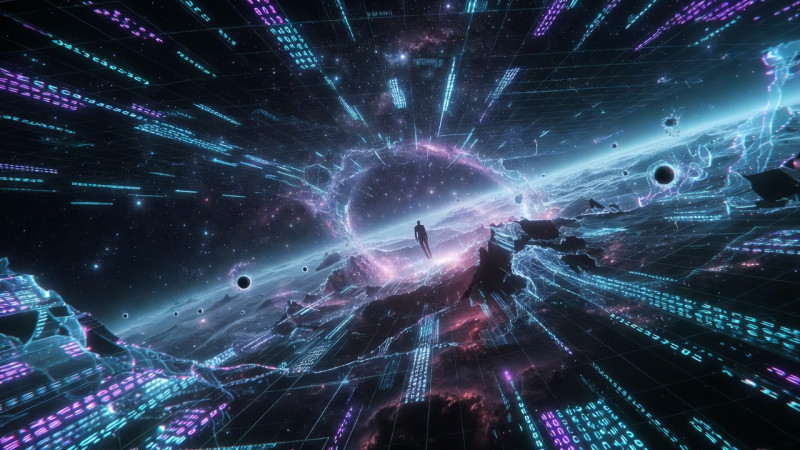
Space Has Always Felt Solid — But Science Is No Longer So Sure
Look up at the night sky and it feels obvious that space is real.
There are stars. There are galaxies. There is distance between things.
But in 2025, some of the world’s top physicists are quietly coming to a disturbing conclusion:
Space may not be a real thing at all.
Instead, it may be something that emerges from deeper, invisible processes — the way a picture emerges from pixels on a screen.
This idea is not coming from science fiction.
It is coming from the hardest problems in modern physics.

The Crisis No One Talks About
Physics is built on two pillars:
- General relativity, which explains gravity and space-time
- Quantum mechanics, which governs particles and energy
Both work extremely well.
But they cannot be combined.
When scientists try to describe what happens inside black holes, or at the beginning of the universe, the math collapses. Space and time stop behaving like things.
They behave more like side effects.
Black Holes Started the Problem
Black holes were supposed to destroy information.
But in the 1990s, physicists discovered something shocking:
They don’t.
The information about everything that falls into a black hole seems to be stored on its surface — not inside it.
This led to a radical idea called the Holographic Principle.
It says that everything inside a volume of space may actually be encoded on a two-dimensional boundary, like a hologram.
If that is true, then space is not fundamental.
It is something that is being projected.

Space as a Data Product
In recent years, physicists studying quantum entanglement noticed something eerie.
When particles become entangled, the way their information connects looks exactly like the geometry of space.
In other words:
Space may be created by how quantum information links together.
Distance, shape, and location may be nothing more than the way data is organized.
Space is not the stage.
It is the picture being drawn.
The “Fabric of Reality” Is Starting to Look Like Code
Some of the newest theories in quantum gravity suggest that the universe is built from tiny packets of information.
Not particles.
Not strings.
Information.
Space emerges when that information forms stable patterns.
This would explain why space can stretch, curve, and even tear — because it isn’t a solid thing. It is a structure, like a digital simulation.
Why We Only Notice at Extreme Conditions
Under normal conditions, space behaves perfectly.
But when gravity becomes intense — near black holes or at the birth of the universe — space breaks down.
Just like a video game world glitches when overloaded.
This is exactly where physicists see space losing its meaning.
What This Means for Reality
If space is not fundamental, then:
- Distance is not truly real
- Motion is not fundamental
- Even location may be an illusion
Reality may be built from relationships between information — not from objects sitting inside space.
You are not “in” space.
You are part of a vast informational network that creates the idea of space.

Why Scientists Are Taking This Seriously
This isn’t fringe science.
The holographic universe is studied at:
- Harvard
- Stanford
- CERN
- Princeton
It is one of the leading paths toward a theory of quantum gravity.
The more scientists try to understand reality, the more they keep finding the same unsettling answer:
Space might be a side effect, not the foundation.
The Universe May Be Stranger Than We Ever Imagined
We once thought Earth was the center of everything.
Then we learned it wasn’t.
Now we may be learning something even more shocking:
The thing we thought everything existed inside…
may not exist at all.
References & Sources
Holographic Principle – Stanford University
https://plato.stanford.edu/entries/quantum-gravity
Black Hole Information Paradox – NASA
https://science.nasa.gov/universe/black-holes
Quantum Entanglement & Spacetime – Scientific American
https://www.scientificamerican.com
CERN Quantum Gravity Research
https://home.cern/science
Princeton Institute for Advanced Study – Spacetime
https://www.ias.edu