.png)
.png)
.png)
.png)
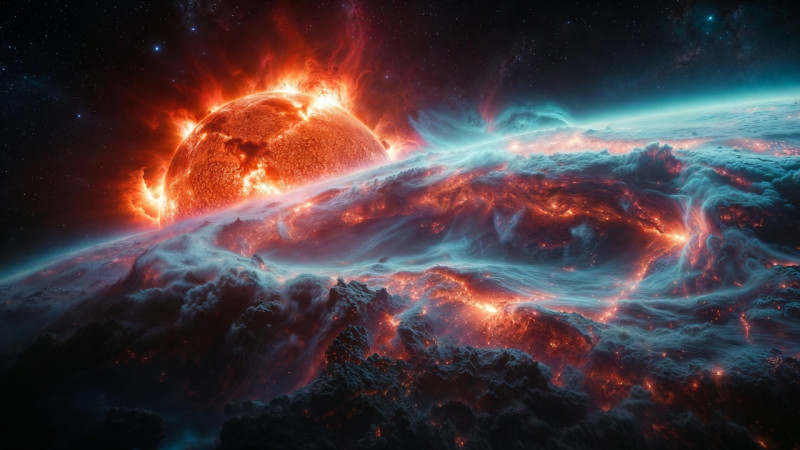
Astronomers Found a Planet With an Atmosphere That Shouldn’t Exist — And Scientists Are Stunned
In a moment that reads more like a cosmic thriller than routine science, astronomers have announced the discovery of an exoplanet with an atmosphere that defies everything we thought we understood about planetary formation. This startling finding — captured by the James Webb Space Telescope (JWST) — is shaking up planetary science and forcing researchers to rethink how alien worlds evolve in extreme environments.
The revelation came in mid-December 2025, when teams around the world shared data revealing that a distant planet known as TOI-561 b possesses a thick and dense atmosphere, despite conditions that should have stripped it away long ago. The planet’s existence in such a hostile zone makes this one of the most intriguing and exciting planetary discoveries of the decade.

A Hellish Planet With an Unexpected Cloak
TOI-561 b orbits its star at a blazing pace — completing a full circuit in just about 11 hours — and lies so close to its star that it should be a barren, airless rock. Under normal cosmic circumstances, the intense radiation and heat would blow away any trace of gas, leaving nothing but a scorched surface. Yet, shockingly, this world is enveloped in a surprisingly thick atmosphere rich in volatile materials.
The planet itself is roughly 1.4 times the radius of Earth and is located nearly 280 light-years away in the constellation Sextans. Its host star is far older and chemically different from our Sun, which may be a key piece of the atmospheric puzzle. Scientists describe TOI-561 b as an ultra-hot super-Earth, but it doesn’t behave like any such world studied before.
Why This Shouldn’t Exist — But Does
Under intense stellar radiation, most planets that close to a star lose their atmospheres quickly. The blistering heat typically drives atmospheric gases into space, leaving behind a stark, exposed world. Yet TOI-561 b retains a thick envelope of gas, suggesting complex interactions between its molten surface and atmosphere.
Researchers propose that the planet’s magma ocean and atmosphere could be engaged in a dynamic exchange. Gases may be released from the surface and then partly reabsorbed, creating a sort of ever-renewing atmospheric cycle — a concept at odds with earlier predictions.
Some scientists believe this unusual balance might explain how the atmosphere survives in such harsh conditions. It’s a cosmic paradox: the very forces that should obliterate an atmosphere may also be contributing to its persistence.

Challenges to Planetary Formation Theory
The discovery of TOI-561 b’s atmosphere isn’t just fascinating — it’s a crack in the foundation of how we think planets form and evolve. For decades, astronomers have relied on models that predict how gases are retained or lost based on a planet’s proximity to its star, its size, and its composition. TOI-561 b smashes those assumptions.
This strange atmospheric composition challenges the idea that close-in rocky exoplanets must be stripped bare. Instead, it suggests that chemical diversity and planetary formation processes can be far more complex and varied than previously imagined.
While the exact makeup of TOI-561 b’s atmosphere is still under detailed study, early observations hint at a composition dominated by volatile elements that would normally escape a planet so close to its star. Astronomers are now analyzing spectrographic data to unravel these chemical signatures.
What This Means for Exoplanet Science
This discovery opens a gateway to entirely new questions about alien worlds:
- Could other extreme planets also harbor unexpected atmospheres?
- Are our models of atmospheric loss too simplistic?
- Might there be types of atmospheric chemistry that only emerge under extreme conditions?
TOI-561 b has become a poster child for planetary oddities, placing itself among a growing catalog of worlds that behave in ways that textbooks never predicted. As scientists continue to pore over the JWST data, more revelations are expected — ones that could reshape our understanding of planetary systems across the galaxy.

Beyond the Discovery: What Comes Next?
With this discovery fresh in the astronomical community’s mind, attention is already shifting to what future instruments might reveal. The upcoming Nancy Grace Roman Space Telescope and ground-based observatories with powerful spectrographs will allow even closer study of such worlds, potentially revealing additional atmospheric anomalies and chemical oddities.
As researchers dive deeper into these data, each new observation could further upend our theories about how planets form and survive. The fact that we now know a planet can maintain an atmosphere in conditions where it “shouldn’t exist” is itself one of the most thrilling turning points in modern astrophysics.
The Bigger Picture
Astronomers have only begun to scratch the surface of the vast diversity of planetary systems in our galaxy. The discovery of TOI-561 b’s unusual atmosphere doesn’t just rewrite a chapter — it opens an entirely new book on what might be possible.
This isn’t science fiction. This is the universe revealing itself to us in all its bizarre, unexpected glory.
References:
NASA – James Webb observes an exoplanet with an atmosphere that defies expectations
https://science.nasa.gov/missions/webb/nasas-webb-observes-exoplanet-whose-composition-defies-explanation/
Economic Times – JWST finds a ‘hell planet’ with an atmosphere that shouldn’t exist (Dec 15, 2025)
https://m.economictimes.com/news/international/us/james-webb-telescope-stuns-astronomers-by-finding-a-hell-planet-with-an-atmosphere-that-shouldnt-exist/articleshow/125984050.cms
EOS (American Geophysical Union) – A lava world unexpectedly hosts an atmosphere
https://eos.org/articles/a-lava-world-unexpectedly-h