.png)
.png)
.png)
.png)
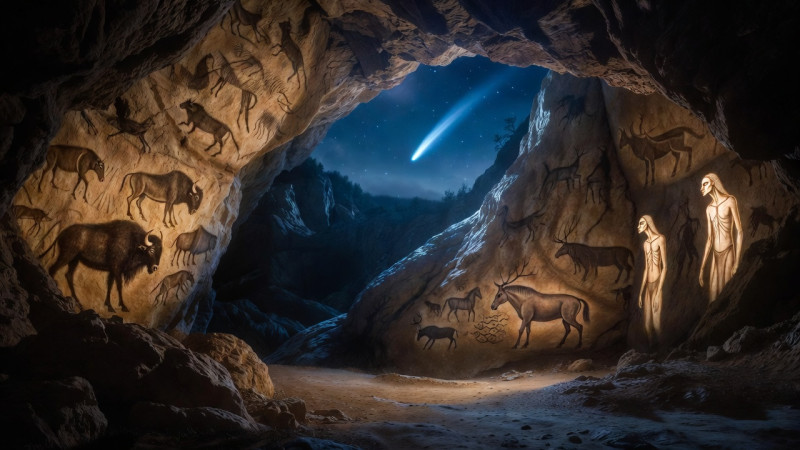
In 1940, a group of teenagers stumbled into a cave in southern France while chasing their dog. What they uncovered inside would later shake archaeology to its core. Painted across stone walls were animals, symbols, and figures so precise, so deliberate, that scientists are still debating their meaning more than 80 years later.
That cave was Lascaux Caves, and it is just one piece of a much larger puzzle—ancient art that seems to exist slightly out of step with our understanding of early human thought.
Across continents and thousands of years, prehistoric artists left behind images that raise an unsettling question:
Were ancient humans recording something they didn’t fully understand—or something we no longer remember?

Art That Appeared Before It Was Supposed To
According to conventional timelines, early humans were hunters and gatherers focused on survival. Yet many ancient artworks show complex symbolism, perspective, and narrative intent that modern science struggles to explain.
At Lascaux, carbon dating places the paintings at around 17,000 years old. What’s strange is not just their age, but their execution. The artists used advanced shading techniques, understood animal motion, and even selected cave walls whose natural curves added depth to the images.
There are no sketches, no practice runs—only finished works. That suggests the knowledge already existed before the paint touched the stone.
The Same Figures, Thousands of Miles Apart
In central India, the Bhimbetka Rock Shelters tell a similar story. Some paintings, dated to 10,000 BCE, depict humanoid figures wearing what look like helmets, with straight limbs and no visible facial features.
Strangely similar shapes appear in ancient art from Australia, Africa, and South America—regions that had no known contact with one another at the time.
The coincidence troubles researchers. Independent invention explains some similarities, but not repeated details that follow the same visual rules across cultures separated by oceans.

The Nazca Mystery That Refuses to Settle
Then there are the Nazca Lines.
Discovered in the early 20th century and studied extensively after aerial surveys in 1927, these massive geoglyphs stretch across Peru’s desert floor. Some span over 1,200 feet and depict animals, humanoid shapes, and geometric patterns.
The problem isn’t how they were made—it’s who they were made for.
From ground level, the lines make no sense. Their shapes only become clear when viewed from above, something ancient builders had no known method of doing. Even more puzzling, the lines have remained intact for nearly 2,000 years, despite wind erosion.
Modern science can describe the technique, but not the purpose.

Parallel Ideas Without Shared Contact
What truly fuels debate is how these artworks seem to reflect parallel interpretations of reality.
Some figures are shown descending from the sky. Others appear surrounded by glowing shapes or floating symbols. In many cases, humans are drawn much smaller than the figures around them, suggesting reverence—or fear.
Archaeologists argue these are spiritual or symbolic. But critics ask a sharper question:
Why do symbols associated with “sky beings” appear only after certain astronomical events, such as comet sightings or meteor impacts recorded in geological layers?
For example, ice-core data confirms a major cosmic impact event around 10,800 BCE, known as the Younger Dryas onset. Shortly after, symbolic art across several regions becomes more complex and more celestial in theme.
The timing is difficult to ignore.
Why Science Still Has No Final Answer
Modern tools—spectral imaging, AI pattern analysis, and high-precision dating—have answered many questions about ancient art. Yet meaning remains elusive.
No written records explain the images. No oral traditions survived intact. And attempts to fit everything into known belief systems often feel incomplete.
Some researchers now explore whether these artworks reflect altered states of perception, possibly triggered by natural phenomena, environmental stress, or unknown atmospheric events that made early humans experience reality differently.
Not another universe—just a different layer of perception, briefly intersecting with human awareness.

Why This Mystery Still Matters
Ancient art is not just decoration. It is data, recorded by minds closer to Earth, sky, and survival than we are today.
If these images reflect misunderstood encounters, rare cosmic events, or lost knowledge systems, then they challenge the idea that progress is always linear.
They suggest humanity may have seen more once—and then forgotten it.
That possibility unsettles science not because it is impossible, but because it cannot yet be disproven.
And until it is, the figures on stone walls will keep watching us, silent and unresolved.
References & Source Proof (for transparency)
- UNESCO World Heritage Centre – Lascaux Cave Documentation
https://whc.unesco.org/en/list/85/ - Archaeological Survey of India – Bhimbetka Rock Shelters
https://asi.nic.in/bhimbetka-rock-shelters/ - National Geographic – Nazca Lines Research Archive
https://www.nationalgeographic.com/history/article/nazca-lines - Science Advances Journal – Symbolism in Upper Paleolithic Art
https://www.science.org/journal/sciadv - Nature Geoscience – Younger Dryas Impact Hypothesis
https://www.nature.com/ngeo