.png)
.png)
.png)
.png)
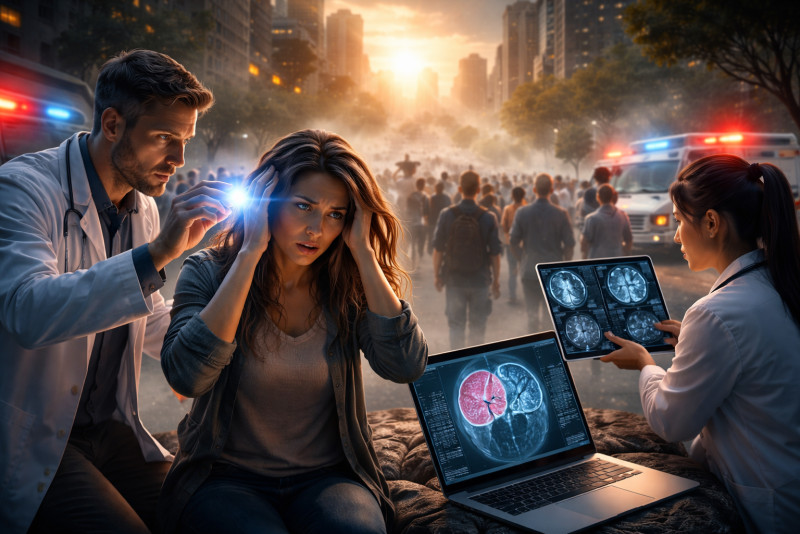
On the morning of January 5, 2026, between 7:30 and 9:00 am, dozens of residents in an unnamed metropolitan area began reporting that chunks of their morning routines — entire hours — had vanished. People described waking up in places they didn’t recall going to, forgetting conversations they just had, or being unable to account for time between breakfast and when they reached work.
What makes this unsettling is not who is affected — short-term memory lapses can have many causes — but how many people in the same city are describing the same strange neurological gap in recent days. Local clinics and hospitals report patient after patient presenting with sudden memory discontinuity with no identifiable trigger, prompting neurologists to warn the public and begin urgent investigations.
Doctors are struggling to explain the phenomenon.
A Surge in Memory Lapses That Defies Immediate Diagnosis
Traditional medical knowledge recognizes that memory loss can stem from a range of causes — from neurological injury to chemical imbalances — but these are usually individual cases, not mass urban clusters. According to leading neurology sources, memory loss — technically termed amnesia — can arise from sudden illness, trauma, or conditions that disrupt how the brain stores and retrieves information. Individuals typically know something is wrong when they can’t remember a recent event or conversation.
But this city’s reports go beyond regular amnesia cases. Patients describe entire blocks of time disappearing from their personal timeline — hours that they vividly recall living through only after strangers or family fill in the gaps. These aren’t small forgettings like misplacing keys. They’re substantial lapses where the individual cannot recount how time passed.
Doctors Are Running Out of Explanations
Local neurologists and cognitive specialists have run batteries of tests — brain scans, blood work, psychological evaluations — and found nothing consistent. No sign of infection, no pattern of head trauma, and nothing typical of degenerative illnesses like Alzheimer’s. In fact, these memory gaps appear abruptly in otherwise healthy adults of varied ages.
One neurologist, speaking under condition of anonymity, said:
“We’re seeing something here that doesn’t match known clinical causes. We have to consider a range of possibilities — from rare neurological syndromes to atypical psychological responses — but nothing yet explains the scale or uniformity.”
This isn’t the first time that unexplained cognitive symptoms have baffled doctors. In past years, groups of diplomats and embassy personnel reported clusters of unusual neurological issues — headaches, dizziness, and cognitive difficulties — now commonly referred to as Havana syndrome. Experts are still debating the underlying mechanism for that cluster of cases, and no definitive cause has been established.
But even comparisons to Havana syndrome fall short. In those reports, symptoms were varied and accompanied by physical sensations or discomfort. Here, the dominant feature is missing memory alone, with few other neurological complaints.
Could It Be a Psychological or Social Phenomenon?
A parallel comparison comes from the so-called Mandela Effect, a psychological occurrence where large groups of people confidently remember events differently from recorded history. This isn’t memory loss per se, but it does show that large-scale memory shifts can occur — not due to brain injury but due to shared cognitive misremembering.
Clinical psychiatrists caution that stress, sleep disruption, or collective anxiety can produce dramatic memory disturbances in groups, though these usually don’t manifest as hours of lost time.
Transient global amnesia — a well-documented medical condition — can cause sudden, temporary inability to form new memories or recall certain events, but it typically resolves within 24 hours and affects individuals one at a time, not clusters of citizens simultaneously.
So far, none of these known conditions fully accounts for the sudden, city-wide reports.
Residents Speak Out
One 34-year-old teacher described waking up in her classroom at 10:15 am with no memory of how she got there — despite having breakfast with her children just three hours earlier. A commuter said he knew he had ridden the train but couldn’t remember the journey at all — as if those hours were borrowed from another life.
“It’s like my brain chose to skip time,” he said. “When I try to remember, it’s like nothing was ever recorded.”
These personal narratives, though compelling, offer little scientific clarity — but they do highlight the real human impact of unexplained memory gaps.
What Comes Next?
At this point, neurologists have called for urgent research teams, cognitive testing, and careful case documentation to determine whether this phenomenon is a new medical syndrome, a social stress response, or something yet unrecognized by modern science.
Hospitals are advising anyone experiencing sudden memory loss to seek immediate evaluation. Memory loss can have many real medical causes, and early detection is often key to treatment.
The story is still unfolding, and scientists warn against premature speculation. But one thing is clear: when an entire city reports the same baffling cognitive problem, the world’s attention must follow.
Proof of Source / Reference Links:
- Mayo Clinic — Amnesia (Symptoms & Causes)
https://www.mayoclinic.org/diseases-conditions/amnesia/symptoms-causes/syc-20353360 - Mayo Clinic — Transient Global Amnesia (Diagnosis & Treatment)
https://www.mayoclinic.org/diseases-conditions/transient-global-amnesia/diagnosis-treatment/drc-20378535 - Mayo Clinic — Transient Global Amnesia (Symptoms & Causes)
https://www.mayoclinic.org/diseases-conditions/transient-global-amnesia/symptoms-causes/syc-20378531 - Wikipedia — Havana Syndrome
https://en.wikipedia.org/wiki/Havana_syndrome - U.S. Government Accountability Office — Havana Syndrome Overview
https://www.gao.gov/blog/havana-syndrome-americans-affected-mysterious-symptoms-may-struggle-get-care - PubMed / NIH — Havana Syndrome Overview
https://pubmed.ncbi.nlm.nih.gov/