.png)
.png)
.png)
.png)
By Ronald Kapper
Sometimes a single line — a slipped word, a marginal note, a faded gloss — is all it takes to topple a tidy story. That’s exactly what happened when scholars pulled a nearly lost rendering from the margins of a medieval manuscript and realised modern readings of whole traditions needed to be rethought. The shock isn’t just academic hair-splitting: a translation once ignored can rewrite chronology, reveal vanished voices, and change how we understand how knowledge moved across centuries.
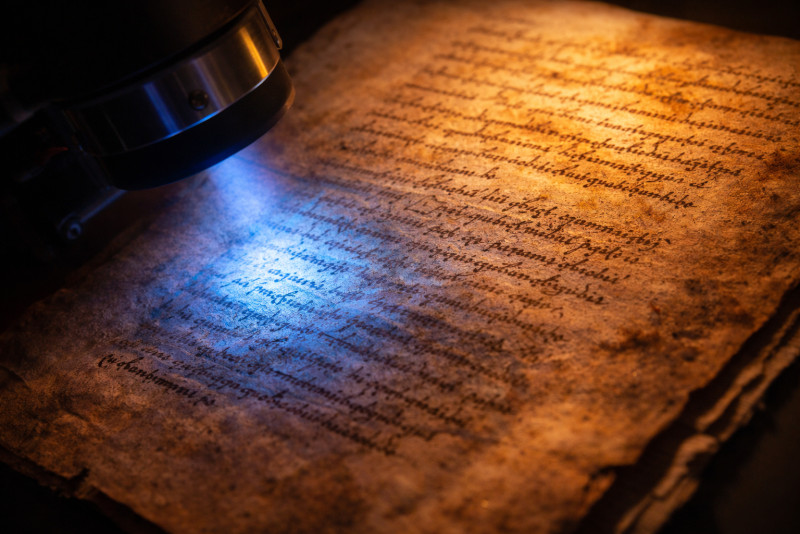
Imagine dusty libraries, a manuscript rebound and reused as a prayer book, its earlier pages scraped and overwritten. For centuries those palimpsest pages were dismissed as blank or burned. Then, with new eyes and new light, the erased words reappeared — not as ornaments, but as chunks of argument, formulas, and narratives that forced historians to rearrange how we place inventions and ideas in time. The classic case is the Archimedes Palimpsest: imaging tools and focused analysis recovered mathematical texts and notes that altered the history of science and showed that key techniques existed earlier than any printed history had assumed.
Why does a translation — a human attempt to carry meaning from one tongue to another — hold that much power? Because translation is an interpretation. A translator chooses words, frames emphasis, and sometimes smooths over odd lines so readers will not stumble. If that translator worked in a different cultural moment, or misread signs, an entire thread of thought can be buried beneath centuries of assumed meaning. When a forgotten reading resurfaces, it can pull that thread free and reveal a fabric no one suspected.
Take the story of ancient scripts and the slow emergence of new tools. For decades, archaeologists and philologists depended on hand-copied transcriptions and nineteenth-century glosses. Those transcriptions were good, but limited: they reflected the eye and the agenda of their time. Later, when scholars applied multispectral imaging and X-ray fluorescence to palimpsests and charred papyri, whole passages returned — phrases that contradicted earlier paraphrases, revealing technical detail and cultural references that rewrote timelines. The Archimedes find, recovered with these techniques, is a standout example: pages thought destroyed contained arguments and methods that changed our sense of Greek mathematics’ originality and reach.
This is not only about Greek math. In epigraphy and decipherment, overlooked readings have overturned centuries of assumption. Think of the Rosetta Stone — the bilingual key that opened Egyptian hieroglyphs to modern understanding — and the later breakthroughs in scripts like Linear B and Mayan glyphs. Each involved a moment when persistence, fresh comparison, or a retranslation unlocked a system that had been treated as opaque. Michael Ventris’ work on Linear B pushed written Greek back by millennia; Yuri Knorosov’s stubborn re-readings of Maya inscriptions changed a field that had long assumed the glyphs were mere pictographs. Those episodes show how a new reading can turn "dead" script into living history.
What makes a “forgotten translation” so combustible today is technology plus curiosity. Imaging uncovers the words; computational philology mines patterns; a global web of scholars compares readings in hours what once took years. That combination means rediscovered translations do not sit in dusty journals; they ricochet through conferences, digital repositories, and rapid peer review. A corrected phrase about ritual practice or a ledger entry about trade routes can cascade: archaeologists redate sites, economists re-evaluate exchange networks, and historians rewrite where ideas likely moved. The ripple is fast and real.
Still, a note of caution: not every newly visible word overturns everything. Scholars test and cross-check. A recovered passage must survive paleographic scrutiny, linguistic checks, and context. Misread letters can lead to wild headlines; careful work often narrows bold claims. But even cautious revisions matter because they chip away at long-held certainties and expand the questions historians ask.
Beyond the mechanics, there is a human story. Many of the rescues are small triumphs: a conservator who insisted on imaging a seemingly blank folio, a linguist who reevaluated a stubborn grammatical form, or a graduate student who noticed a marginalia phrasing matched a seldom-seen dialect. Those acts bring lost voices back into the archive: sidelined scribes, invisible translators, technical experts whose names the manuscripts never recorded. The recovered translation doesn’t merely change dates; it restores people to history.
So what should readers take away? First, history is still under construction. Second, translation is not neutral: it’s an act of choice, and the choices of past readers can mislead ours. Finally, the tools of the present — imaging, pattern analysis, global collaboration — are making the past talk again. Every new translation recovered is an invitation to listen differently. We should expect more surprises: whole chapters waiting under varnish, arguments waiting under prayer, and meanings that will nudge our picture of the past into sharper, stranger focus.
References:
-
Wired — “Accelerator Deciphers Archimedes.” https://www.wired.com/2005/05/accelerator-deciphers-archimedes.
-
Persee / Gallica — Multispectral imaging and the Archimedes Palimpsest. https://www.persee.fr/doc/galim_0753-5015_2004_num_45_1_1646.
-
Cambridge Faculty of Classics — The decipherment of Linear B (Michael Ventris). https://www.classics.cam.ac.uk/research/projects/mycep/decipherment.
-
Wikipedia / Yuri Knorozov — How Knorozov advanced Mayan decipherment. 100 views