.png)
.png)
.png)
.png)
By Ronald Kapper
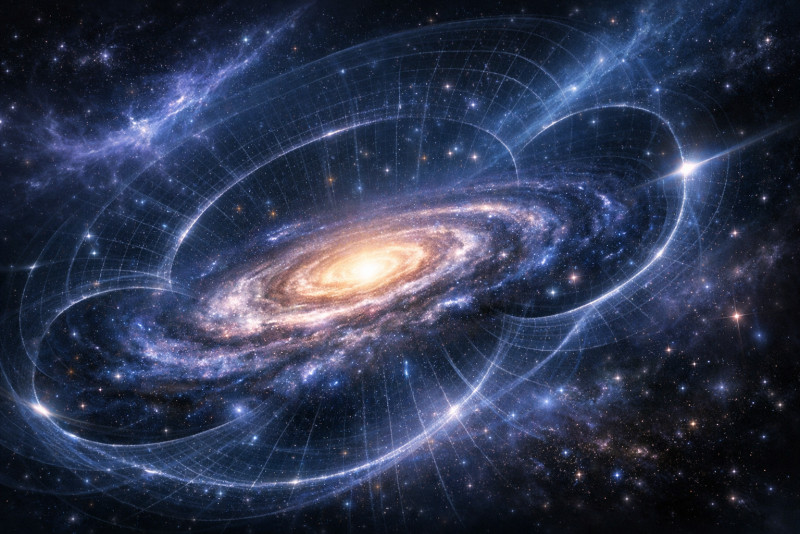
Imagine a cosmic blind spot that has puzzled astronomers for a century — something that tugs on galaxies, bends light, sculpts cosmic web, yet never shows up in a detector. We call it dark matter, but what if that name is a trap? What if the strange signals attributed to invisible particles are really the fingerprints of something far stranger: gravity behaving oddly, space-time carrying hidden information, or the cosmos wearing a disguise?
This idea explodes because it flips the script: instead of hunting elusive particles in underground labs, we’d be decoding rules of reality itself. That’s a story that rockets across science feeds and social threads — a parallel-reality twist without invoking parallel universes. And it’s already being argued seriously by theorists and tested by observers.

Not “no evidence” — just the wrong evidence
The standard picture — cold dark matter made of particles — nails many cosmic facts: the cosmic microwave background, large-scale structure, and galaxy formation. Yet on the scale of individual galaxies, patterns emerge that look eerily coordinated with visible matter, as if the luminous stars are whispering the gravitational rules. That tension opened the door for alternatives like MOND (Modified Newtonian Dynamics), which alters gravity at tiny accelerations and predicts rotation curves with uncanny accuracy. But MOND stumbles at cluster scales and cosmic background measurements, so the debate is alive and sometimes ugly.
Emergent gravity — gravity as an effect, not a thing
One radical possibility: gravity is not fundamental. Instead, it could emerge from microscopic degrees of freedom — entropy, quantum entanglement, information woven into space-time. In this view, the extra pull we call dark matter is an emergent property of space-time reacting to ordinary matter and cosmic expansion. Erik Verlinde’s emergent-gravity proposals and related work suggest that some phenomena attributed to dark matter may be explained without new particles — a daring claim that has prompted tests and headlines. If true, it means the universe’s “missing mass” is really missing logic: our theory is incomplete.

Superfluid cosmos — collective behavior, not single particles
Another thrilling option borrows from condensed-matter physics: what if dark effects arise from a cosmic superfluid? In this model, dark components condense into a fluid with collective excitations that mimic modified gravity on galaxy scales while still acting like dark matter in the cosmic web. That hybrid idea tries to keep the wins of particle dark matter while explaining galactic regularities through emergent behavior — like how a chorus of tiny actors creates a giant wave. It’s bold, testable, and full of surprises.
Observations forcing the question
The cosmos keeps testing our ideas. Some galaxies appear to lack dark matter entirely, while others behave as if dark matter is glued to stars. Colliding clusters — famously the Bullet Cluster — seem to show mass offset from gas, supporting particle dark matter. New surveys, precise lensing maps, and strange galaxy finds keep swinging the pendulum. Each puzzling object is a clue: maybe there’s more than one phenomenon at work — particle dark matter, modified gravity manifestations, or emergent information effects — all mixing together.

Why this idea would change everything
If dark phenomena are emergent or geometric, the prize is massive. We would rewrite fundamental physics, connect gravity to quantum information, and open new observational strategies. Experiments would shift from building bigger detectors to mapping subtle gravitational fingerprints across thousands of galaxies and hunting for telltale signatures of emergent behavior. Technology and theory would sprint sideways, chasing a radical but testable possibility.

The honest forecast
None of these alternatives has yet dethroned the particle picture. Each faces its own hurdles: matching the cosmic microwave background, surviving cluster collisions, or producing precise lensing maps. Still, science thrives on this friction. The healthiest view right now is pragmatic curiosity: dark matter might be particles, or emergent properties, or a cocktail of effects. Either way, the hunt is the headline — one that keeps telescopes pointed, theorists arguing, and the public marveling.
Author: By Ronald Kapper
References / Proof & Further Reading:
- E. P. Verlinde — Emergent Gravity and the Dark Universe (arXiv).
- B. Famaey & S. McGaugh — Modified Newtonian Dynamics: observational overview.
- L. Berezhiani & J. Khoury — Theory of Dark Matter Superfluidity (Phys. Rev. / arXiv).
- Guardian coverage on emergent gravity challenges (March 2024).
Wired — reports on galaxies with little or no dark matter (data-driven puzzles).