.png)
.png)
.png)
.png)
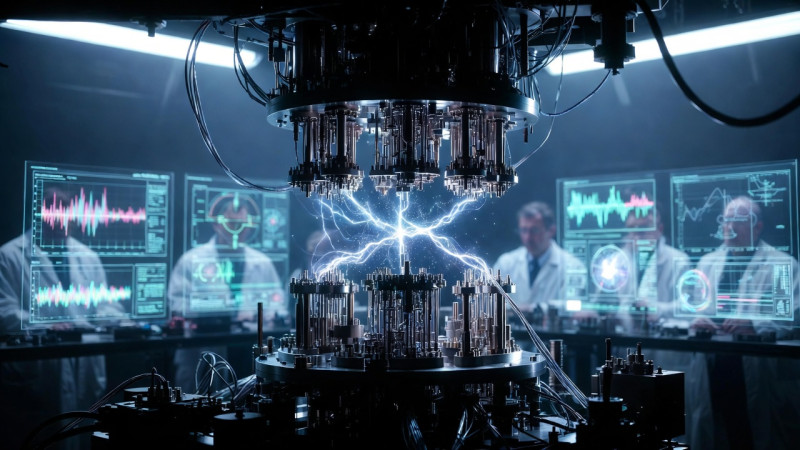
Inside some of the quietest laboratories on Earth, physicists are seeing something deeply unsettling. Instruments detect light, motion, or usable work appearing in systems designed to start with almost nothing. No fuel. No heat source. No visible trigger. And yet—energy shows up.
At first glance, it feels like a violation of one of science’s most sacred rules: energy cannot be created from nothing. But these experiments are not exposing a loophole in physics. Instead, they are revealing just how misleading the idea of “nothing” really is.
At quantum and microscopic scales, emptiness is busy, restless, and surprisingly useful.
The vacuum is not empty—and experiments prove it
In everyday language, a vacuum means total absence. In physics, the quantum vacuum is something else entirely. Even at the lowest possible energy state, fields continue to fluctuate. Particles briefly appear and vanish. Space itself hums with activity that normally stays hidden.
One of the most striking demonstrations of this is the Dynamical Casimir Effect. In this phenomenon, scientists rapidly change the boundary conditions of an electromagnetic field—often using superconducting circuits that behave like mirrors moving at extreme speeds. When the system is driven fast enough, the vacuum responds by producing real photons.
Light appears without a lamp.
This effect has been predicted for decades and has now been observed in laboratory systems. The energy does not come from nowhere—it comes from the external force driving the system—but the vacuum supplies the raw fluctuations that become measurable light. The result looks like creation, even though it is transformation.
When information behaves like fuel
Another category of “energy from nowhere” comes from experiments inspired by Maxwell’s demon, a famous thought experiment that once seemed to threaten the second law of thermodynamics.
Modern versions replace the demon with sensors and computers. These systems measure tiny random motions—thermal fluctuations—and respond instantly with feedback. By acting at precisely the right moment, they turn randomness into directed work.
In these information engines, energy appears to be extracted from disorder. A microscopic particle climbs against a gradient. A system performs work without a traditional fuel source.
But once again, nothing is free. Measurement, storage, and control all have physical costs. When those costs are fully counted, thermodynamics remains intact. The shocking part is not that laws are broken—it’s that information itself has physical weight.
At small scales, knowing what a system is about to do can be as powerful as pushing it.
Noise, asymmetry, and motion from chaos
Related experiments involve nanoscale ratchets and asymmetric systems that convert random motion into steady movement. When a system is uneven and exposed to fluctuations, it can drift in a preferred direction without a conventional engine.
To human intuition, randomness should cancel out. At microscopic scales, it often doesn’t.
These systems still obey energy conservation, but they expose how deeply timing, structure, and control influence outcomes. What looks like “extra” energy is usually energy entering in subtle forms—vibrations, feedback signals, or environmental noise that becomes useful only because the system is designed to exploit it.
Why this feels impossible
These discoveries feel unsettling because they challenge assumptions we rarely question:
- That empty space is inert
- That randomness is useless
- That measurement is passive
At quantum scales, all three assumptions fail.
The vacuum reacts. Randomness can be harvested. Measurement changes reality.
Energy is not appearing from nowhere—it’s emerging from places we once ignored.
What this actually means for science
These experiments do not unlock limitless power sources. The energies involved are extremely small and require highly controlled environments. But the implications are still profound.
They influence how scientists design quantum computers, ultra-sensitive detectors, and nanoscale machines. They reshape how physics understands the relationship between information and energy. And they force a more honest definition of what “empty” really means.
The universe is not generous—but it is more subtle than we thought.
FAQs
Q1: Is this real “free energy”?
No. All experiments obey conservation laws when fully measured. The surprise lies in where the energy originates.
Q2: Does this break thermodynamics?
No. Modern experiments expand thermodynamics to include information, measurement, and feedback.
Q3: What’s the clearest example of energy seeming to appear?
Photon creation linked to the Dynamical Casimir Effect is one of the most direct laboratory demonstrations.
Q4: Can this scale up to power technology?
Unlikely. The effects are tiny, but the principles matter for future quantum systems.
Q5: Why are scientists excited anyway?
Because these results reveal hidden layers of reality that were once purely theoretical.
References: