.png)
.png)
.png)
.png)
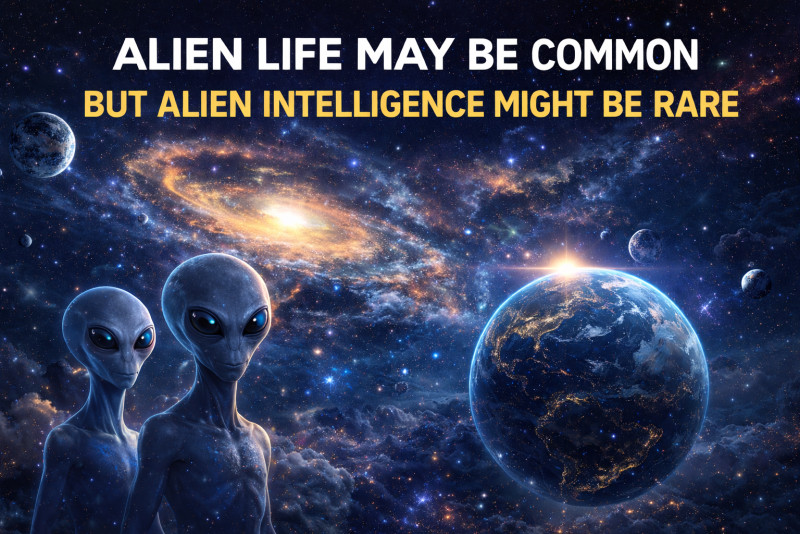
The universe is not short on real estate. With hundreds of billions of galaxies, each holding billions of stars, it seems almost impossible that Earth is the only place where life exists. Many scientists now agree on one thing: life itself may be common.
But intelligence? That is a very different story.
The idea that simple organisms may be scattered across the cosmos while advanced, thinking civilizations remain scarce is gaining ground among astronomers, biologists, and physicists. It helps explain why the universe looks alive on paper — yet silent in practice.
Life Begins Easily, Intelligence Does Not
On Earth, life appeared remarkably early. Geological evidence suggests single-celled organisms existed more than 3.5 billion years ago, not long after the planet cooled enough to support water.
For billions of years after that, nothing much changed.
Life remained simple. No cities. No tools. No technology. Just microbes adapting quietly to their environment.
Complex life took an extraordinary amount of time to emerge, and intelligent life even longer. Modern humans have existed for only about 300,000 years — a blink in cosmic terms.
This long delay suggests that life may spark easily, but intelligence requires a rare chain of events.
The Rare Path to Thinking Minds
For intelligence to develop, a planet needs more than water and chemistry. It needs long-term stability, protection from frequent cosmic disasters, a suitable atmosphere, and just the right evolutionary pressures.
Earth benefited from a stable orbit, a protective magnetic field, plate tectonics, and even a large moon that helped regulate climate. Remove just one of these factors, and complex life may never appear.
Many scientists now believe that while microbes could thrive on countless worlds, the leap from survival to self-awareness is far from guaranteed.
Why the Sky Remains Quiet
This idea offers a compelling explanation for the long-standing mystery known as the Fermi Paradox: if intelligent life is common, why have we not seen any sign of it?
Radio signals, spacecraft, or megastructures should be detectable if advanced civilizations were widespread. Yet decades of observation have produced no confirmed evidence.
One possibility is that intelligent civilizations are simply few and far between, separated by vast distances and time gaps. Some may rise and fall before others ever appear.
Earth’s moment may be rare — and brief.
Extinction May Be the Rule, Not the Exception
Intelligence introduces new risks.
Technology gives a species power, but also vulnerability. Nuclear weapons, environmental collapse, and runaway technologies are uniquely intelligent problems.
On Earth, humans have reached a point where self-destruction is a real possibility. Other intelligent species elsewhere may face similar challenges — and fail.
If most intelligent civilizations burn out quickly, the odds of two existing at the same time become incredibly small.
Signs of Life Without Minds
Modern telescopes are now detecting exoplanets with atmospheres that could support life. Scientists are searching for chemical fingerprints linked to biological activity.
But even if these signs are found, they would not confirm intelligence. Bacteria produce gases too.
Discovering life may become routine in the future. Discovering intelligence may remain extraordinary.
A Humbling Possibility
If intelligent life is rare, humanity may carry a heavier responsibility than we realize.
We could be one of the few thinking voices in a vast, mostly quiet universe. That does not make us special in a triumphant sense — it makes us fragile.
Understanding this may change how we view our planet, our conflicts, and our future.
Frequently Asked Questions
Does this mean humans are alone in the universe?
Not necessarily. Simple life may exist on many planets, even if intelligent civilizations are uncommon.
Why does intelligence take so long to appear?
It requires stable conditions, complex evolution, and time — often billions of years.
Have scientists found alien life yet?
No confirmed discovery has been made, but research is ongoing.
Could intelligent aliens exist but be undetectable?
Yes. Advanced civilizations may use technologies beyond our current understanding or choose not to broadcast their presence.
Does rare intelligence make Earth more important?
It highlights how unusual and delicate intelligent life may be, not how dominant it is.
Final Perspective
The universe may be full of life quietly breathing, adapting, and surviving. But thinking, questioning, and wondering beings may be far rarer than science fiction suggests.
If that is true, then intelligence is not the norm — it is the exception.
And that makes every choice we make matter a little more.