.png)
.png)
.png)
.png)
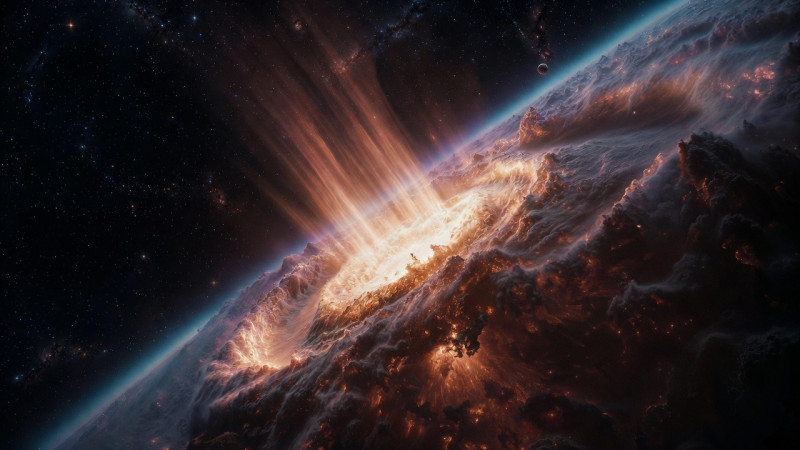
A Flash That Overwhelmed the Universe
On an ordinary day in October 2022, space quietly delivered something extraordinary. Telescopes around the world were suddenly flooded with intense radiation from a single point in the sky. Within minutes, scientists realized they were witnessing the most powerful explosion ever recorded.
The event is now widely known as GRB 221009A, often called the “Brightest of All Time.” And even by the wild standards of cosmic explosions, this one went far beyond expectations.
What made it so shocking was not just its brightness—but its sheer scale.
What Exactly Exploded?
The explosion came from a gamma-ray burst, a short-lived but incredibly intense release of energy. Gamma-ray bursts usually occur when a massive star collapses into a black hole, launching jets of energy across space at nearly the speed of light.
These events are common in the universe, but this one stood apart.
GRB 221009A released more energy in seconds than the Sun will emit over its entire lifetime. Instruments designed to detect extreme events were briefly overwhelmed. Some detectors even saturated, meaning the signal was too strong to measure cleanly at first.
That had never happened before.
Bigger Than Anyone Predicted
Scientists expected a powerful event. They did not expect this.
As data poured in, researchers realized the explosion was at least ten times brighter than typical gamma-ray bursts. The afterglow lingered for months, visible across radio, optical, and X-ray wavelengths.
What puzzled scientists most was how clean and focused the blast appeared. The energy was tightly concentrated, aimed almost directly at Earth from a galaxy billions of light-years away. That alignment alone made the event extremely rare.
Even models built to explain extreme cosmic explosions struggled to account for what was observed.
Why This Changes What We Know
For decades, astronomers believed there was an upper limit to how energetic these explosions could be. GRB 221009A shattered that assumption.
The event raised serious questions:
-
How much energy can collapsing stars really release?
-
Are there unknown mechanisms at work?
-
Have similar explosions happened before, unseen?
Scientists are careful not to jump to conclusions. No new laws of physics have been claimed. But the data suggests that nature may be capable of far more violence than previously thought.
No Threat, Just a Reminder
Despite its power, the explosion posed no danger to Earth. It happened far beyond our galaxy. But it served as a reminder of how small our planet is in a universe capable of such extremes.
Astronomers continue to study the event, reanalyzing data and updating models. Years from now, GRB 221009A may still be shaping how we understand stellar death and cosmic energy.
Frequently Asked Questions
What made this explosion so special?
Its brightness and energy output exceeded anything previously recorded.
Was Earth in danger?
No. The event occurred billions of light-years away.
Is this the largest explosion ever?
It is the most powerful explosion ever directly observed by instruments.
Could this happen closer to us?
Such events are extremely rare, and no nearby threat is known.
Did this break physics?
No laws were broken, but some limits may need revision.
Disclaimer
This article is based on publicly reported scientific observations and peer-reviewed analysis. Research into this event is ongoing, and interpretations may evolve as more data is studied.
Reference Links
NASA – Brightest Gamma-Ray Burst Ever Recorded
https://www.nasa.gov
European Space Agency (ESA) – Record-Breaking Gamma-Ray Burst
https://www.esa.int
Nature Astronomy – GRB 221009A Observations
https://www.nature.com