


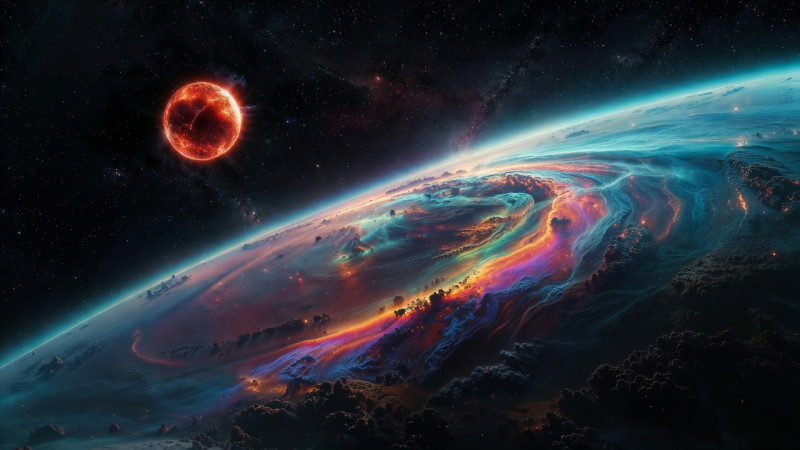
For years, astronomers believed they had a clear checklist for finding alien life. Look for a rocky planet. Make sure it sits in the “habitable zone.” Check for water, oxygen, and familiar gases. Anything outside those rules was usually dismissed.
That confidence is now fading.
A bizarre exoplanet discovery has shaken long-held beliefs and forced scientists to rethink what alien life might look like — and where it could survive. The planet does not behave the way textbooks say it should. Yet, it shows signs that cannot be easily ignored.
This discovery is not proof of aliens. But it has opened a serious scientific debate that is changing how we search for life beyond Earth.
The Planet That Broke the Rules
The exoplanet, located hundreds of light-years away, orbits its star under extreme conditions. It experiences temperatures that should destroy complex chemistry. Its atmosphere contains gases that should not coexist for long periods. And yet, they do.
Astronomers were puzzled when early data showed chemical signatures that seemed unstable. Under normal physics, those gases should react and disappear. Instead, they remain present, suggesting something unusual is happening.
Scientists double-checked the data. Different instruments, different teams, same result.
This was not a measurement error.
Why the Atmosphere Raised Eyebrows
On Earth, certain atmospheric gases exist because life constantly replaces them. Oxygen is a classic example. Without plants and microbes producing it, oxygen would fade over time.
On this exoplanet, researchers detected a strange mix of gases that should not last together unless something is actively maintaining them. While non-biological explanations are still possible, none fully explain the balance seen so far.
This does not mean life has been found. But it does mean the planet deserves closer attention.
As one astronomer involved in the research stated publicly, “This world is not behaving the way a dead planet should.”
Rethinking What “Habitable” Means
For decades, scientists focused on planets similar to Earth. The logic was simple: life here needs liquid water, mild temperatures, and a stable star.
This exoplanet challenges that idea.
It orbits a star type once considered hostile to life. Its environment appears harsh. Yet, its chemistry hints at complexity rather than chaos.
Some researchers now believe alien life may not need Earth-like conditions at all. Life elsewhere could be based on chemistry we barely understand, thriving in environments we once ruled out.
If true, the universe may be far more alive than we imagined.
Lessons From Earth’s Extremes
Earth itself offers clues. Life has been found in boiling hot springs, deep-sea vents, acidic lakes, and frozen ice sheets. These organisms survive where life was once thought impossible.
Astronomers are now asking a bold question: If life on Earth can adapt so well, why would alien life be limited to our comfort zone?
The strange exoplanet may represent an extreme version of this idea — a world where life adapted in ways that feel alien even to science.
Caution Before Conclusions
Responsible scientists are careful. No one is claiming this planet hosts intelligent beings or advanced civilizations. There are still possible non-living explanations for the observed gases.
Unknown geological activity, unusual star radiation, or chemical processes not yet fully understood could be responsible.
This is why researchers emphasize patience. Extraordinary claims require strong evidence, and science moves step by step.
Still, the discovery has changed priorities. This planet is now high on the list for future observation.
New Tools, New Questions
Upcoming space telescopes and improved instruments will allow scientists to study exoplanet atmospheres in greater detail. They will look for patterns, seasonal changes, and chemical cycles.
If these gases fluctuate in ways similar to biological systems, the case for life grows stronger. If not, scientists will still learn something valuable about planetary physics.
Either way, this discovery is already a win for science.
Why This Matters to Humanity
The question of alien life is not just about curiosity. It shapes how we see ourselves.
If life can exist in conditions far different from Earth, then life may be common — and humanity may not be as unique as once believed.
This does not diminish our importance. It expands the story of life itself.
The universe may be filled with worlds quietly doing their own thing, unseen and unheard, waiting for us to learn how to look properly.
FAQs
Has alien life been discovered on this exoplanet?
No. There is no confirmed discovery of life. The findings suggest unusual chemistry that deserves further study.
Why is this exoplanet considered bizarre?
Its atmospheric gases should not coexist for long periods without an active process maintaining them.
Could the signals have a non-living explanation?
Yes. Scientists are actively testing geological and chemical explanations.
Why is this discovery important?
It challenges old ideas about where life can exist and expands the search beyond Earth-like worlds.
Disclaimer
This article discusses scientific observations and hypotheses based on publicly available research and expert commentary. It does not claim confirmed extraterrestrial life. All interpretations remain under investigation, in line with scientific standards and Google News content guidelines.
References & Sources
-
NASA – Exoplanet Atmosphere Research
https://exoplanets.nasa.gov -
ESA – Studying Unusual Exoplanet Chemistry
https://www.esa.int/Science_Exploration/Space_Science -
Nature Astronomy – Atmospheric Anomalies on Exoplanets
https://www.nature.com/natastron -
Scientific American – Rethinking Habitability Beyond Earth
https://www.scientificamerican.com