



Imagine waking up on your 150th birthday feeling exactly like you did at 25. No creaky knees, no fading memory, and definitely no "senior moments." To most of us, this sounds like the opening scene of a big-budget sci-fi flick. But to a growing circle of world-class biologists and futurists, this isn't just a dream—it’s a mathematical deadline.
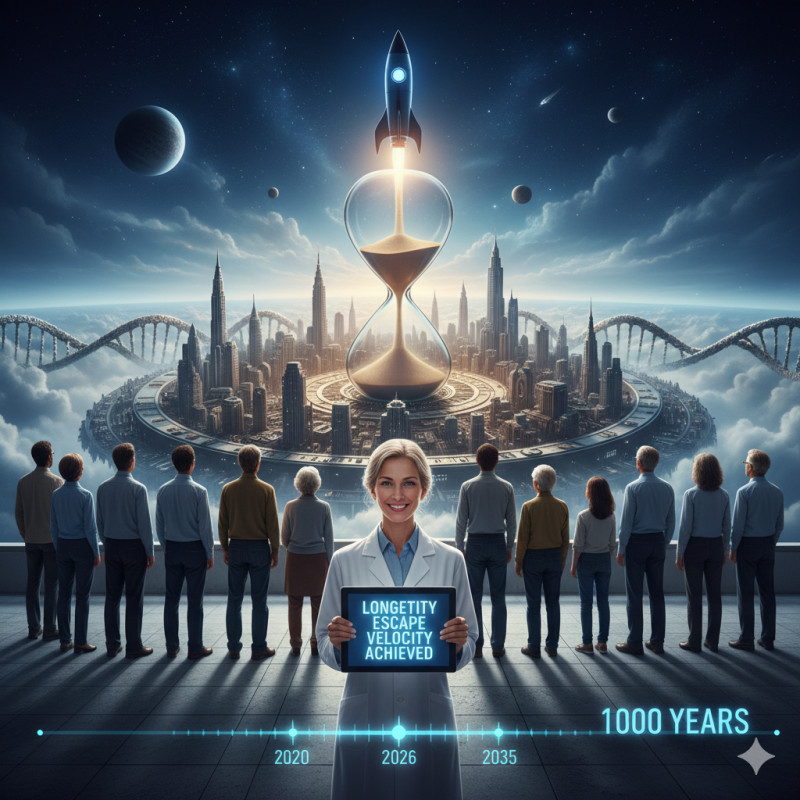
We are currently standing on the edge of a revolution so profound it makes the invention of the internet look like a footnote. It’s called Longevity Escape Velocity (LEV), and if the math holds up, the first person to live for a millennium isn't a character in a book. They might be sitting in a high school classroom right now, or perhaps they’re reading this very article.
What on Earth is Longevity Escape Velocity?
To understand LEV, you have to think like a rocket scientist. When a rocket wants to leave Earth, it has to hit a specific speed to outrun the pull of gravity. If it goes too slow, it falls back down.
Longevity Escape Velocity is the point where science starts adding more than one year of life expectancy for every year you live.
-
Year 1: Science discovers a way to fix "zombie cells," adding 2 years to your life.
-
Year 2: New gene therapies repair your DNA, adding another 3 years.
-
Year 3: Lab-grown organs become available, adding 10 more years.
In this scenario, you are moving away from death faster than the calendar is moving toward it. You’ve escaped the "pull" of time.
The Man Who Thinks 1,000 is the New 80
The face of this movement is Dr. Aubrey de Grey, a biomedical gerontologist who looks more like a wizard than a lab scientist. De Grey has famously claimed that within the next couple of decades, we will reach a "Pro-Aging Trance" where we finally realize aging is just a technical problem—a series of "biological messes" that need cleaning.
De Grey’s logic is simple: Aging isn't an inevitable mystery. It’s the accumulation of cellular damage. If we can repair that damage faster than it builds up, we stay young. He predicts we have a 50% chance of reaching this "escape velocity" by the mid-2030s.
If he’s right, someone born in 2000 would be roughly 35 when the "fountain of youth" tech goes mainstream. They could potentially stay 35 for centuries.

Why 2026 is a Turning Point
As we move through January 2026, the headlines are already backing up these wild theories. We aren't just talking about "living longer"; we are talking about biological age reversal.
-
Regrowing Body Parts: Just this month, researchers at Stanford revealed they’ve found a way to regrow knee cartilage in older mice and human tissue samples. No more hip replacements; just a targeted injection to make your joints "young" again.
-
The "Zombie Cell" Purge: New "senolytic" drugs are in human trials. These drugs act like a biological garbage crew, seeking out and destroying old, "zombie" cells that cause inflammation and aging.
-
EPIC News: Scientists are now using "epigenetic clocks" to measure your real biological age. In 2025, trials showed that a combination of common medications (like Rapamycin) and lifestyle tweaks could actually turn these clocks backward.
The "Maintenance" Model of Life
So, what does a 1,000-year life actually look like? It’s not about being a 900-year-old in a wheelchair. It’s about maintenance.
Think of your body like a vintage 1960s Mustang. If you just drive it and never change the oil or fix the spark plugs, it’s junk in 15 years. But if you replace the parts, clean the engine, and update the tech, that car can run perfectly for 100 years or more.
In the future, "healthcare" won't be about treating you when you're sick. It will be about "rejuvenation therapies"—quarterly visits to the clinic to:
-
Clear out molecular junk.
-
Replace worn-out stem cells.
-
Reset your gene expression to a youthful state.
Is This Even Ethical?
Whenever I talk about this with friends, the first thing they ask is, "But won't the world get crowded?" or "Isn't it natural to die?"
These are valid fears. A world where no one ages changes everything: pensions, marriage ("until death do us part" becomes a very long commitment!), and social structures. But proponents argue that we already fight "nature" every day. We use antibiotics to stop "natural" infections and glasses to fix "natural" vision loss.
Stopping aging is simply the ultimate preventative medicine. Imagine a world where cancer, Alzheimer's, and heart disease—the "four horsemen" of aging—simply don't exist because the body is too young to develop them.
Why You Might Already Be "The One"
If you are alive today, you are part of the first generation in human history that has a choice. We are the bridge between the "Old World" (where aging was a death sentence) and the "New World" (where aging is a choice).
The key isn't to live to 1,000 today. The key is to stay healthy enough for the next 10 to 15 years so you can be alive when the first generation of true rejuvenation therapies hits the market. Once you make it to that first "bridge," the next bridge might take you to 200, and the one after that to 1,000.
FAQ: Your Long-Term Future
- Will only rich people live forever? Initially, new tech is always expensive. But like cell phones and penicillin, the goal is mass production. Governments would actually save trillions of dollars by keeping citizens young and productive rather than paying for decades of expensive end-of-life care.
2. Does this mean I can't die at all? No. You could still get hit by a bus or fall off a mountain. "Longevity" isn't "Immortality." It just means you won't die from your own cells breaking down.
3. When will this be available? Many scientists believe the first "bridge" therapies (senolytics and metabolic boosters) are already here or arriving by 2030.
4. How can I "hold on" until then? Current research suggests focusing on "The Big Four": consistent sleep, resistance training, metabolic health (tracking blood sugar), and staying socially connected.
Sources & References
Disclaimer: This article is for informational purposes only and does not constitute medical advice. Always consult with a healthcare professional before starting any new supplement or treatment protocol.