Imagine finding a twin of our home—a blue-marbled "Earth 2.0" floating 25 light-years away. For nearly two decades, astronomers thought they had done exactly that. They called it Fomalhaut b, and it was the golden child of space exploration. It was the first planet outside our solar system ever captured in a direct photograph using visible light.
But then, the unthinkable happened. As the Hubble Space Telescope zoomed back in for a check-up, the planet was gone. No explosion, no black hole—just a slow, ghostly fade into nothingness.
If you’re wondering how a massive planet simply "un-exists," you aren't alone. This cosmic vanishing act has sent shockwaves through the scientific community, forcing us to rethink everything we know about how worlds are born—and how they die.
The Rise and Fall of Fomalhaut b
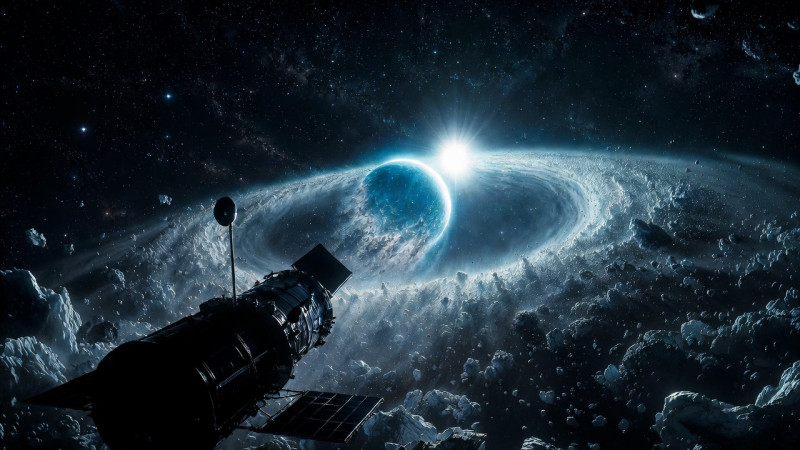
Back in 2008, the world was buzzing. NASA released a stunning image of a tiny, bright dot sitting inside a massive ring of icy debris surrounding the star Fomalhaut. It looked like a classic "Goldilocks" planet. Scientists estimated it was about the size of Jupiter, but its bright reflection suggested it might be a rocky world with a thick atmosphere—a potential "Earth 2.0" in the making.
For years, it was a celebrity in the astronomy world. But as Hubble continued to track its orbit, things started getting weird.
-
The Ghostly Glow: The planet was way too bright in visible light, yet it didn't show up at all in infrared (heat) scans. Real planets give off heat; Fomalhaut b was ice cold.
-
The Great Expansion: Instead of staying a solid dot, the "planet" began to grow larger and fainter.
-
The Vanishing Act: By 2014, the bright spot had stretched out so much it was barely a whisper. By 2025, it had effectively vanished from Hubble's view.
The "Opps" Heard 'Round the Universe
So, what happened? Did an alien civilization move their planet? Not quite.
The leading theory—and it's a wild one—is that Fomalhaut b was never a planet to begin with. Instead, astronomers likely witnessed the immediate aftermath of a colossal cosmic car crash.
Imagine two massive space rocks, each about 125 miles wide (roughly the size of a small country), slamming into each other at thousands of miles per hour. The resulting explosion would create a massive, expanding cloud of fine dust and ice. In the beginning, that cloud would be so dense it would reflect starlight and look exactly like a solid planet.
Over time, however, the dust would drift apart. The "planet" would get bigger, thinner, and eventually disappear as the particles scattered into the void. We weren't looking at a world; we were looking at a cosmic ghost.
Why This Matters for the Search for Earth 2.0
You might think, "Okay, so they got it wrong. Why is that a big deal?" It’s a big deal because it’s a cautionary tale for our future. As we build more powerful tools like the James Webb Space Telescope to find "habitable" worlds, Fomalhaut b serves as a reminder that the universe is a master of disguise.
If a giant dust cloud can "masquerade" as a planet for 20 years, how many other "Earth-like" worlds are actually just debris from a violent collision? It teaches us that "seeing is believing" isn't enough in deep space. We need to check the heat, the gravity, and the chemical signatures before we start packing our bags for a new home.
A New Mystery Appears: CS2
Just as the original Fomalhaut b (now called cs1) faded away, recent 2025 and 2026 observations have revealed a second bright spot in the same system, dubbed cs2.
This is incredibly rare. According to current models, these kinds of massive collisions should only happen once every 100,000 years. To see two of them in the same system within a human lifetime is like winning the cosmic lottery—or realizing that some star systems are far more violent and chaotic than we ever imagined.
FAQs: The Mystery of the Missing Planet
Did the planet actually explode?
Not exactly. It likely never existed as a single solid object. What we saw was a massive cloud of dust from a collision that was already expanding when we first "discovered" it.
Could there still be life there?
While the "planet" we saw is gone, the star system itself is still there. However, with so many massive collisions happening, it’s probably a very dangerous place for life to take root.
Will we ever find a real Earth 2.0?
Yes! We’ve already found thousands of confirmed exoplanets. The Fomalhaut incident just helps us refine our search so we don't get "fooled" by dust clouds in the future.
Final Thoughts: The Universe is Alive
The "disappearance" of Fomalhaut b isn't a failure of science; it’s a triumph. It shows that our technology is now good enough to watch the universe change in real-time. We aren't just looking at a static map of the stars; we are watching a live, violent, and beautiful story of creation and destruction.
Space is messy. It’s chaotic. And sometimes, the "planets" we find are just the echoes of a massive crash that happened long before we were born.
What do you think? Should we be worried about "fake" planets, or is the discovery of a massive cosmic collision even more exciting than a new Earth?
References & Sources
-
NASA/ESA Hubble News: Hubble sees asteroids colliding at nearby star
-
ScienceDaily: A planet just vanished. NASA's Hubble reveals a violent cosmic secret
-
Proceedings of the National Academy of Sciences (PNAS): Study on the expansion of Fomalhaut b dust cloud