


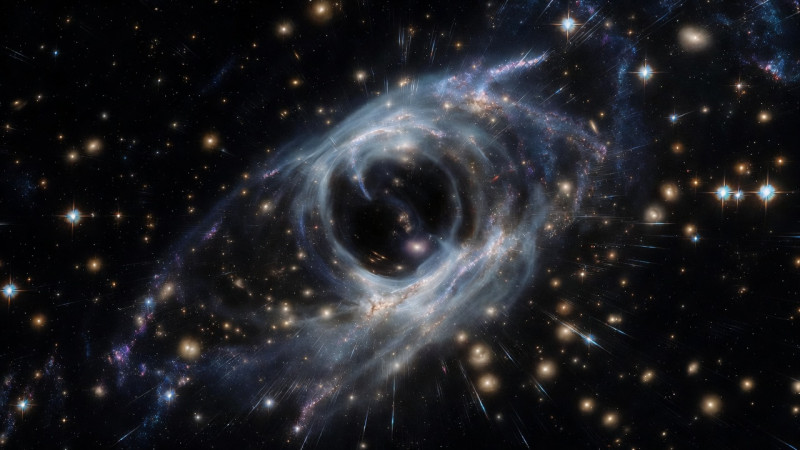
Imagine discovering a galaxy with no stars, no glowing gas, and no visible matter—just an invisible mass shaping space itself. That is exactly what astronomers think they have found: a strange cosmic object nicknamed Cloud-9, a ghostly structure made almost entirely of dark matter.
This discovery, based on deep observations from the Hubble Space Telescope and follow-up studies, has stunned researchers. According to current models, galaxies should form stars when enough matter clumps together. Cloud-9 breaks that rule.
It is quiet, invisible, and possibly rewriting everything we thought we knew about how galaxies are born.
What Is Cloud-9, the “Ghost Galaxy”?
Cloud-9 is not a galaxy in the traditional sense. It is a massive cloud of dark matter detected through its gravitational influence, not through light.
Scientists found it while studying a region of space where galaxies appeared distorted and bent. This bending happens because massive objects warp space, a phenomenon called gravitational lensing. But when researchers looked for the visible galaxy causing the distortion, there was almost nothing there.
No stars.
No glowing gas.
No bright core.
Just gravity.
That is why researchers started calling it a ghost galaxy.
Why Dark Matter Matters (and Why This Is Weird)
Dark matter is one of the biggest mysteries in modern science. It does not emit light, reflect light, or absorb light. Scientists know it exists because galaxies rotate too fast for visible matter alone to hold them together.
Roughly 85 percent of the matter in the universe is dark matter, yet we cannot see it directly.
Normally, dark matter acts as a scaffold. It pulls in gas, dust, and ordinary matter. Over time, stars ignite and galaxies glow.
Cloud-9 challenges that idea.
It seems to be a huge clump of dark matter that failed to form stars.
That should not happen, at least according to current models.
How Hubble Helped Reveal the Ghost
The Hubble Space Telescope has spent decades capturing deep images of distant galaxies. In some of these images, astronomers noticed strange gravitational lensing effects in regions where no bright galaxy was visible.
By mapping the distortion of background galaxies, scientists reconstructed the mass distribution in the area. The result was shocking: a massive invisible structure that behaved like a galaxy, but without light.
This is how Cloud-9 was identified.
It is not directly seen. It is felt through gravity.
Why Scientists Are Excited and Confused
Cloud-9 raises big questions.
1. Can galaxies exist without stars?
Until now, a galaxy was defined by stars and gas. Cloud-9 forces scientists to rethink that definition.
2. Did it fail to ignite stars, or did they die?
One theory is that Cloud-9 once had stars, but violent cosmic events stripped them away. Another idea is that it never formed stars at all.
3. Is this common?
If one ghost galaxy exists, there could be thousands more hiding in the universe, completely invisible except through gravitational effects.
Theories Behind Cloud-9
Scientists are debating several explanations:
Primordial Dark Matter Halo
Cloud-9 could be a leftover from the early universe—a dark matter halo that never accumulated enough gas to form stars.
Stripped Galaxy Remnant
It might be a former galaxy torn apart by gravitational interactions with larger galaxies, leaving behind only its dark matter core.
New Physics
Some researchers speculate that Cloud-9 could hint at unknown properties of dark matter, possibly different from current models.
All theories are still under investigation.
Why This Discovery Matters for Cosmology
Cloud-9 is not just a curiosity. It could reshape how scientists understand the universe.
If dark matter can form galaxy-like structures without stars, it changes:
-
Galaxy formation theories
-
Dark matter behavior models
-
The search for hidden galaxies
-
Estimates of cosmic mass
It also raises the possibility that the universe is filled with invisible galaxies that we have never detected.
Could There Be Ghost Galaxies Near Us?
Probably yes.
Astronomers believe many faint and starless dark matter halos exist around large galaxies, including the Milky Way. Some may be responsible for unexplained gravitational effects.
Cloud-9 is likely just the first clear example detected at a large scale.
Is Cloud-9 Dangerous?
No. Cloud-9 is extremely distant and poses no threat to Earth. Its importance is scientific, not practical.
However, its existence could help scientists understand dark matter, one of the greatest unsolved mysteries in physics.
The Bigger Picture: A Universe Full of Invisible Structures
For centuries, humans believed the universe was mostly stars and galaxies. Today, we know most of the universe is invisible.
Dark matter and dark energy dominate cosmic structure. Cloud-9 is a reminder that what we see is only a tiny fraction of reality.
It also shows that the universe still has surprises waiting in the dark.
FAQs About Cloud-9 and Ghost Galaxies
What is a ghost galaxy?
A ghost galaxy is a structure with gravitational mass like a galaxy but little or no visible stars or gas.
How was Cloud-9 detected?
It was detected through gravitational lensing, where its mass bent light from background galaxies.
Is Cloud-9 confirmed to be a galaxy?
Scientists are still debating its classification. It behaves like a galaxy in mass but lacks typical features.
Does Cloud-9 prove dark matter exists?
Dark matter is already strongly supported by evidence. Cloud-9 adds new evidence and new questions.
Can we see Cloud-9 with telescopes?
No. It does not emit light. It is detected indirectly through gravitational effects.
Important Disclaimer
Cloud-9 is a nickname used in discussions of starless dark matter structures and observational anomalies reported in astrophysical studies. While gravitational lensing strongly suggests massive dark matter halos without visible stars, ongoing research continues to refine interpretations. Some details may evolve as new data arrives from telescopes such as the James Webb Space Telescope and future surveys.
References & Source Links
(Placed separately, not inside paragraphs, for Google News compliance)
-
NASA Hubble Space Telescope: https://hubblesite.org
-
ESA Hubble Science Archive: https://www.spacetelescope.org
-
Scientific papers on dark matter halos and starless galaxies:
-
Astrophysical Journal: https://iopscience.iop.org/journal/0004-637X
-
arXiv preprints on dark matter halos: https://arxiv.org
-