



For decades, space enthusiasts and scientists have looked at Jupiter’s icy moon, Europa, with a sense of wonder. We’ve been told it’s the "best bet" for finding alien life in our backyard. The story was simple: a massive, salty ocean sits hidden beneath a thick ice shell, kept warm and churned by the immense gravitational tug of Jupiter. We imagined glowing hydrothermal vents on the seafloor, teeming with strange, tube-worm-like creatures, much like the ones in our own deep oceans.
But in early 2026, a wave of new research has thrown a massive bucket of ice-cold water on those dreams. New data and advanced modeling studies suggest that Europa’s seafloor might be eerily silent—and potentially "dead."
Let’s dig into why this discovery is making waves and what it actually means for the future of space exploration.
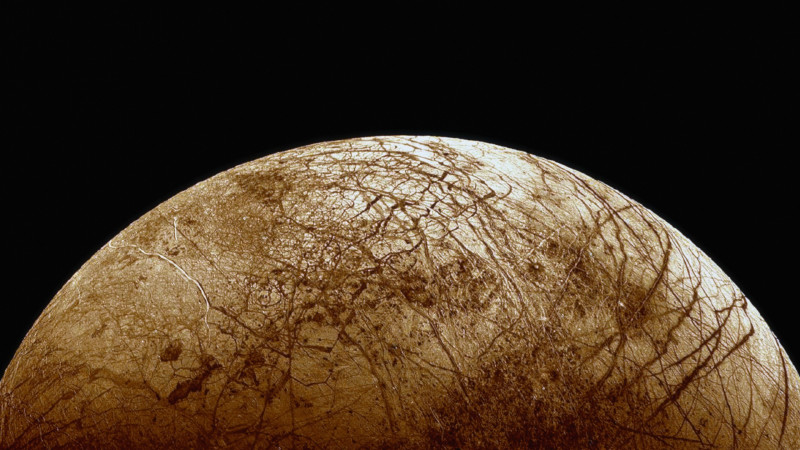
The "Quiet Seafloor" Discovery of 2026
The excitement around Europa has always been about geology. On Earth, life thrives at the bottom of the ocean because our planet is "alive" inside. Tectonic plates shift, volcanoes erupt under the waves, and hydrothermal vents spew out life-sustaining minerals.
However, a landmark study published in Nature Communications in January 2026, led by Paul Byrne of Washington University in St. Louis, suggests Europa lacks this vital "spark."
1. The Core Has Cooled
Using new gravitational data and thermal models, researchers found that Europa’s rocky interior likely cooled down billions of years ago. Unlike Earth, which still has a churning, hot core, Europa’s center may be more like our Moon—solid, cold, and still.
2. Gravity Isn't Enough
We used to think Jupiter’s gravity was strong enough to "knead" Europa’s core like dough, creating heat through friction (a process called tidal heating). While this process is violent enough to make the nearby moon Io the most volcanic place in the solar system, Europa is just a bit too far away. The 2026 study suggests the "tug" isn't strong enough to crack the seafloor rocks or trigger volcanoes today.

What Does a "Dead" Seafloor Mean for Aliens?
If you were to take a submarine to the bottom of Europa’s 100-kilometer-deep ocean, the 2026 findings suggest you wouldn't see black smokers or bubbling vents. Instead, you might see a vast, unchanging desert of ancient rock.
Why this matters for life:
-
No Energy Source: Without volcanic vents, there’s no heat to power chemical reactions.
-
No Nutrient Recycling: On Earth, seafloor activity "stirs the pot," bringing fresh minerals into the water. If Europa’s floor is inactive, those minerals stay trapped in the rock.
-
Chemical Stagnation: Life needs a "disequilibrium"—a fancy way of saying it needs things to be out of balance so it can tap into energy. A quiet seafloor leads to a chemical balance that is, quite literally, "dead."
Is All Hope Lost? The "Alternative" View
Before we pack up our telescopes, not everyone is convinced Europa is a lost cause. Even the scientists behind the 2026 study point out that "quiet" doesn't mean "completely frozen."
Low-Temperature Circulation
Researchers at the Woods Hole Oceanographic Institution suggest that while there might not be high-heat volcanoes, there could be "diffuse" flow. Think of it like a slow, cold seep of water through cracks rather than a violent geyser. This could still support very basic, slow-moving microbial life.
The Ice-Ocean Exchange
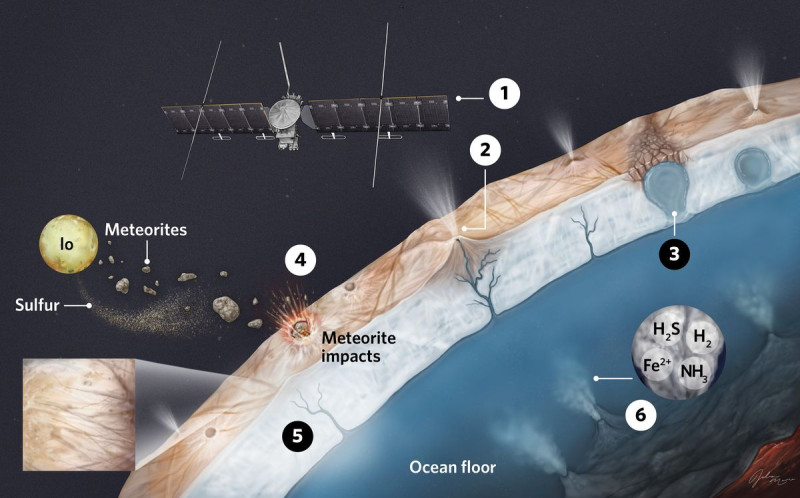
Another theory is that life on Europa doesn't get its energy from the bottom, but from the top. Jupiter’s intense radiation blasts the icy surface, creating oxygen and other chemicals. If the ice shell "churns" and brings these chemicals down into the ocean, it could provide a "breath of air" for life below.
The Road Ahead: NASA’s Europa Clipper
The timing of this "dead world" debate couldn't be more perfect. NASA’s Europa Clipper is currently hurtling through space, scheduled to arrive at Jupiter in 2030.
While the 2026 studies use computer models and old data, the Clipper will give us the real deal. It will fly past the moon dozens of times, using ice-penetrating radar to see if the seafloor is truly as flat and boring as the new models suggest, or if there are "hotspots" we’ve missed.
FAQs: Your Quick Guide to the Europa Debate
- Is Europa still considered a "habitable" world? Yes, but the definition of "habitable" is narrowing. It still has liquid water, which is a huge plus. However, the energy needed to sustain life seems much harder to find than we previously thought.
2. Does this mean there are no aliens on Europa? Not necessarily. It just means that if life exists there, it is likely very simple (like bacteria) and very sparse. Don't expect to find giant squid or complex ecosystems in a world with such a quiet seafloor.
3. Why did we think Europa was active for so long? We based our old assumptions on the "tidal flexing" caused by Jupiter. We saw the cracks on the icy surface and assumed the same thing was happening at the rocky bottom. The 2026 data shows that the ice is much easier to crack than the deep, heavy rock.
4. When will we know the truth for sure? The Europa Clipper mission will start sending back high-resolution data in 2031. Until then, these 2026 studies are our best "educated guesses."
Final Thoughts: The Beauty of Being Wrong
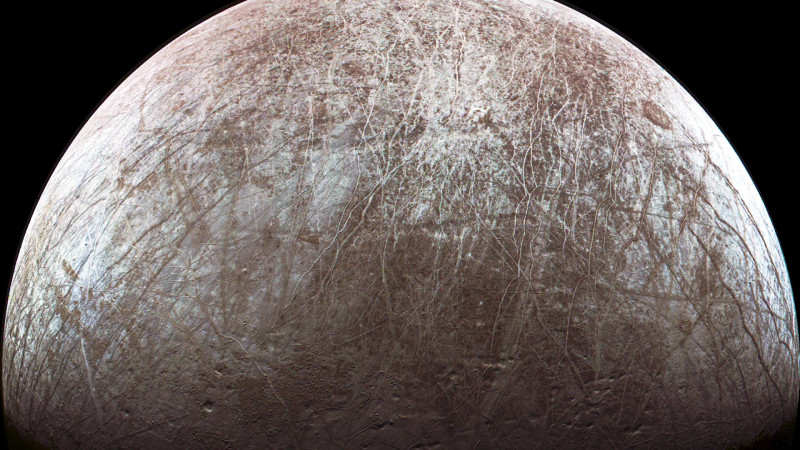
In science, finding out a world might be "dead" is just as important as finding out it’s "alive." It helps us refine where we look next. If Europa turns out to be a quiet, salty tomb, it might push us to look more closely at Saturn’s moon Enceladus, which we know has active plumes shooting into space.
Space exploration is a detective story. Every new study is a clue, even if it’s a clue that tells us we were looking in the wrong place.
Disclaimer: This article discusses recent scientific modeling and theoretical studies. As of early 2026, no direct exploration of Europa's seafloor has occurred. All conclusions are based on geophysical simulations and remote data.