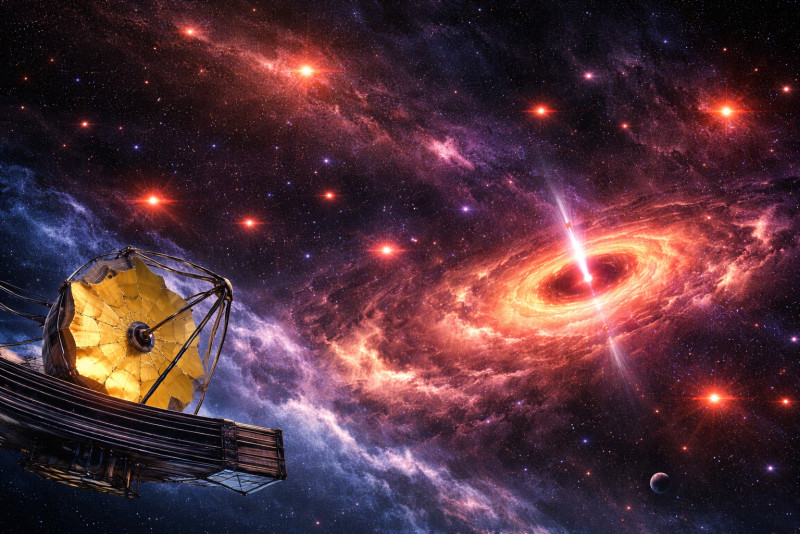
If you’ve been following the journey of the James Webb Space Telescope (JWST) since it first opened its golden eye in 2022, you know it has a knack for finding things that shouldn't exist. Among the most baffling were the so-called "Little Red Dots."
The Breakthrough: Cocoons of Fire
The mystery was solved by an international team, including researchers from the University of Copenhagen’s Cosmic Dawn Centre. By analyzing two years of spectroscopic data—essentially the "light DNA" of these objects—they discovered that the little red dots aren't galaxies at all.
Why This Changes Everything
Before this 2026 discovery, astronomers were worried. They were seeing "supermassive" black holes in the early universe that seemed too big for their age. It was like finding a fully grown oak tree in a garden that was only planted yesterday.
-
They are lighter than they look: The gas cocoons were actually making the black holes appear about 100 times more massive than they truly are.
-
Growth spurts are real: We are catching these black holes in the middle of a "feeding frenzy." This phase explains how they grow from small "seeds" into the giants we see at the centers of galaxies like our own Milky Way.
-
They are everywhere: Scientists estimate that almost one in every ten galaxies in the early universe is actually one of these "Little Red Dots."
The "Messy Eater" Theory
Professor Darach Watson, one of the lead authors of the study, famously described these objects as "messy eaters." Because the black holes rotate so fast, they blow a significant portion of their "food" back out through their poles.
FAQs: The "Little Red Dots" Explained
1. Why did it take so long to solve the mystery? Because the gas cocoons are so thick, they block X-rays and radio waves—the usual signals astronomers use to find black holes. It took JWST’s incredible infrared sensitivity to peer "through" the dust and see the heat signature of the gas itself.
2. Are "Little Red Dots" dangerous to Earth? Not at all. These objects existed over 13 billion years ago. We are seeing them as they were in the distant past. Most of them have since evolved into the quiet, mature supermassive black holes we see in the centers of modern galaxies.
3. If they are black holes, why are they red? Black holes themselves are invisible, but the gas around them is not. The red color comes from "reddening"—a process where dense gas and dust absorb blue light and only allow red light to pass through, much like how a sunset looks red because of the Earth's atmosphere.
4. Could they be "Dark Stars"? While some scientists suggested the dots might be "Dark Stars" (stars powered by dark matter), the 2026 data strongly points toward standard black hole physics. The "cocoon" model fits the observations much more accurately.
Final Thoughts: Looking Into the Abyss
The resolution of the "Little Red Dot" mystery is a triumph for modern science. It proves that the early universe wasn't just a place of quiet star birth, but a turbulent, glowing landscape of "cosmic cocoons" where the giants of the universe were being forged.
As JWST continues its mission throughout 2026, we can expect even more answers. But for now, we can look at those tiny red specks and know we aren't just looking at light—we’re looking at the very first growth spurts of the universe's most powerful engines.
References & Sources:
-
Those strange red dots in James Webb images finally have an explanation - ScienceDaily (January 15, 2026)
-
Mystery of the Universe's 'Little Red Dots' Solved - Explorersweb (January 14, 2026)
-
James Webb Solves the Mystery of the Universe’s “Little Red Dots” - SciTechDaily (January 21, 2026)
-
Early Universe’s ‘Little Red Dots’ Are Young Supermassive Black Holes - Sci.News (January 15, 2026)
-
Little red dots as young supermassive black holes in dense ionized cocoons - Nature Journal (January 14, 2026)
Disclaimer: While the "black hole in a cocoon" theory is the current leading scientific explanation published in Nature as of January 2026, the study of the early universe is ongoing. Alternative theories, such as ultra-dense star clusters or exotic stellar remnants, are still being investigated by some members of the astronomical community.