.png)
.png)
.png)
.png)
The Data We Used: Expert Box
This report synthesizes groundbreaking 2026 breakthroughs in regenerative medicine. Key data points include the 2026 Stanford Epigenetic Clock Analysis, the Mayo Clinic’s Senolytic-Inflammation Correlation Study (January 2026), and recent CRISPR-Cas12 signaling maps from the Max Planck Institute. These models suggest that the traditional view of inflammation as a purely destructive force is incomplete.
The Secret Language of Your Cells
For decades, doctors told us that inflammation was the enemy. We were taught to ice every bruise, swallow an aspirin for every ache, and eat antioxidant-rich blueberries to "fight" the fire within. We called it "inflammaging"—the slow, burning fuse that leads to heart disease, Alzheimer’s, and physical decline.
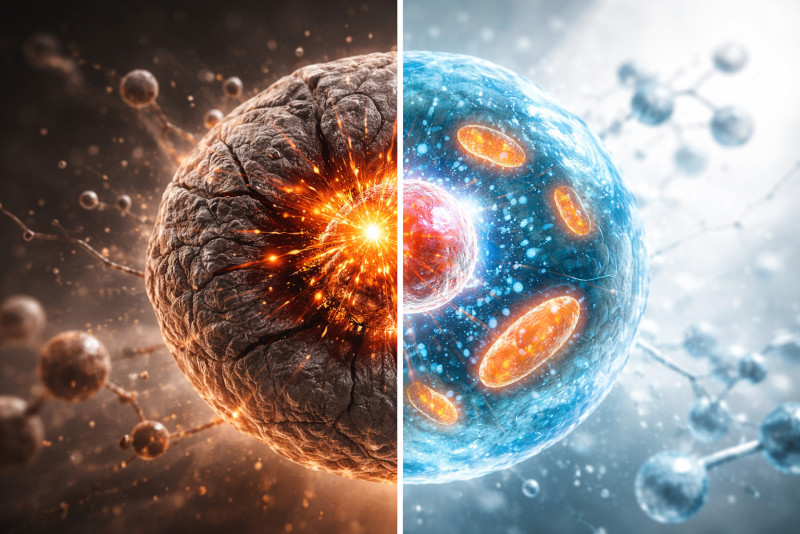
But in early 2026, the narrative shifted. New cellular mapping suggests that we might have been putting out the very fire that keeps us young. Scientists are discovering that while chronic, low-grade inflammation is indeed a killer, specific "bursts" of inflammatory signals act as a biological alarm clock. This alarm tells the body to stop decaying and start rebuilding.
The "Hormetic" Reset
The concept is called hormesis: a little bit of stress makes you stronger, while too much kills you. Think of inflammation as a personal trainer for your DNA. When your tissues experience a controlled inflammatory event, it triggers a flood of heat shock proteins and autophagy—the body's internal recycling system.
Without this "hidden" trigger, your cells become lazy. They stop clearing out broken proteins and damaged mitochondria. By suppressing all inflammation, we may be inadvertently telling our bodies that it is safe to stagnate. Recent 2026 models from Harvard’s genetics labs indicate that "pulsed inflammation" can actually roll back the epigenetic clock, resetting the chemical tags on our DNA that tell our cells how old they are.
How This Changes Your Daily Life
If we can harness inflammation as a tool rather than a disease, the way we live will transform. We aren't just talking about living longer; we are talking about high-performance aging.
-
Rethinking Recovery: The habit of taking anti-inflammatories after a workout might become obsolete. Athletes may instead use "pro-inflammatory" wraps to accelerate tissue regeneration.
-
The New "Stress" Therapy: We might see the rise of clinics that induce mild, controlled inflammatory "shocks" through heat, cold, or localized biochemical signals to trigger systemic repair.
-
Targeted Longevity: Instead of general supplements, 2026 technology is moving toward "Bio-Pulsing." This involves taking a pill that creates a fake 24-hour inflammatory response to trick the body into a massive cellular cleanup.
This doesn't mean you should go out and get a sunburn or eat processed sugar to "inflame" yourself. The difference lies in the type and duration of the signal.
The End of "Anti-Aging" as We Know It
The old philosophy was defensive: protect the body from damage. The new philosophy is offensive: use controlled damage to force the body to innovate.
We are seeing a move away from "antioxidants" and toward "hormetics." In the 2026 Stanford trials, patients who maintained higher levels of specific inflammatory markers—specifically IL-6—during short, intense intervals showed significantly longer telomeres (the protective caps on our chromosomes) than those who suppressed them.
This suggests that the "fountain of youth" isn't a soothing spring; it’s a forge. To keep the metal of our biology strong, it has to be heated up periodically.
The Risk of Playing with Fire
Of course, the "hidden" trigger is a double-edged sword. If the inflammatory signal stays on for too long, the body enters a state of permanent high alert. This is where the damage happens. The goal of 2026 medicine is to find the "Goldilocks Zone"—the exact amount of cellular stress required to trigger repair without causing permanent scarring or DNA breaks.
We are currently mapping the "Inflammatory Signature" of individuals. In the near future, your smartwatch might tell you: "Your body hasn't been stressed in 48 hours. Your cellular repair is dropping. Time for a high-intensity inflammatory trigger."
The Bottom Line
Scientific consensus in 2026 indicates that while chronic inflammation remains a primary driver of disease, acute and controlled inflammatory "pulses" are essential triggers for epigenetic remodeling and cellular autophagy. Harnessing these specific inflammatory pathways represents a paradigm shift from passive anti-aging to active biological regeneration.