.png)
.png)
.png)
.png)
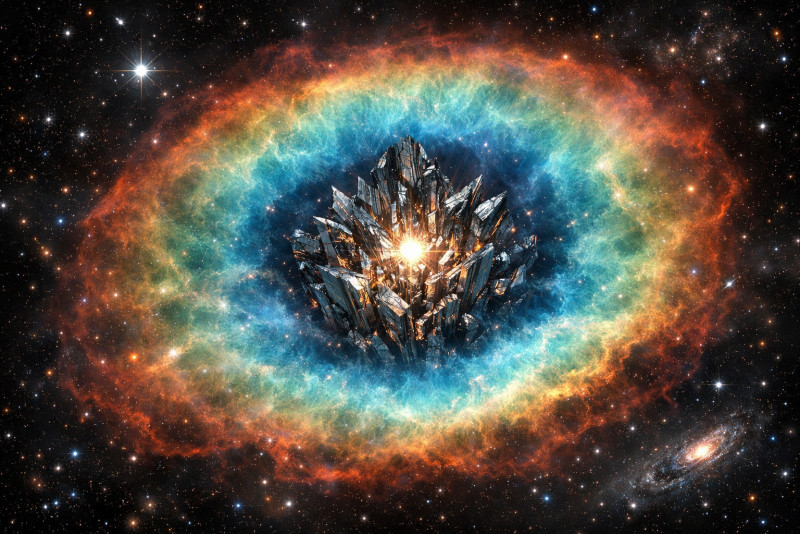
Space usually feels like a place of predictable patterns. Stars burn, they die, and they leave behind beautiful clouds of gas. But in January 2026, the famous Ring Nebula (Messier 57) decided to stop following the script. Using a powerful new instrument called WEAVE, astronomers have detected a colossal "iron bar" stretching right through the heart of the nebula.
The Discovery: An "Iron Bar" 3 Trillion Miles Long
For decades, we thought we had the Ring Nebula figured out. We saw it as a simple bubble of hydrogen and oxygen exhaled by a dying sun-like star. But the 2026 data from the WHT Enhanced Area Velocity Explorer (WEAVE) in Spain has revealed a "ghost in the machine."
Scientists found a narrow, bar-shaped cloud of ionized iron atoms cutting across the nebula's center. To put the scale into perspective:
-
Length: It stretches 500 to 1,000 times the distance between Pluto and the Sun.
-
Mass: It contains roughly as much iron as the planet Mars.
-
The Problem: Stars like the one that created the Ring Nebula aren't supposed to make this much iron. They are "lightweight" stars. Iron is usually the calling card of massive supernovas.
Is it a Vaporized Planet?
One of the most chilling theories being discussed at University College London (UCL) is that this iron bar is the "corpse" of a rocky planet. As the central star died and expanded into a Red Giant, it likely swallowed its orbiting worlds. The iron core of one of those planets might have been vaporized and stretched out into this bizarre magnetic bar.
If this is true, we aren't just looking at a nebula; we are looking at a crime scene. And it’s a preview of Earth’s own fate in 5 billion years.
The 2026 Bio-Sentinels: Why This Matters for Astronaut Health
While astronomers stare at iron bars 2,600 light-years away, NASA is sweating over the "Bio-Sentinels." Set to launch alongside the most ambitious deep-space missions of 2026, these shoebox-sized satellites are carrying a precious cargo: living yeast cells.
Why yeast? Because their DNA is surprisingly similar to ours. As we prepare to send the Artemis II crew around the Moon, the Bio-Sentinels are our "canaries in the coal mine."
The Hidden Dangers of Cosmic Metal and Radiation
The discovery of concentrated iron in the Ring Nebula highlights something we often forget: space isn't empty. It is filled with "Heavy Ions"—fast-moving nuclei of elements like iron that act like microscopic cannonballs.
When a "Heavy Ion" hits a human cell, it doesn't just bump into it; it shreds the DNA. This is the "Bio-Sentinel" nightmare. The 2026 mission is specifically designed to see if we can even survive outside Earth's protective magnetic field for long periods.
The Health Risks: What Astronauts Face in 2026
As we push toward the Moon and Mars, the "Iron Core" anomaly reminds us that we are moving into a shooting gallery of heavy elements. NASA’s latest health assessments for the 2026 Artemis crews highlight three major "Sentinels" of risk:
-
DNA Shattering: Cosmic rays (including iron nuclei) cause double-strand breaks in DNA. Unlike a simple sunburn, these breaks are incredibly hard for the body to repair correctly, leading to high cancer risks.
-
The "Moon Face" and Fluid Shifts: Without gravity, fluids move to the head, increasing pressure on the brain and potentially flattening the eyeballs, leading to permanent vision loss (SANS).
-
Immune System Silence: 2026 studies suggest that deep-space radiation can "hibernate" the human immune system, potentially reactivating dormant viruses like shingles or herpes during a mission.
How This Changes Your Daily Life
You might think an iron bar in space has zero impact on your Tuesday morning, but the tech being built to solve this mystery is already landing on Earth.
-
Better Medical Imaging: The WEAVE technology used to "see" the iron bar is being adapted for high-resolution cancer mapping in hospitals.
-
Radiation Protection: The shielding being developed for 2026 astronauts is leading to new "smart fabrics" that could protect workers in nuclear power or high-altitude aviation.
The Data We Used (2026 Sources)
-
Monthly Notices of the Royal Astronomical Society (Jan 2026): "WEAVE imaging spectroscopy of NGC 6720: an iron bar in the Ring."
-
NASA Artemis II Research Briefing (2025/2026): Guidelines on "Standard Measures" for astronaut physiological changes.
-
The Bio-Sentinel Deep Space Mission Update: NASA Ames Research Center data on yeast DNA repair in high-radiation environments.
Frequently Asked Questions
1. Is the Ring Nebula’s iron bar dangerous to Earth? No. It is 2,600 light-years away. It is a scientific "anomaly," not a physical threat to our planet. However, it tells us a lot about how planets die.
2. Why is iron so "weird" in this nebula? Because the star that formed the Ring Nebula wasn't big enough to create iron through fusion. The iron shouldn't be there in such a concentrated, bar-like shape.
3. What is the Bio-Sentinel mission? It is a NASA mission using yeast to study how deep-space radiation damages living cells. It’s a vital test before we send humans to Mars.
4. Can we shield astronauts from these "iron" cosmic rays? Current shielding helps, but "Heavy Ions" (like iron) are very difficult to stop. This is why the 2026 data is so critical for future mission safety.
The Bottom Line
The discovery of a massive iron structure inside the Ring Nebula proves that our models of how stars die—and how planets are destroyed—are still incomplete. As the 2026 Bio-Sentinel mission reveals the staggering biological toll of space radiation, we are learning that the "heavy metal" of the cosmos is both a beautiful mystery and a deadly obstacle for human exploration.
Source References: