The Internet is Freaking Out—But Should You?
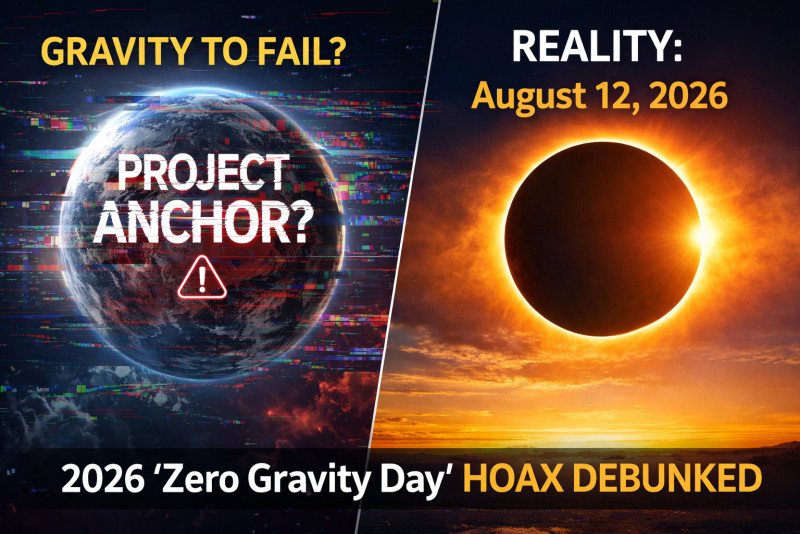
If you’ve spent any time on TikTok or Instagram lately, you’ve probably seen the terrifying headlines. People are claiming that on August 12, 2026, the world is going to "glitch." The rumor, often tagged as Project Anchor, suggests that Earth will suddenly lose its gravity for exactly seven seconds.
The videos are cinematic and scary. They talk about 40 million people floating into the sky, global chaos, and a secret NASA document leaked to the public. But before you start bolting your furniture to the floor or panic-buying bungee cords, let’s take a deep breath.
While the "Zero Gravity" story is a total fabrication, there is something massive happening on that exact date. It’s not an apocalypse—it’s one of the most stunning celestial shows of our lifetime: a Total Solar Eclipse.
What is the "Project Anchor" Hoax?
The "Project Anchor" conspiracy theory claims that NASA has known about a "gravitational anomaly" since 2019. According to the viral posts, two massive gravitational waves from colliding black holes will intersect at Earth, effectively "switching off" the planet's pull for a few seconds.
The rumor even includes a suspiciously specific $89 billion budget that NASA supposedly spent to build underground bunkers for the elite.
Why It’s Physically Impossible
Science can be complicated, but gravity is pretty straightforward. Gravity isn't a "signal" that can be jammed or a "switch" that can be turned off. It is a direct result of mass.
As long as the Earth has its core, mantle, and crust, it will have gravity. To lose gravity for seven seconds, the Earth would literally have to vanish and then reappear. If that happened, we’d have much bigger problems than a seven-second float!
The Reality Check: NASA has officially addressed these claims, confirming there is no such thing as "Project Anchor" and that gravity is not going anywhere.
The Real Event: The Total Solar Eclipse of August 12, 2026
So, why did the hoaxers pick August 12, 2026? Because they knew something big was already on the calendar. On that day, the Moon will pass directly between the Earth and the Sun, plunging parts of the world into daytime darkness.
This isn't just any eclipse; it’s the first total solar eclipse visible from mainland Europe in 27 years.
Where can you see it?
The "path of totality"—the narrow strip where the Sun is completely blocked—will sweep across some of the most beautiful places on Earth:
-
Greenland: For the rugged adventurers.
-
Iceland: The shadow will pass directly over Reykjavik.
-
Spain: The eclipse will happen right at sunset, creating a "Golden Ring" effect over the Mediterranean.
What will it feel like?
If you’ve never experienced a total eclipse, it’s hard to describe. It isn't just "getting dark."
-
The Temperature Drops: You’ll feel a sudden chill as the Sun’s heat is cut off.
-
Animal Confusion: Birds stop singing and bees head back to their hives, thinking night has fallen.
-
The Corona: You’ll see the Sun’s outer atmosphere—a ghostly, shimmering halo of white light that is normally invisible to the naked eye.
Why Do These Hoaxes Go Viral?
It’s easy to laugh at "Zero Gravity" rumors, but they spread because they use just enough "science-y" sounding words (like gravitational waves or black holes) to sound plausible. When you combine that with a real date—August 12—it creates a perfect storm of misinformation.
The 2026 eclipse is a moment for wonder, not worry. Instead of fearing a "gravity glitch," we should be preparing for a once-in-a-generation sky show.
How to Prepare for the 2026 Eclipse
If you want to witness the real event on August 12, 2026, you need to start planning now. This will be one of the most traveled-to eclipses in history.
-
Get Certified Glasses: Never look at the Sun without ISO-certified solar eclipse glasses. Regular sunglasses won't protect you.
-
Book Early: Hotels in northern Spain and Iceland are already seeing spikes in bookings for August 2026.
-
Check the Weather: Spain offers the best chance of clear skies, while Iceland and Greenland are more "scenic" but riskier with clouds.
Frequently Asked Questions
1. Will we really lose gravity in 2026?
No. Gravity is a constant force generated by the Earth's mass. There is no scientific mechanism that could cause it to stop or pause.
2. What is Project Anchor?
It is a fictional "secret project" created for social media clout. NASA has no record of such a project, and the "leaked documents" shown in videos are digital fakes.
3. Is the solar eclipse dangerous?
Only for your eyes! It is perfectly safe to be outside during an eclipse, but you must use proper eye protection to look at the Sun. The eclipse does not emit "dangerous radiation" or affect gravity.
4. Where is the best place to see the August 2026 eclipse?
Spain is widely considered the best spot due to the high probability of clear, sunny weather in August.
Final Thoughts: Look Up, Not Down
The "Project Anchor" hoax is a classic example of how the internet can turn a beautiful scientific event into a scary ghost story. Don't let the fear-mongering ruin what is set to be an incredible 2026.
On August 12, you won't be floating into space—but if you’re in the path of totality, your jaw might just hit the floor.
Disclaimer: This article is for informational purposes. Always verify astronomical events through official agencies like NASA or the ESA. Stay safe and use certified solar filters when viewing any eclipse.
Proof & References
-
NASA’s official stance on gravity and mass: nasa.gov
-
Path of Totality Maps for 2026: timeanddate.com
-
Snopes Fact Check on the 2026 Zero Gravity claim: snopes.com
-
European Space Agency (ESA) Solar Eclipse Guides: esa.int