


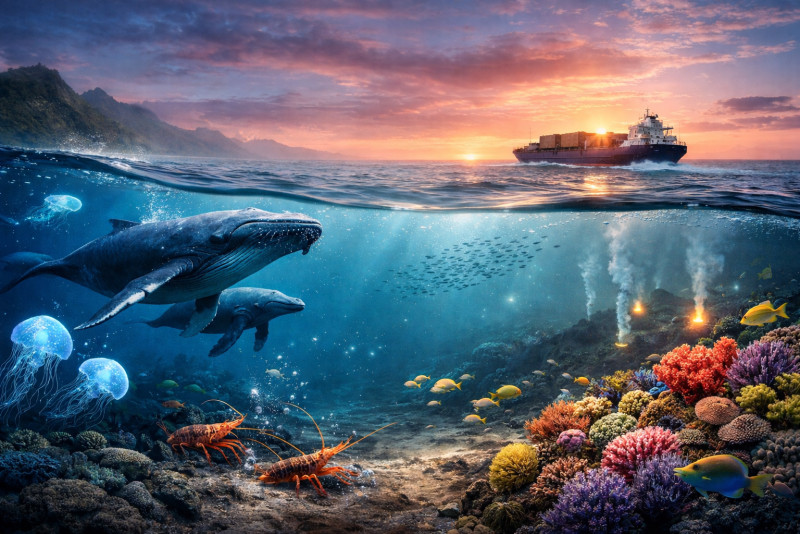
For decades, we’ve treated the ocean like a giant, liquid highway. Between the constant thrum of massive cargo ships, the sharp pings of military sonar, and the explosive thuds of oil exploration, the underwater world has been anything but quiet. But lately, something weird—and frankly, beautiful—is happening. Scientists are calling it the "Silent Seafloor" phenomenon, and it’s changing everything we thought we knew about the deep blue.
If you were to dive a mile down today, you might notice something different. The oppressive, mechanical "fog" of human noise is lifting. In its place? A symphony of biological sounds that haven’t been heard clearly since the mid-20th century. This isn't just a win for the whales; it’s a fundamental shift in how our planet’s largest ecosystem breathes.
What Exactly is the Silent Seafloor?
The "Silent Seafloor" isn't actually about silence in the way we think of it. It’s about the absence of us.
Ever tried to have a deep conversation at a construction site? That’s what life has been like for marine animals for the last fifty years. Sound travels five times faster underwater than in air, and because the water is so dense, noise doesn't just fade away—it hangs around. For a blue whale trying to find a mate 500 miles away, our shipping lanes have been like a permanent wall of static.
However, starting in late 2025 and moving into 2026, a perfect storm of new international shipping regulations (like the IMO’s URN guidelines) and a global shift toward "silent" propulsion technology has led to a measurable drop in deep-ocean ambient noise. The results have been immediate and, quite honestly, a bit shocking.
The Great "Unmasking" of 2026
Researchers at NOAA and various international marine institutes have begun documenting what they call the "Unmasking." When the mechanical hum fades, the biological world "turns up the volume."
-
Extended Communication Ranges: Whales that were previously limited to communicating within a 10-mile radius are now being "heard" by their kin hundreds of miles away. It’s as if the world suddenly grew smaller for them.
-
The Return of the Invertebrates: It turns out, even tiny snapping shrimp and lobsters get "stressed" by noise. On a quieter seafloor, these creatures are more active, which kickstarts the entire food chain.
-
The "Reef Call" Effect: Larval fish and coral polyps actually use sound to find their way home. In a noisy ocean, they get lost. In a silent one, they "hear" the reef and settle where they belong.
Why This Matters to You (Even if You’re a Landlubber)
You might be thinking, "Cool, the whales are happy. But why does this affect my life?" The ocean is the world’s largest carbon sink. The health of the seafloor—from the tiniest microbes to the biggest mammals—dictates how well the ocean can regulate our climate. When the ocean is "quiet," marine life thrives. When marine life thrives, the biological pump (the process by which the ocean moves carbon to the deep sea) works more efficiently.
A silent seafloor isn't just a peaceful place; it’s a functional one. We are seeing a more resilient ocean emerge simply because we’ve stopped screaming at it.
The Tech Behind the Silence
This didn't happen by accident. The "Silent Seafloor" is the result of some seriously cool engineering.
-
Air-Lubrication Systems: Modern ships now blow a "carpet" of bubbles under their hulls, which acts as a muffler for engine noise.
-
Bio-Inspired Propellers: New propeller designs, modeled after the wings of silent-flight birds like owls, are slashing the "cavitation" noise that used to plague the deep sea.
-
Acoustic "Slow Zones": Just like speed limits in school zones, major shipping lanes near the Galapagos and the Arctic have implemented "Quiet Zones."
The Mystery of the "Deep Hum"
Interestingly, as human noise has decreased, scientists have picked up a new, low-frequency hum coming from the seafloor that they can't quite explain. Some believe it’s the sound of the Earth’s crust settling; others think it’s a massive, coordinated "chatter" between deep-sea species we haven't even discovered yet.
Whatever it is, we can finally hear it. And that’s the real magic of the Silent Seafloor—it’s not that the ocean was ever empty; it’s that we finally stopped talking over it long enough to listen.
FAQs: Everything You Need to Know
Is the ocean actually silent now?
Not at all! It’s actually louder in some ways, but with natural sounds. Think of it like turning off a loud vacuum cleaner so you can finally hear the birds singing outside.
Did the COVID-19 pandemic start this?
The pandemic gave us a "preview" in 2020, but the current Silent Seafloor phenomenon is due to permanent policy changes and new ship designs that began hitting the water in 2025.
Can humans hear these sounds? Not without help. We use underwater microphones called hydrophones. If you were down there yourself, you’d mostly feel the vibrations, but through a hydrophone, it sounds like a busy tropical rainforest.
Does noise pollution actually kill fish?
It rarely kills them instantly, but it causes "acoustic masking." This means they can't find food, can't find mates, and can't hear predators coming. Over time, that leads to a collapse in fish populations.
What’s next for the Silent Seafloor?
The goal is to expand "Quiet Zones" to cover 30% of the world's oceans by 2030. If we stay on this track, we might see the first generation of "acoustically healthy" oceans in over a century.
Final Thoughts
The Silent Seafloor phenomenon is a rare piece of good news in the environmental world. It proves that nature doesn't always need a 100-year plan to recover—sometimes, it just needs us to be a little bit quieter.
Next time you’re standing by the beach, look out at the horizon. It might look the same as it did ten years ago, but underneath that blue surface, a long-lost conversation is finally starting up again.
References & Sources
-
NOAA Research: A rare glimpse of a quieter ocean (2025)
-
International Maritime Organization (IMO): GloNoise Partnership on underwater noise extended to 2026
-
Nature npj Acoustics: Analysis of North Pacific and Arctic Ocean Soundscapes (Published 2025)
-
JPI Oceans: Final findings on the impact of underwater noise on marine life (2025)
-
Smithsonian Ocean: The Ocean’s Hidden Language and the Impact of Noise
Disclaimer: This article is for informational purposes only. While it discusses real-world scientific trends and environmental phenomena observed through 2026, individual local results may vary based on regional shipping traffic and maritime laws.