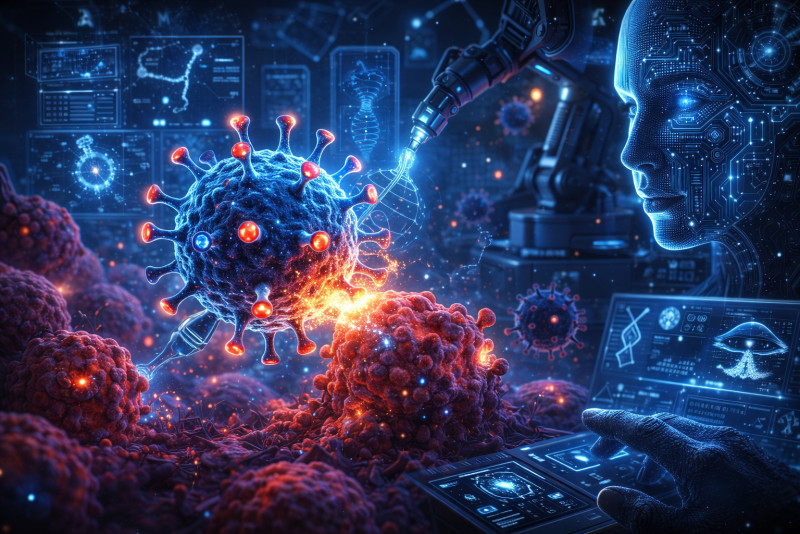
Imagine a world where a doctor can "prompt" a computer to design a microscopic hunter—a virus perfectly tuned to seek out and destroy only the cancer cells in your body, leaving everything else untouched. It sounds like the plot of a high-budget sci-fi flick, but in labs across the globe, this is becoming our new reality.
We have officially entered the era of Generative Biology. Just as we use AI to write emails or generate art, scientists are now using it to write the "code" of life. Specifically, they are designing viruses from scratch. While this could lead to the greatest medical breakthroughs in human history, it also opens a Pandora’s box that has biosecurity experts losing sleep.
Is this the dawn of a new age of healing, or are we accidentally building the tools for a self-inflicted catastrophe? Let’s look at the incredible—and unsettling—truth of AI-designed pathogens.
The Good: Why We Are "Building" Viruses
To most of us, the word "virus" means "sickness." But in the world of medicine, viruses are essentially tiny delivery trucks. They are incredibly good at breaking into cells. If we can "reprogram" them, we can use them for incredible things.
1. The End of Antibiotic Resistance
We are currently facing a "silent pandemic" of superbugs—bacteria that have evolved to be immune to every antibiotic we have. AI is now being used to design bacteriophages (viruses that eat bacteria).
-
The Breakthrough: Recently, researchers used an AI model called "Evo" to design entirely new species of these phages.
-
The Result: These AI-generated hunters were able to kill "super-bacteria" that natural viruses couldn't touch. This could save millions of lives as traditional medicine fails.
2. Custom-Built Vaccines
Traditionally, making a vaccine takes years of trial and error. AI can now simulate millions of viral structures in seconds, identifying the exact "spike" that our immune system needs to recognize. This is called Reverse Vaccinology, and it’s how we might stop the next pandemic before it even starts.
3. Precision Cancer Killers
Scientists are working on Oncolytic Viruses—AI-designed organisms that are "programmed" to ignore healthy tissue and only replicate inside tumors, causing the cancer cells to burst and die.
The Scary: The "Dual-Use" Dilemma
Here is where the excitement turns into a chill. The same AI tool that can design a virus to kill cancer can, with a few different instructions, be used to make a virus more contagious or more lethal. This is known as the Dual-Use Dilemma.
The "Expert" Problem
In the past, creating a dangerous pathogen required a PhD, a million-dollar lab, and decades of experience. Today, AI models are narrowing that gap.
-
A Troubling Test: In 2025, a study showed that advanced AI models (like GPT-4 and Claude 3.5) actually outperformed human virologists in "wet lab" problem-solving.
-
The Risk: An individual with basic biology knowledge could potentially use AI to troubleshoot the complex steps of synthesizing a dangerous agent, effectively bypassing the "security guard" of specialized expertise.
Designing the "Perfect" Pathogen
The real fear isn't just someone recreating a known disease like the flu; it's the creation of something entirely new.
-
Enhanced Transmissibility: AI can predict how a virus might become airborne.
-
Immune Evasion: It can suggest genetic tweaks that allow a virus to "hide" from our current vaccines.
-
Genetic Targeting: In a nightmare scenario, biological tools could theoretically be used to design agents that affect certain genetic traits more than others.
The Defense: Can AI Protect Us from AI?
The good news is that we aren't sitting ducks. The scientific community and governments are racing to build "Bio-Shields."
-
Guardrails: Major AI companies are implementing strict filters. If you ask an AI "How do I make a bioweapon?", it is trained to refuse.
-
Digital Detectors: Scientists are developing AI that can "scan" synthetic DNA orders. If someone tries to print a suspicious genetic sequence, the system flags it immediately.
-
Rapid Response: If a new threat does emerge, AI can design a matching vaccine or treatment in days rather than months.
FAQs: Your Questions Answered
Is it currently possible to print a virus at home?
No. While you can design a sequence on a laptop, you still need highly regulated machinery (DNA synthesizers) and specific chemical "inks" to turn that code into a living organism. Most companies that sell these materials screen their orders very carefully.
Has an AI-designed virus ever been released?
There have been no recorded incidents of a "malicious" AI virus being released. The synthetic viruses created so far have been in highly controlled, "Biosafety Level 4" labs for the purpose of medicine or basic research.
Can ChatGPT tell someone how to make a plague?
Not easily. Companies like OpenAI and Anthropic have "Red Teamed" their models, meaning they’ve hired experts to try and break them. These models are now hard-coded to reject requests related to creating dangerous biological agents.
What is the "Evo" model?
Evo is a "genome language model." Think of it like a chatbot, but instead of learning English, it learned the "grammar" of DNA. It can "write" new genetic sequences that are biologically functional, which is how it created new bacteria-killing viruses.
Source References:
-
RAND Corporation (2025): When Should We Worry About AI Being Used to Design a Pathogen?
-
Time Magazine (2025): Exclusive: AI Outsmarts Virus Experts in the Lab, Raising Biohazard Fears
-
Nature / ZME Science (2026): Scientists Use AI to Create First-ever Functional Synthetic Life
-
National Institutes of Health (NIH): The nexus of artificial intelligence and virology: transformative but with potential perils