.png)
.png)
.png)
.png)
In July 1969, humanity held its breath as astronauts stepped onto the Moon for the very first time. The Apollo landing changed history overnight. It proved that humans could leave Earth, touch another world, and come back alive.
More than half a century later, scientists are quietly saying something extraordinary.
2026 could rival — and possibly surpass — 1969.
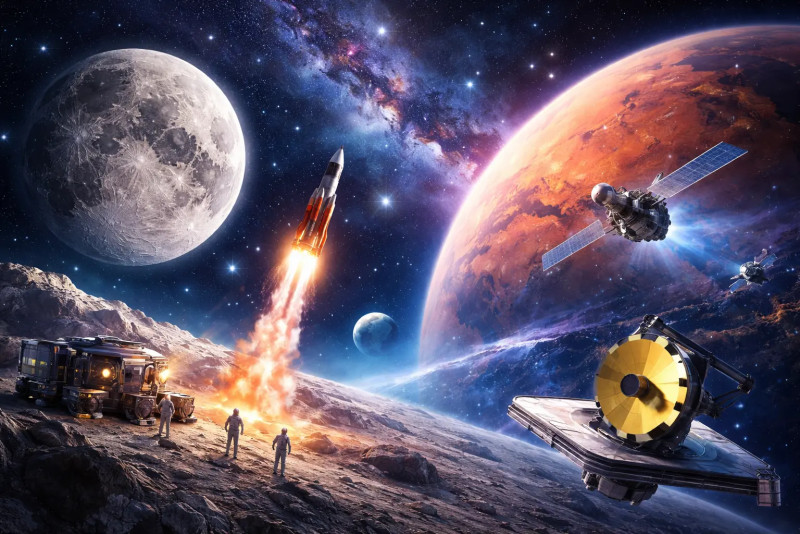
Not because of one single event, but because of many powerful discoveries happening at the same time. For the first time in modern history, missions to the Moon, Mars, deep space, and distant galaxies are all reaching critical moments together.
This is not hype.
This is timing, technology, and momentum colliding.
Why Scientists Are Comparing 2026 to 1969
The year 1969 was historic because it marked a turning point. Before Apollo 11, space was theoretical. After it, space became reachable.
2026 represents a similar shift, but on a much larger scale.
Instead of just one destination, scientists are exploring many worlds at once. Instead of brief visits, they are planning long-term presence. And instead of blurry images, we now have instruments powerful enough to study atmospheres, chemistry, and even the building blocks of life.
What makes 2026 special is not ambition alone — it is readiness.

The Moon Returns to Center Stage
For decades, the Moon felt like unfinished business. After Apollo, humanity left and never truly returned.
That changes now.
By 2026, NASA’s Artemis program is expected to push human exploration further than ever before.
These missions are not symbolic. They are practical.
Astronauts will test new landing systems, study lunar ice, and prepare for long-duration stays. The Moon is no longer a destination. It is becoming a training ground for deeper space travel.
Scientists believe this phase will determine whether humans can realistically survive on Mars.
Mars: From Exploration to Preparation
Mars has fascinated humans for centuries, but until recently, it remained just out of reach.
That changes in 2026.
Multiple space agencies are preparing key missions that will study the planet’s surface, atmosphere, and subsurface in unprecedented detail. These missions aim to answer questions that were once considered science fiction.
-
Did Mars ever support life?
-
Where did its water go?
-
Can humans survive there long-term?
Data collected during this period will shape the first real plans for human missions to Mars later in the 2030s.
This is the moment Mars stops being a mystery and starts becoming a destination.

A New Era of Space Telescopes
If the Moon landings showed us where we could go, telescopes show us where we came from.
By 2026, astronomers will be operating the most advanced set of space observatories in history, led by the James Webb Space Telescope.
Webb is already rewriting textbooks, but 2026 marks the point when long-term data begins to reveal patterns scientists have waited decades to see.
Researchers expect breakthroughs in:
-
The formation of early galaxies
-
The chemical makeup of exoplanet atmospheres
-
The life cycles of stars
-
The origins of cosmic structures
For the first time, astronomers may be able to compare distant planetary atmospheres with Earth’s in a meaningful way.
The Quiet Revolution of Space Stations
While dramatic missions grab headlines, another revolution is unfolding quietly in orbit.
By 2026, space agencies and private companies are preparing the transition from a single international station to multiple orbital platforms.
These stations will focus on:
-
Long-duration human health
-
Advanced manufacturing
-
Space medicine
-
Climate observation
Low Earth orbit is becoming a working environment, not just a laboratory.
This shift mirrors what airports did for aviation in the 20th century.

Asteroids, Defense, and Planetary Safety
One of the least discussed but most important developments leading into 2026 is planetary defense.
Space agencies are improving their ability to track near-Earth objects and test deflection methods. These efforts are not driven by fear, but by preparation.
For the first time in history, humanity is gaining the ability to detect and respond to potential cosmic threats.
This is not about panic.
It is about responsibility.
Why This Moment Feels Different
Many years have promised space breakthroughs. Few delivered them all at once.
What makes 2026 unique is convergence.
-
Mature technology
-
Global cooperation
-
Private investment
-
Clear scientific goals
Unlike the Cold War era, this push is not driven by competition alone. It is driven by curiosity, survival, and long-term thinking.
Space is no longer a race.
It is becoming a shared project.
What This Means for Ordinary People
You do not need to be an astronaut to feel the impact.
Space research influences daily life more than most people realize — from weather forecasting and communication systems to medical imaging and materials science.
Discoveries made in 2026 will shape technology, education, and even global cooperation for decades.
Just as 1969 inspired generations of engineers and scientists, 2026 may do the same — on a much larger scale.
Frequently Asked Questions (FAQs)
Why is 2026 compared to 1969?
Because both years mark major turning points. 1969 proved humans could reach the Moon. 2026 proves humans can stay, explore deeper, and understand the universe with precision.
Is a human Mars mission happening in 2026?
No, but 2026 is a critical preparation year. Data collected now will shape future crewed missions.
Will there be another Moon landing?
Human lunar missions are actively planned as part of ongoing programs, focusing on sustainable exploration rather than short visits.
How certain are these missions?
Space timelines can shift, but the missions planned around 2026 are already funded, tested, and underway.
Final Thoughts
History rarely announces itself in advance.
In 1969, few people realized they were watching the beginning of a new era. Today, we have the advantage of foresight.
All signs point to 2026 becoming a year future textbooks will highlight — not for one dramatic moment, but for a chain of discoveries that permanently change humanity’s place in the universe.
The next giant leap is not a single step.
It is a sustained journey.
Disclaimer
This article is based on publicly available mission plans, scientific briefings, and official space agency announcements available up to early 2026. Space exploration timelines may evolve due to technical, financial, or safety considerations. All interpretations are journalistic in nature and do not represent official mission guarantees.
References & Sources
-
NASA – Artemis Program Mission Overview
https://www.nasa.gov/humans-in-space/artemis -
NASA Science – James Webb Space Telescope Discoveries
https://science.nasa.gov/mission/webb -
European Space Agency – Future Exploration Roadmaps
https://www.esa.int -
SpaceNews – Global Space Mission Timelines
https://spacenews.com -
NASA Planetary Defense Coordination Office
https://www.nasa.gov/planetarydefense