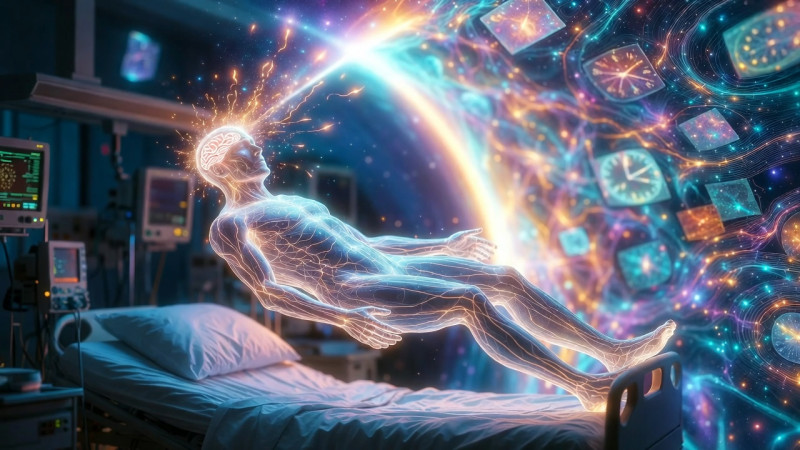
People who have survived cardiac arrest, severe trauma, or medical emergencies often describe something extraordinary. They speak of bright lights, a feeling of peace, floating above their bodies, or even encounters with loved ones who have passed away. These moments are known as near-death experiences (NDEs), and for decades they were dismissed as spiritual stories or hallucinations.
Today, science is catching up.
Modern neuroscience, emergency medicine, and brain-imaging studies are revealing that near-death experiences may be the result of very specific biological and neurological processes that occur when the brain is pushed to its absolute limit. This is not speculation anymore. Multiple studies over the last two decades, including hospital-based cardiac arrest research, have given scientists a clearer picture of what happens in the final moments between life and death.
So what actually causes near-death experiences — scientifically?
What Is a Near-Death Experience?
A near-death experience is reported by people who were clinically close to death but survived. This includes patients whose hearts stopped, who suffered oxygen deprivation, or who were under extreme physical stress.
Commonly reported elements include:
-
A sensation of leaving the body
-
Moving through a tunnel
-
Intense light or vivid colors
-
A feeling of peace or detachment from pain
-
Rapid replay of life memories
-
Loss of fear, including fear of death
Importantly, these experiences are reported across cultures, religions, and age groups, which immediately raised questions among scientists. If belief systems differ, why are the experiences so similar?
The Role of Oxygen Deprivation
One of the strongest scientific explanations behind near-death experiences is cerebral hypoxia, a condition where the brain does not receive enough oxygen.
When oxygen levels drop suddenly — such as during cardiac arrest — the brain enters a crisis mode. Visual regions of the brain are especially sensitive to oxygen loss. As they begin to fail, peripheral vision shuts down first, while central vision remains active. This creates the classic “tunnel vision” effect that many people report.
At the same time, the brain may generate bright flashes or lights as neurons misfire under stress. This is not imagination. It is a measurable physiological response.
Why People Feel Peace Instead of Pain
One of the most puzzling aspects of near-death experiences is the overwhelming sense of calm and comfort, even when the body is critically injured.
Science points to neurochemicals.
Under extreme stress, the brain releases large amounts of endorphins, the body’s natural painkillers. These chemicals reduce pain, suppress fear, and create feelings of warmth or euphoria. This response is similar to what happens during intense physical exertion or trauma, but magnified many times over.
In short, the brain may be protecting itself by numbing terror and pain when survival is uncertain.
The Brain’s “Last Stand” Activity
For a long time, scientists believed the brain simply shut down when the heart stopped. That assumption turned out to be wrong.
In 2013, researchers studying rats observed a brief surge of highly organized brain activity immediately after cardiac arrest. This activity included gamma waves — the same brain waves associated with conscious awareness, memory recall, and vivid perception.
Human studies conducted later in intensive care units have suggested something similar. In some patients, brain activity continues for tens of seconds after the heart stops, and in rare cases, even longer.
This burst of activity may explain why near-death experiences feel hyper-real, more intense than everyday life.
Out-of-Body Experiences Explained
Many people who report NDEs say they watched doctors working on them from above or felt as though they were floating outside their physical body.
Neuroscience links this sensation to disruption in the temporoparietal junction, a region of the brain responsible for body awareness and spatial orientation. When this area is overstimulated or deprived of oxygen, the brain may lose its sense of where the body ends and the environment begins.
Experiments have shown that electrical stimulation of this region can artificially induce out-of-body experiences in conscious patients. This strongly suggests that these sensations are brain-generated, not supernatural departures of consciousness.
Why Life Flashes Before the Eyes
The rapid replay of memories is another striking feature of near-death experiences. People describe seeing key moments from their lives in seconds.
This phenomenon is linked to the hippocampus and frontal cortex, areas involved in memory storage and emotional processing. Unde