.png)
.png)
.png)
.png)
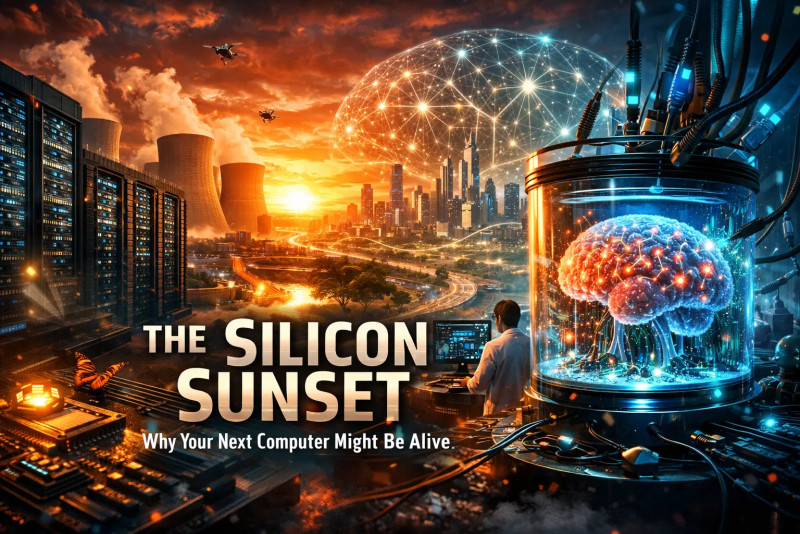
The Silicon Sunset: Why Your Next Computer Might Be Alive
For seventy years, the law of the land has been Moore’s Law: the doubling of transistors on a silicon chip every two years. But as we move through 2026, we have officially hit the physical limits of the atom. Silicon is too hot, too thirsty for power, and too "rigid" to keep up with the demands of the next generation of Generative AI.
The solution isn't a better chip. It’s Organoid Intelligence (OI).
Across the globe, from the labs of Johns Hopkins to the neural-tech hubs in Melbourne, scientists are moving beyond artificial intelligence. They are building Synthetic Biological Intelligence (SBI)—using living, pulsing, human brain cells as the "wetware" of the future.

Part I: The Energy Crisis That Silicon Can’t Solve
To understand why we are growing computers in petri dishes, we have to look at the "AI Power Wall" that hit the tech industry in late 2025.
Data centers now consume nearly 10% of the world’s electricity. A single query to a sophisticated AI model uses ten times the energy of a traditional search. The carbon footprint of training a single "frontier" model is equivalent to the lifetime emissions of dozens of cars. If we continue on this path, the AI revolution will bankrupt the global power grid.

The Human Brain: The 20-Watt Miracle
Compare that to the human brain. Your brain can perform complex logic, recognize every face you’ve ever met, and invent a poem, all while running on roughly 20 watts of power—about the same as a lightbulb in your refrigerator.
The Math of Biology:
-
Silicon AI: Requires massive cooling towers, liquid nitrogen, and gigawatts of power.
-
Biological AI: Requires a nutrient-rich "soup" (medium) and room temperature.
-
Efficiency Ratio: Scientists estimate that a mature Biocomputer could be one million times more energy-efficient than a GPU.

Part II: What is an Organoid? (Building the Wetware)
We aren't talking about "brains in jars" from 1950s horror movies. These are Brain Organoids. They are three-dimensional, lab-grown cultures that replicate the structural and functional complexity of the human brain, but on a microscopic scale.
1. The Alchemy of Stem Cells
The process begins with Induced Pluripotent Stem Cells (iPSCs). Scientists can take a simple skin cell from a donor and "reprogram" it back into a blank slate. These cells are then coaxed into becoming neurons, glial cells, and even the "white matter" that connects different brain regions.
2. The 3D Advantage
Unlike a flat petri dish (2D), an organoid is a three-dimensional structure. This is crucial because neurons are social; they need to form trillions of connections (synapses) in 3D space to create "intelligence." By 2026, we have mastered the art of Scaffolding—using 3D-printed microscopic frames to help these cells grow into specific shapes that mimic the human cerebral cortex or the cerebellum.
3. The Digital Bridge: Multi-Electrode Arrays (MEAs)
How do you "talk" to a clump of cells? You can't use a USB cable. Instead, researchers use MEAs. These are grids of microscopic sensors that both "read" the electrical firing of the neurons and "write" data into them using tiny electrical pulses. This creates a bidirectional loop—a true Brain-Machine Interface (BMI) at the cellular level.

Part III: The 2026 Breakthroughs: From "Pong" to "Processing"
The watershed moment for this technology occurred when a cluster of cells, nicknamed "DishBrain," learned to play the vintage video game Pong.
While a traditional AI needs thousands of "training epochs" (trial and error) to understand the game, the living cells "learned" the physics of the ball in under five minutes. Why? Because biological matter is inherently "plastic"—it has an evolutionary drive to find patterns and minimize "entropy" or surprise in its environment.
Current Applications in 2026:
-
Asynchronous Pattern Recognition: Biocomputers are being used to detect deepfakes and subtle anomalies in satellite imagery that baffle silicon algorithms.
-
Personalized Neurology: Pharmaceutical companies are using "Your Brain on a Chip" to see how new Alzheimer’s drugs affect your specific neurons before they ever start a clinical trial.
-
Hybrid Servers: The first "Wetware" servers have been integrated into cloud clusters, where silicon handles the storage and biology handles the "intuitive" decision-making.

Part IV: The "Ick" Factor – The Ethics of Synthetic Sentience
This is where the topic becomes the most talked-about science news of the year. If a computer is made of human brain cells, does it have a soul?
In early 2026, the International Society for Stem Cell Research released new guidelines regarding "Emergent Consciousness." As organoids get larger—growing from the current 50,000 cells to over 10 million—they begin to show organized electrical activity similar to that of a 40-day-old human fetus.
The Sentience Spectrum
Most scientists argue that organoids are far too simple to "feel." They lack a central nervous system, eyes, and ears. They are, in essence, "brains in a void." However, recent studies have shown that organoids can produce gamma-wave oscillations—the same brain waves associated with deep focus and REM sleep in adult humans.
The Legal Grey Zone:
-
Donor Rights: If your skin cells are used to grow a computer that discovers a billion-dollar patent, do you get royalties?
-
Moral Status: At what point does a "biological processor" gain the right to not be deleted or dismantled?
-
The Trapped Mind: Critics fear we may accidentally create "locked-in" consciousness that has the capacity to suffer but no way to communicate.

Part V: Bioplanning – The New Software Engineering
In 2026, we are seeing the rise of a new career path: the Bioplanner. These are individuals who don't write code in Python or C++; instead, they design the environments that force neurons to grow into logical gates.
How You "Program" a Cell
Instead of "If-Then" statements, Bioplanners use Optogenetics. By genetically modifying the neurons to respond to light, they can "flicker" data into the organoid.
-
Positive Feedback: If the organoid solves a logic puzzle, it is "rewarded" with a hit of dopamine or a steady electrical pulse.
-
Negative Feedback: If it fails, it is subjected to "chaotic" noise.
Over time, the living tissue physically rewires itself to favor the "correct" path. This isn't software; it’s Biological Reinforcement Learning.

Part VI: The Geopolitics of the "Wetware Race"
Just as the 20th century saw the Space Race and the 21st saw the Chip War between the US and China, 2026 is seeing the Bio-Computing Race.
Countries with more relaxed bio-ethical regulations are moving faster. We are seeing "Bio-Foundries" being built in Singapore and Brazil, where thousands of organoids are grown in parallel to create massive "Wetware Supercomputers." The goal is to bypass the need for expensive, US-controlled NVIDIA chips and leapfrog directly into biological dominance.
Part VII: The Long-Term Vision: The Symbiotic City
By 2030, we may see the first Biological Smart Cities. Imagine a city power grid managed not by a central server, but by a living "Bio-Hub" that can predict energy needs based on the "intuition" of biological neurons.
We are moving away from the cold, rigid world of binary code and toward a future that is fluid, living, and incredibly efficient. The silicon chip was a 70-year detour in the history of information. The future of computing isn't built in a factory; it’s grown in a lab.

Summary: Why This Matters to You
The transition to Organoid Intelligence isn't just a win for scientists; it's a win for the planet. By slashing the energy costs of AI, we can continue to innovate without destroying the environment.
However, we must tread carefully. We are the first species in history to create an "other" out of our own biological building blocks. The line between "Tool" and "Tissue" has officially blurred.
Key Takeaways for the Reader:
-
Efficiency: $10^6$ times more efficient than current chips.
-
Plasticity: Biological computers learn faster and adapt better to new information.
-
Ethics: We are currently debating the "rights" of lab-grown brain tissue.
-
Future: Expect to hear the term "Synthetic Biological Intelligence" (SBI) more than "AI" by the end of the decade.