.png)
.png)
.png)
.png)
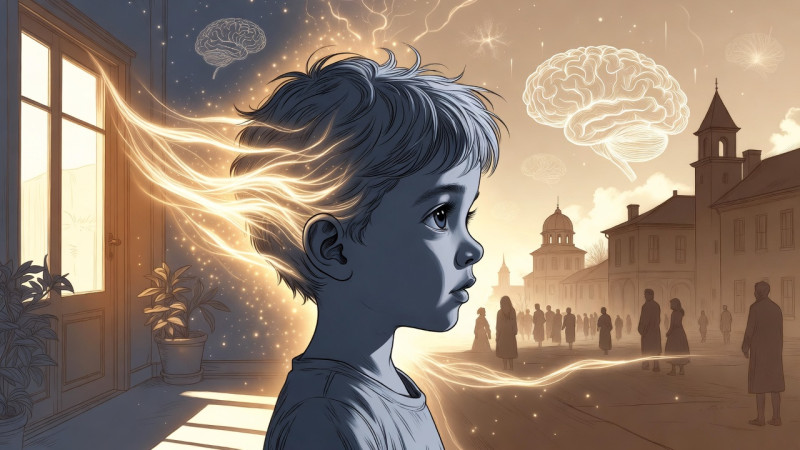
In quiet villages, busy cities, and ordinary homes around the world, a strange pattern has repeated itself for decades. A child begins talking about another life. They name places they have never visited, describe people long dead, and recount events that later turn out to be historically accurate. In some cases, the details are so precise that families and researchers are left shaken.
These are not isolated stories whispered in folklore. They are documented cases, studied, recorded, and debated by scientists for more than half a century. The question remains deeply unsettling:
Why do some people remember past lives with details that can be verified?
The Phenomenon of Past Life Memory
Reports of past life memories are most commonly found in children between the ages of two and seven. The memories often fade as the child grows older, which makes the early years crucial for documentation.
These recollections usually appear spontaneously. The child does not enter hypnosis, therapy, or guided meditation. They simply begin speaking.
Typical claims include:
-
A full name from another life
-
Specific locations, sometimes with directions
-
Occupations or social roles
-
Manner of death
-
Emotional attachments to people they have never met
What sets certain cases apart is verification. Investigators have sometimes confirmed that the described person existed and that the details match historical records.
The Most Studied Scientific Research
The most extensive research into this phenomenon began in the 1960s, led by psychiatrist Dr. Ian Stevenson at the University of Virginia. Over his career, Stevenson documented more than 2,500 cases across Asia, Europe, Africa, and North America.
His work did not attempt to prove reincarnation as belief. Instead, it focused on verifiable data: names, geography, family relations, and cause of death. In many cases, children accurately described details they could not have learned through normal means.
Later, the research was continued by Dr. Jim Tucker, who applied stricter controls, psychological screening, and cross-verification.
Despite decades of study, no single explanation has fully accounted for all cases.
Cryptomnesia: Forgotten Memories Resurfacing
One of the leading psychological explanations is cryptomnesia.
Cryptomnesia occurs when a person recalls information they were exposed to earlier in life but no longer remember learning. The brain stores the memory but loses the source. When it resurfaces, it feels original.
In theory, a child may overhear conversations, media, or stories and later repeat them, believing they are personal memories.
However, cryptomnesia struggles to explain cases where:
-
Information was obscure or unpublished
-
The family had no connection to the location
-
The child accurately described private or undocumented events
Genetic Memory and Inherited Experience
Another theory explores epigenetics, the idea that trauma and experiences can influence gene expression across generations.
Studies show that stress responses can be passed down biologically. This has raised speculation that fragments of memory-like information could travel genetically.
Yet there is a limit. Epigenetics can influence behavior and emotional responses, but it does not explain specific names, locations, or historical events recalled with clarity.
Brain Development and Identity Confusion
Neurologists point to early childhood brain development.
Young children have a less rigid sense of identity. The boundary between imagination, memory, and reality is still forming. This can lead to highly vivid internal narratives.
However, imagination alone does not account for cases where children correctly identify people, recognize locations they have never visited, or recall factual sequences later confirmed by records.
This is where skepticism often collides with data.
Cultural Influence and Expectation
Cultural context plays a role. Past life memories are reported more frequently in regions where reincarnation is socially accepted. Critics argue that belief systems may shape expression.
Yet verified cases have also appeared in cultures with no belief in reincarnation, including families who initially rejected the idea.
In many instances, parents actively discouraged the child from speaking about it.
The Role of Trauma and Sudden Death
A striking number of documented cases involve memories of violent or sudden death. Some children describe accidents, attacks, or wartime events with emotional intensity.
Researchers have noted that trauma appears to be a recurring theme.