.png)
.png)
.png)
.png)
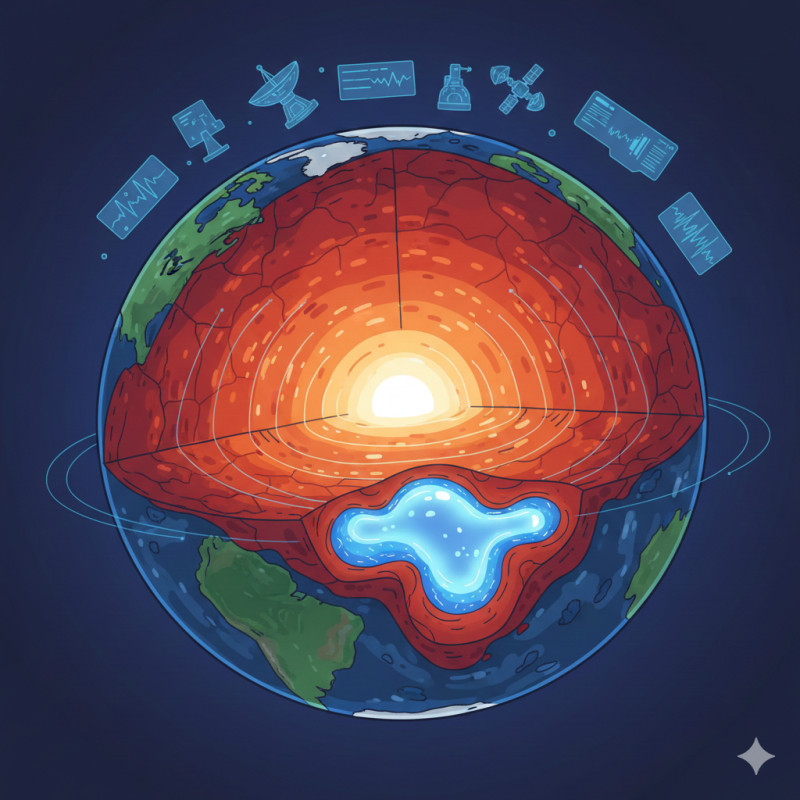
Deep beneath our feet, far below oceans, cities, and even the deepest mines ever built, Earth’s mantle has long been considered a hostile, predictable place. Crushed by immense pressure and scorched by extreme heat, it was thought to contain only solid rock slowly flowing over geological time.
But new scientific data suggests something unexpected — and frankly unsettling — is hiding there.
According to findings presented at a geophysics conference in October 2024, researchers analyzing seismic and electromagnetic signals have detected structures inside Earth’s mantle that do not behave like solid rock at all. The signals indicate the presence of large regions that conduct electricity unusually well, something that, by current geological understanding, should not exist at those depths.
The Discovery That Raised Red Flags
The anomaly first appeared during routine analysis of seismic waves generated by earthquakes recorded between 2022 and early 2024. When these waves passed through certain regions of the mantle, particularly beneath parts of the Pacific Ocean and southern Africa, they slowed, scattered, and behaved inconsistently.
At first, scientists assumed instrument error.
But when multiple independent datasets from observatories in Japan, Europe, and the United States showed the same pattern, concern turned into curiosity.
Then came the second shock: electromagnetic readings from deep-mantle probing experiments conducted in March 2024 revealed unexpectedly high electrical conductivity in the same regions.
Solid mantle rock does not do that.
What Exactly Shouldn’t Be There?
Based on current models, the mantle should be made mostly of solid silicate minerals, compressed so tightly that even liquids struggle to exist.
Yet the data suggests the presence of one — or more — of the following:
-
Vast pockets of partially molten material
-
Exotic high-pressure minerals never seen before
-
Water-rich zones trapped at extreme depths
-
Metallic compounds behaving like conductors
Any one of these would be surprising.
Together, they border on impossible.
One senior geophysicist involved in the analysis reportedly described the finding as “a violation of everything we teach about the mantle.”
Why Water Is the Most Disturbing Possibility
Among the theories, one stands out as the most controversial: ancient water reservoirs trapped hundreds of kilometers below Earth’s surface.
Not liquid oceans — that would be impossible — but water chemically bound inside minerals, released under immense pressure.
If confirmed, this would mean Earth may contain hidden water reserves deep in the mantle, possibly rivaling the volume of surface oceans.
The idea isn’t entirely new, but until now, evidence was thin. The October 2024 data makes it harder to dismiss.
Water dramatically increases electrical conductivity and alters seismic wave behavior — exactly what researchers are seeing.
A Challenge to Mantle Physics
The mantle isn’t supposed to behave this way.
Under temperatures exceeding 1,000°C and pressures millions of times higher than atmospheric levels, materials should be rigid, predictable, and stable.
Instead, the data suggests localized zones acting almost fluid-like, absorbing energy, bending seismic waves, and interacting with Earth’s magnetic field in ways that defy current equations.
This matters because mantle behavior drives:
-
Volcanic eruptions
-
Plate tectonics
-
Earthquakes
-
Long-term climate regulation
If our understanding of the mantle is flawed, so is our understanding of Earth itself.
When and Where This Was Detected
-
Primary data collection: 2022–2024
-
Key analysis period: January to September 2024
-
Findings presented: October 2024
-
Depth involved: Approximately 400–700 kilometers below Earth’s surface
These depths are well beyond direct sampling. Everything scientists know comes from indirect measurements — making the anomaly even more unsettling.
Could This Be Something Entirely Unknown?
Some researchers are pushing even further.
A minority view suggests the signals could indicate previously