.png)
.png)
.png)
.png)
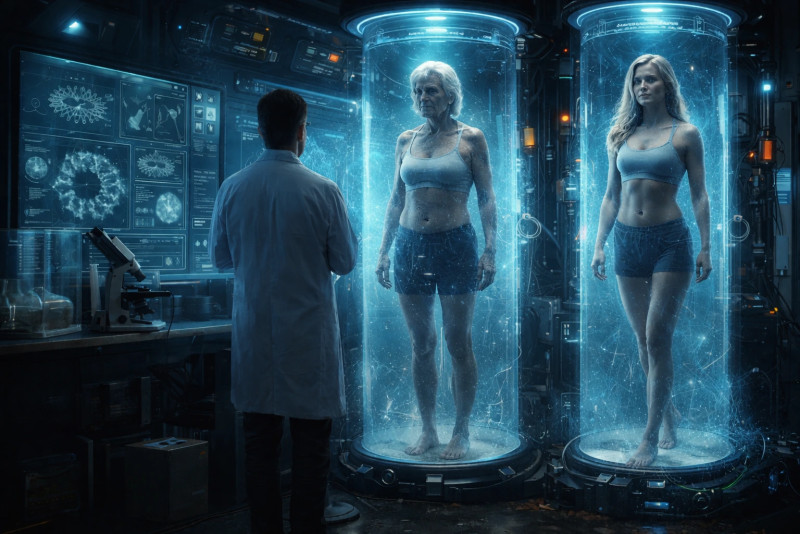
The End of "Getting Old": Could We Really Just Switch Off Aging?
Imagine waking up on your 80th birthday, but instead of the usual stiff joints and foggy memory, your body feels like it did when you were 25. No, this isn't the plot of a sci-fi movie or a "fountain of youth" myth. It is the very real, very serious science of cellular reprogramming.
Right now, in high-tech labs from Silicon Valley to Cambridge, scientists are working on a way to "reboot" our cells. They’ve discovered that aging isn't necessarily a one-way street; it’s more like a piece of software that has gathered too many bugs over time. And just like your computer, they think we can hit the reset button.

The Big Breakthrough: What is Cellular Reprogramming?
To understand this, we have to look at our DNA. Think of your DNA as a massive library of instruction manuals. When you’re young, the pages are clean, and the cell knows exactly how to read them. But as time passes, "gunk" builds up on the pages—this is what scientists call epigenetic changes. The cell gets confused, reads the wrong instructions, and starts to "age."
In 2006, a scientist named Shinya Yamanaka discovered something that shook the world. He found four specific proteins (now famously called Yamanaka Factors) that can take an old, specialized cell—like a skin cell—and turn it back into a "blank slate" stem cell.
It was like turning an old, grumpy adult back into a baby.

"Partial" Reprogramming: The Secret Sauce
While turning cells back into babies is cool, it’s not exactly what we want for a whole human. If you turned all your heart cells into stem cells, your heart would literally stop beating. It would lose its "identity."
The real magic happening in 2026 is Partial Reprogramming.
Instead of a full reset, scientists are giving cells a "quick refresh." They turn on those Yamanaka Factors just long enough to scrub away the epigenetic gunk—the "age"—without making the cell forget what its job is. A heart cell stays a heart cell, but it becomes a young heart cell.

The Current Frontier: 2026 and Beyond
We aren't just talking about mice anymore. As of early 2026, the first-ever human clinical trials for cellular reprogramming have officially kicked off.
-
Life Biosciences is leading the charge, using this tech to try and regrow the optic nerves in people with vision loss.
-
Altos Labs, backed by billions of dollars and some of the smartest minds on the planet, is mapping out how to apply this to the whole body.
Wait, is This Actually Safe?
This is the million-dollar question. The biggest risk with "resetting" cells is the risk of cancer. If you reset a cell too much, it can start dividing uncontrollably. That’s why the "partial" part of this science is so vital. Researchers are using "chemical switches"—like taking a specific antibiotic—to turn the rejuvenation process on and off with precision.
Important Note: While the results in animals have been nothing short of miraculous (think blind mice seeing again and old mice living 30% longer), we are still in the early stages of human testing. This isn't something you can buy at a pharmacy just yet.

Why This Matters for You
This isn't just about living to 150. It’s about Healthspan.
Most of us spend our final decades fighting off "the big four": heart disease, cancer, Alzheimer’s, and diabetes. Cellular reprogramming treats the root cause—aging itself—rather than just the symptoms. If we can keep our cells young, those diseases might never even show up.
The Future Outlook
By 2030, we might see the first "rejuvenation clinics" opening for specific issues like joint repair or vision restoration. The dream of a "fountain of youth" pill is still a ways off, but for the first time in human history, the "Aging Switch" is no longer a fantasy. It’s a work in progress.
Common Questions (FAQs)
- Does this mean I’ll live forever? Probably not. But it could mean living much longer with the body of a much younger person. The goal is to make 90 the new 40.
2. Can I get this treatment now?
No. Aside from a few highly controlled clinical trials, this technology is still in the laboratory and testing phase. Avoid any "anti-aging" clinics claiming to offer cellular reprogramming today—they likely aren't the real deal.
3. Will it be expensive?
Initially, yes. Like all new medical tech (think MRIs or gene therapy), it will likely start out very pricey. However, as the tech scales, the hope is to make it a standard part of preventative medicine.
4. Is this the same as stem cell therapy?
Not exactly. Traditional stem cell therapy involves injecting new cells. Cellular reprogramming is about rejuvenating the cells you already have.

Source Proofs & References:
-
Life Biosciences: First Human Cellular Reprogramming Trial (Feb 2026) - lifespan.io
-
EPFL Study: Partial Reprogramming Restores Memory (Feb 2026) - news-medical.net
-
The Science of Yamanaka Factors - NobelPrize.org
Disclaimer: This article is for informational purposes only and does not constitute medical advice. Cellular reprogramming is an experimental field of biotechnology. Always consult with a healthcare professional regarding age-related health concerns.