.png)
.png)
.png)
.png)
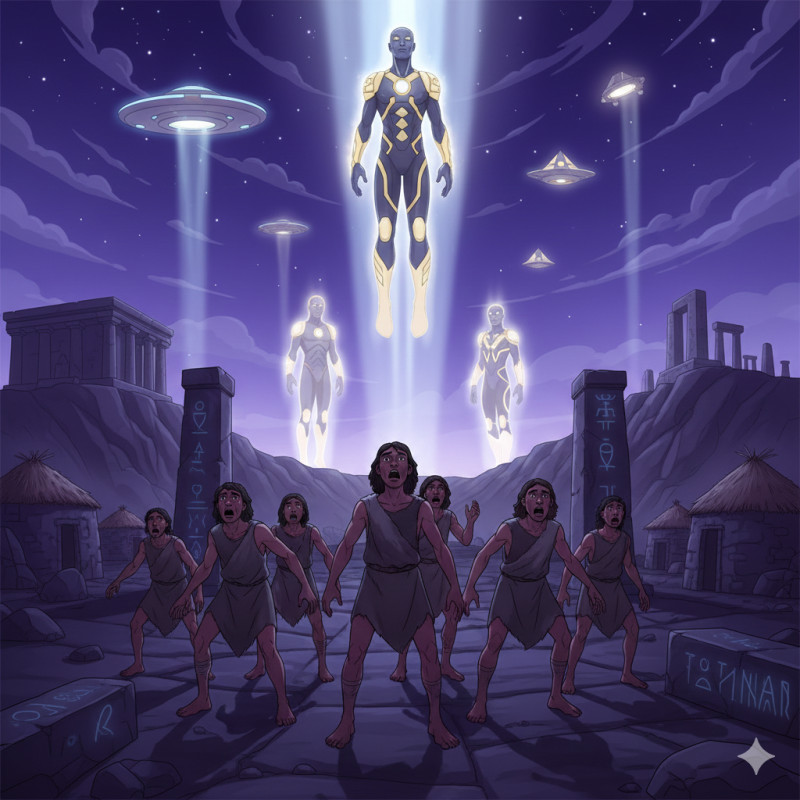
Across civilizations separated by oceans and centuries, humans described their gods in remarkably similar ways. They came from the sky. They possessed weapons of light and fire. They controlled weather, disease, and death. They demanded obedience and offered protection in return.
For thousands of years, these stories were treated as faith. In recent decades, however, a growing number of scientists, historians, and researchers have asked a provocative question: what if ancient gods were not divine at all, but advanced beings from elsewhere in the universe?
It is a theory that sounds outrageous at first — until the evidence is examined closely.
The Strangest Pattern in Human History
Ancient civilizations had no contact with each other, yet their depictions of gods share striking similarities. Stone carvings from South America, texts from Mesopotamia, and records from ancient Egypt describe beings who descended from the sky in glowing vehicles, taught humans advanced knowledge, and vanished just as suddenly.
In Sumerian records dating back to around 3000 BCE, gods known as the Anunnaki were said to have come from the heavens to shape humanity. In ancient Indian texts written between 1500–500 BCE, flying machines called vimanas are described in battle scenes that resemble aerial warfare.
These accounts are not symbolic poetry alone. They often include technical details — materials, sounds, flight paths — that feel oddly specific for mythology.
Technology Misunderstood as Divinity
If a technologically advanced civilization encountered early humans, the reaction would be predictable. Any being capable of flight, energy weapons, or genetic manipulation would appear supernatural.
A modern human visiting the Stone Age with a drone and a flashlight could easily be worshipped as a god. Scale that technology thousands or millions of years ahead, and the gap becomes incomprehensible.
This idea aligns with what physicist Arthur C. Clarke famously stated in the mid-20th century: any sufficiently advanced technology is indistinguishable from magic.
To ancient observers, alien technology would not be science. It would be divinity.
The Genetic Mystery of Humanity
One of the most controversial aspects of this theory involves human origins. Genetic studies show that modern humans appeared relatively suddenly around 300,000 years ago, with a level of cognitive ability that advanced rapidly compared to earlier hominins.
Some researchers speculate that external intervention may have accelerated human development. Ancient texts often describe gods “creating” humans or altering them for specific purposes — labor, worship, or companionship.
While mainstream science attributes this to natural evolution, unanswered gaps remain. Why did symbolic thinking, language, and culture explode so quickly? Why do myths from unrelated cultures describe creation through modification rather than gradual development?
The alien hypothesis does not replace evolution — it questions whether evolution alone tells the full story.
Weapons That Sound Uncomfortably Familiar
Descriptions of divine weapons in ancient texts raise eyebrows among modern readers.
In the Mahabharata, a weapon is described that emits a blinding light, causes victims’ hair and nails to fall out, and poisons land for years. In ancient texts from the Middle East, cities are destroyed by fire from the sky, leaving nothing alive.
These descriptions closely resemble radiation exposure and nuclear aftermaths — concepts unknown to ancient civilizations.
Skeptics argue these are metaphors. Others ask why metaphors would include effects that match modern physics so precisely.
Gods Who Needed Worship
One recurring theme across religions is that gods demand worship, obedience, and offerings. If these beings were truly omnipotent creators of the universe, why would they require constant validation?
Some theorists suggest worship may not have been spiritual at all. It could have been a social control system, designed to maintain authority over early humans. Rituals, laws, and moral codes could have been tools to stabilize civilizations under external supervision.
Interestingly, many ancient gods eventually “left,” promising to return one day. This motif appears in cultures worldwide.
Where Did They Go?
Most ancient gods disappear abruptly from historical records. They ascend back to the heavens, retreat behind veils, or vanish after catastrophic events.
By around 500 BCE, direct divine interaction fades, replaced by prophets, intermediaries, and abstract belief systems. Some researchers suggest this marks the end of an intervention phase — or the realization that humanity was no longer manageable.
The silence that followed is as puzzling as the arrival.
Modern Science Is Quietly Reopening the Question
In the last decade, serious scientific institutions have begun studying unexplained aerial phenomena without ridicule. Governments have acknowledged objects performing maneuvers beyond known human technology.
While no official body claims these are gods or aliens, the door is no longer closed.
If advanced non-human intelligence exists — and the vastness of the universe makes that statistically likely — then ancient encounters become a possibility worth examining, not dismissing.
A Theory, Not a Verdict
The idea that gods were aliens does not disprove faith, nor does it confirm extraterrestrial visitation. It challenges humanity to look at ancient history with fresh eyes and modern tools.
What ancient people called gods may have been misunderstood visitors. Or they may have been symboli