



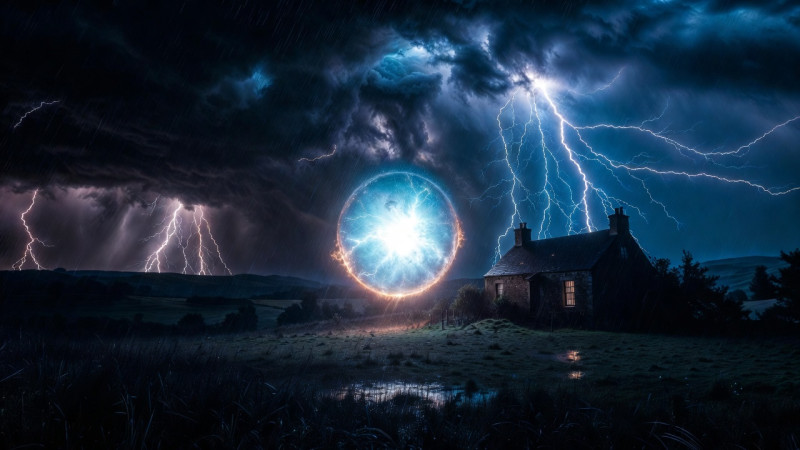
Why can’t science explain ball lightning?
If normal lightning is nature’s loudest light switch, ball lightning is the glitch that makes people swear the sky is playing tricks.
Witnesses describe it as a bright orb—white, orange, blue, even purple—floating calmly through chaos. It might hover near the ground, roll across a room, slip past a window, or vanish like it was never there. Some accounts say it pops with a bang. Others say it fades out silently. And here’s the part that drives researchers crazy: the stories are consistent enough to take seriously, but rare enough to be hard to measure.
Ball lightning has been reported for centuries, yet it still sits in the uncomfortable space between “real but elusive” and “hard to reproduce.” Even modern physics has a problem with a glowing sphere that can last seconds, move oddly, and sometimes appear indoors.
The evidence is real—but it’s scattered
One of the earliest famous reports comes from Widecombe-in-the-Moor, England, where a violent storm struck a packed church on Sunday, 21 October 1638. Eyewitness accounts describe a “ball of fire” tearing through the building, killing several people and injuring many others. The event is often cited as a historic ball-lightning case because it was documented and remembered in detail. Source: The Great Thunderstorm (Widecombe) https://en.wikipedia.org/wiki/The_Great_Thunderstorm Wikipedia
Fast-forward to the jet age, and the mystery doesn’t go away—it follows people into metal aircraft.
A widely discussed scientific account came from radio astronomer R. C. Jennison, who described a glowing sphere inside a passenger plane during a storm. The incident occurred shortly after midnight—00:05 (EST), 19 March 1963, during an Eastern Airlines night flight. Jennison later reported it in Nature (1969), and historians of atmospheric science still reference it because it reads like a careful observation, not a tall tale. Sources: ADS abstract / historical review https://ui.adsabs.harvard.edu/abs/1969Natur.224..895J/abstract and https://hgss.copernicus.org/articles/12/43/2021/ Astrophysics Data System+1
So yes—there are credible reports across centuries, including trained observers. But here’s the problem: a report isn’t a lab measurement.
The core issue: it’s too rare to catch properly
Scientists love repeatability. Ball lightning refuses to cooperate.
Most sightings happen in storms, often unexpectedly, and usually end within seconds. Even if you have a camera, you might not have the right sensors: spectroscopy, electromagnetic readings, high-speed video, distance calibration, and environmental measurements at the exact location.
That’s why the field has long relied on eyewitness descriptions—useful, but messy. A standard overview notes how wildly reports vary in size, color, motion, and whether the phenomenon seems dangerous or harmless. Source: https://en.wikipedia.org/wiki/Ball_lightning Wikipedia
When we did catch it on instruments, the results raised new questions
A major breakthrough came from researchers in China who accidentally recorded a ball-lightning event while running lightning spectroscopy observations on the Qinghai Plateau in the summer of 2012. Their paper, published 17 January 2014 in Physical Review Letters, reported optical and spectral data and found signatures consistent with soil elements (such as silicon, iron, and calcium) appearing in the light. Source (paper details and abstract text): 0 views