.png)
.png)
.png)
.png)
Rendlesham Forest Incident (1980): The Case That Earned the Name “Britain’s Roswell”
On a cold stretch of nights in late December 1980, a quiet forest in Suffolk, England became the setting for one of the most famous military-linked UFO reports ever recorded in the UK. The story didn’t grow from a tabloid headline first—it spread because U.S. Air Force personnel stationed at RAF Woodbridge/RAF Bentwaters said they witnessed something they couldn’t explain, and one senior officer later put key details into an official memo.
That combination—trained witnesses, a military setting, and paperwork that surfaced through official channels—is exactly why the Rendlesham Forest Incident still gets called “Britain’s Roswell.” National Archives+2NICAP+2
Where it happened, and why the location matters
Rendlesham Forest sits between what were then two major Cold War-era bases: RAF Woodbridge and RAF Bentwaters, used by the United States Air Force at the time. The first reports came from near the East Gate area, where security patrols had a clear line toward the trees—and toward distant coastal lights that later became part of the debate. Wikipedia+1
Because this was a controlled military environment, the incident is often framed differently from civilian sightings. Supporters argue it adds credibility. Skeptics argue it also adds more routine explanations—lighthouses, stars, and misread distances—because even trained people can be fooled at night in unfamiliar terrain.
The first night: early hours of December 26, 1980
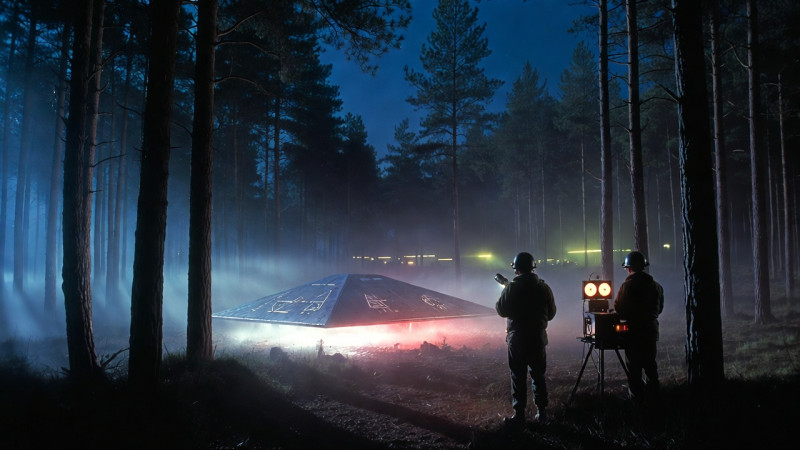
The most-cited timeline begins around 03:00 (3:00 a.m.) GMT on December 26, 1980, when a security patrol reported unusual lights that appeared to descend into the forest. In later summaries, the patrol described approaching a glowing object with colored lights and a metallic appearance. Wikipedia+1
A key point in how this case became legend is the repeated claim of a “landed craft” and strange markings or symbols. Those details appear strongly in later retellings, while researchers who dug into early statements argue the earliest accounts are more cautious and sometimes point toward distant lights and confusion about what was being chased. Ian Ridpath+1
Not long after, local police were contacted. In the police-related discussion that later emerged, one recurring explanation is that the most consistent light source in that direction could have been the Orford Ness lighthouse—visible from the area and capable of producing a rhythmic flash that, at a distance, can feel strangely “alive.”