.png)
.png)
.png)
.png)
Why Does Vacuum Space Produce Energy From Nothing?
Space looks like the ultimate blank canvas. No air. No sound. No visible matter. So when physicists say “the vacuum has energy,” it sounds like a loophole in reality—like the universe is handing out free power.
But here’s the twist: modern physics doesn’t treat vacuum space as nothing. It treats it as a stage filled with quantum fields, even when there are no particles around. And those fields don’t sit perfectly still.
That restlessness is the heart of the mystery—and it’s also why vacuum “energy from nothing” is one of the most misunderstood ideas in science.
The vacuum isn’t empty in quantum physics
In quantum field theory, the basic ingredients of nature are fields spread everywhere: the electromagnetic field, electron field, quark fields, and so on. A “particle” is like a ripple or excitation in a field.
Even when there are no ripples—when the field is in its lowest possible state—it still carries residual energy, often called zero-point energy. That idea isn’t a motivational quote; it’s a hard consequence of quantum rules that prevent a system from having perfectly exact values of certain properties simultaneously. Encyclopedia Britannica
So the vacuum is better imagined as quiet, not absent—like a calm ocean that still has tiny, unavoidable tremors.
If vacuum energy is real, why can’t we power cities with it?
This is where the “from nothing” part collapses.
In physics, you don’t get usable energy just because energy exists. To extract energy, you need a difference—a gradient, a temperature change, a pressure difference, a boundary condition, something you can tap like water flowing downhill.
Vacuum energy, in many contexts, acts like a baseline. A baseline doesn’t run your generator unless you can compare it to something lower. That’s why most “free energy from the vacuum” claims crash into the wall of thermodynamics.
What physicists can do is reveal vacuum effects when the vacuum is constrained or viewed in unusual conditions.
Exhibit A: The Casimir effect (predicted 1948)
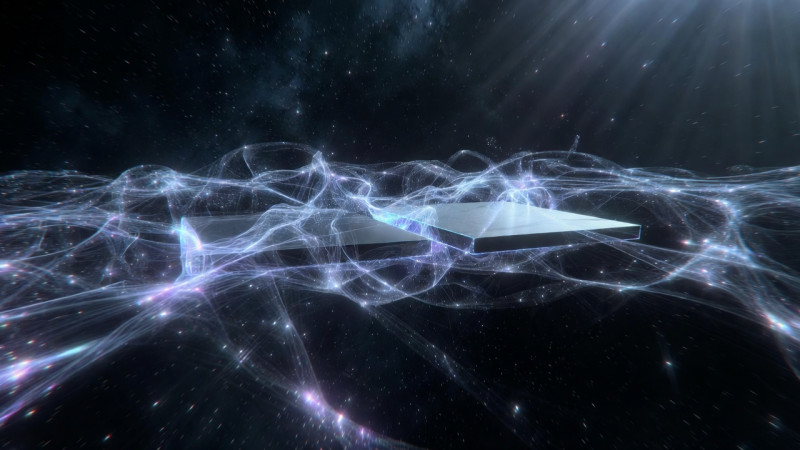
One of the cleanest “vacuum energy shows itself” demonstrations is the Casimir effect: put two uncharged conducting plates extremely close together in a vacuum, and they attract. Not because of static electricity—but because the allowed vacuum fluctuations between the plates differ from those outside.
Hendrik B. G. Casimir published this prediction in 1948, and the paper was communicated at the meeting of May 29, 1948. DWC
What’s thrilling here is not that the vacuum creates infinite power. It’s that the vacuum’s background “jitter” can push on matter in a measurable way when geometry forces the quantum fields to behave differently.
If you try to build a machine from it, you’ll find the catch: when the plates move together and you “gain” energy, you must spend energy to separate them again. The bookkeeping balances.
Exhibit B: The Lamb shift (measured 1947)
Vacuum effects don’t just tug on metal plates—they also nudge atoms.
In 1947, Willis Lamb and Robert Retherford measured a tiny shift in hydrogen’s energy levels, now called the Lamb shift. Their work was discussed at the Shelter Island Conference on June 1–3, 1947, and it became a landmark moment in quantum electrodynamics. APS Link+1
What causes the shift? In simplified terms: the electron in a hydrogen atom isn’t floating in a perfectly calm vacuum. The quantized electromagnetic field has zero-point fluctuations, and that changes the atom’s energy levels sli