.png)
.png)
.png)
.png)
By Ronald Kapper
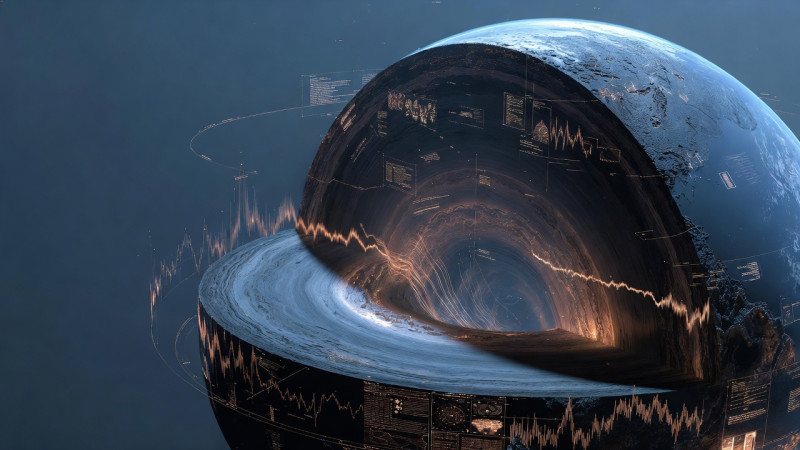
For decades, Earth scientists believed the planet’s interior followed slow, predictable rhythms. Tectonic plates crept. Magma shifted. Seismic noise came and went. But hidden deep beneath our feet, researchers have been tracking something strange—a repeating signal from deep inside the Earth that appears to be getting stronger.
It is not an earthquake. It is not volcanic activity. And it is not caused by human industry. Yet it shows up with remarkable regularity in seismic data recorded across continents.
The mystery has been quietly debated in scientific circles for years. Now, with improved instruments and long-term datasets, researchers say the phenomenon can no longer be ignored.

A Pulse That Shouldn’t Exist
The signal first drew attention in the early 2000s, when seismologists noticed a faint but persistent tremor repeating roughly every 26 seconds. It appeared on seismographs around the world, often synchronized across multiple stations.
Unlike earthquakes, which release sudden bursts of energy, this signal behaved more like a heartbeat—steady, rhythmic, and strangely consistent.
Seismic networks operated by organizations such as United States Geological Survey and IRIS confirmed that the pulse originated far below Earth’s surface, likely within the upper mantle or near the core–mantle boundary.
What puzzled researchers most was its persistence. Earthquakes stop. Storms pass. But this signal kept coming back—day after day, year after year.
Why Scientists Are Paying Attention Now
For a long time, the signal was considered a curiosity rather than a concern. But recent analyses suggest its strength and clarity have increased in modern datasets compared to older records.
Researchers studying long-term seismic archives have noticed:
-
Improved coherence across distant seismograph stations
-
Slight increases in amplitude during certain years
-
Greater detectability even in noisy environments
These changes do not necessarily mean Earth is becoming more dangerous. But they do suggest the process behind the signal may be evolving, not static.
That evolution is what has scientists paying closer attention.

Possible Explanations — None Fully Satisfying
Several hypotheses have been proposed, each grounded in real geophysics, yet none offering a complete answer.
Deep Ocean Interaction
Some scientists believe the pulse may be linked to ocean waves interacting with the seafloor. As massive wave systems collide and reinforce each other, they could transmit rhythmic vibrations downward into Earth’s crust.
However, this theory struggles to explain why the signal appears so stable even when ocean conditions change.
Magma Movement Beneath the Crust
Another explanation involves slow magma circulation deep beneath tectonic plates. If magma channels open and close rhythmically, they could generate repeating seismic signatures.
But magma systems are usually chaotic. A clock-like rhythm is unexpected.
Earth’s Core Dynamics
Recent studies suggest Earth’s inner core may rotate at slightly different speeds than the mantle. Subtle shifts in this rotation could create mechanical oscillations detectable at the surface.
This idea is supported by research published in journals like Nature Geoscience, yet the timescale and consistency of the pulse remain difficult to model.

The Role of Better Technology
One reason the phenomenon seems “stronger” may be simple: we are listening better.
Over the past 20 years, global seismic monitoring has improved dramatically. Digital sensors are more sensitive. Data-sharing between countries is faster. Artificial intelligence now helps detect patterns that humans once missed.
But even when researchers adjust for these improvements, the signal’s persistence stands out.
It has survived instrument upgrades, station relocations, and changes in data-processing methods. That consistency suggests the source is real—and deeply rooted.
Not a Warning, But a Question
Importantly, scientists are careful not to frame this as a sign of impending disaster. There is no evidence linking the signal to earthquakes, volcanic eruptions, or tectonic instability.
Instead, researchers describe it as a reminder of how little we truly understand about Earth’s interior.
More than 95 percent of Earth’s volume lies beneath th