.png)
.png)
.png)
.png)
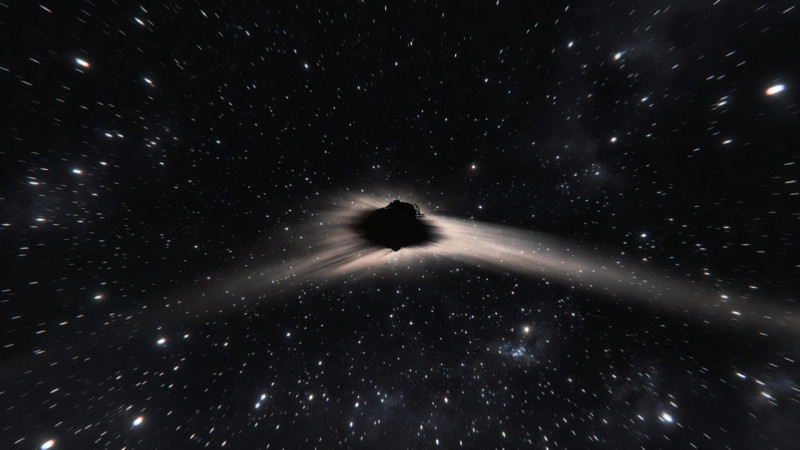
Astronomers are tracking an object moving through space in a way that defies expectations — and possibly challenges long-standing assumptions about how the universe works.
The object does not follow the orderly paths typical of planets, asteroids, or comets. It appears to be passing through a region of space rather than orbiting within it, moving at a speed and on a trajectory that scientists say is extremely unusual. While researchers are cautious about drawing conclusions, many agree on one thing: this object does not behave the way known cosmic bodies should.
The discovery has reignited debates about interstellar visitors, unseen cosmic populations, and whether our models of space are missing something fundamental.

A Motion That Raised Red Flags
Most objects detected by telescopes fall neatly into categories. They orbit stars, circle galaxies, or travel predictable paths shaped by gravity. This object does none of that.
Its movement suggests it originated outside the local region of space and is merely passing through — a rare event. Even more puzzling, its speed appears too high to be easily explained by gravitational interactions alone.
According to astronomers analyzing the data, the object’s trajectory does not match debris ejected from nearby star systems, nor does it behave like known rogue planets.
“This is not something we see often,” one researcher involved in the observations noted. “Its motion is… unexpected.”
How Scientists Detected It
The object was first flagged during a deep-sky survey designed to track faint and fast-moving bodies. Advanced telescopes continuously scan the sky, comparing images taken hours or days apart to identify motion.
Follow-up observations were conducted using instruments operated by organizations such as NASA, along with international observatories and space-based sensors. What they found confirmed that the object was real — and genuinely strange.
Its brightness fluctuates inconsistently, suggesting an irregular shape or unusual surface properties. Unlike comets, it shows no clear gas or dust tail. Unlike asteroids, it does not rotate or reflect light in a predictable pattern.

Why It “Shouldn’t” Exist — At Least According to Models
Current models of planetary formation and stellar systems predict that most debris remains gravitationally bound. Objects wandering freely between stars should be exceedingly rare.
Yet in recent years, astronomers have detected more candidates for interstellar objects than expected. Each new detection raises an uncomfortable question: are these objects rare anomalies — or evidence of a much larger, unseen population?
If such objects are common, it could mean that star systems eject far more material than scientists once believed, or that the galaxy is filled with remnants from processes we do not yet fully understand.
Not the First Time — But Still Unusual
This is not the first time astronomers have encountered a visitor from beyond our stellar neighborhood. Earlier detections sparked intense debate, with scientists arguing over whether those objects were comets, asteroids, or something entirely new.
What makes this latest object stand out is how little it resembles previous examples. Its motion, reflectivity, and lack of outgassing place it in a gray zone between established categories.
Some researchers suggest it may represent a class of objects that has gone largely unnoticed simply because our instruments were not sensitive enough until now.
Could It Be Natural? Most Likely — But With Caveats
Scientists stress that extraordinary claims require extraordinary evidence. There is no indication this object is artificial or technological in origin. Natural explanations remain the most likely — but they are not yet fully satisfying.
Possibilities include:
-
A fragment from a disrupted star system
-
An unusually dense, non-volatile body
-
A relic formed under conditions no longer common in the galaxy
Each explanation has gaps. None neatly account for all observed properties.
That uncertainty is what makes the discovery scientifically valuable.

What This Could Mean for Astronomy
If objects like this are more common than previously thought, it could reshape our understanding of how matter moves through the galaxy.
Interstellar objects may act as messengers, carrying information about distant star systems, planetary formation, and even the chemical makeup of regions we cannot directly observe.
Some researchers have suggested that future missions could attempt to intercept such objects, allowing scientists to study truly alien material up close — something that has never been done before.
The Role of New Telescopes
Next-generation observatories, including the