The Day Humans Finally Reach Mars Won’t Be the Hardest Part
When most people imagine the first crewed mission to Mars, they picture the launch.
Towering rockets. Deafening engines. A spacecraft leaving Earth behind forever.
It makes sense. Reaching another planet sounds like the ultimate technological challenge.
But ask many scientists, physicians, and spaceflight experts what worries them most about a Mars mission, and you’ll often hear a different answer.
Getting astronauts to Mars may not be the hardest part.
Keeping them physically healthy, mentally stable, and alive after they get there could be far more difficult.
For decades, space agencies have focused on solving the engineering problems of deep-space travel. Rockets are becoming more powerful. Spacecraft designs continue to improve. Life-support technologies grow more sophisticated each year.
Yet Mars remains uniquely unforgiving.
The planet sits, on average, about 225 million kilometers from Earth. Communication delays can stretch beyond 20 minutes one way. Rescue missions are effectively impossible. Medical emergencies become life-threatening in ways they never would aboard the International Space Station.
And then there are the invisible dangers.
Radiation. Isolation. Psychological strain. Reduced gravity. Resource scarcity.
These are the challenges that could ultimately determine whether humanity becomes a multi-planet species—or discovers that Mars is far harder to inhabit than we imagined.
The Radiation Problem Nobody Can Ignore
Earth protects us in ways most people rarely think about.
A powerful magnetic field deflects many charged particles streaming through space. The atmosphere absorbs dangerous radiation before it reaches the ground.
Mars offers far less protection.
Its atmosphere is roughly 100 times thinner than Earth’s, and it lacks a global magnetic field comparable to our own.
That means astronauts traveling to and living on Mars would face significantly higher radiation exposure.
This isn’t merely a technical inconvenience.
Radiation can damage DNA, increase cancer risk, affect the cardiovascular system, and potentially impact cognitive function.
According to NASA research, astronauts on long-duration missions beyond Earth’s protective magnetosphere could accumulate radiation doses far higher than those experienced in low Earth orbit.
The challenge becomes even more complicated because scientists are still studying the long-term effects of deep-space radiation exposure.
Most human radiation data comes from Earth-based environments or shorter-duration space missions.
A Mars expedition would expose astronauts to conditions humanity has never experienced before.
Solar Storms Could Become Life-Threatening
One particular concern is solar particle events.
The Sun occasionally releases enormous bursts of energetic particles that can flood space with radiation.
On Earth, our magnetic field shields us from much of this activity.
On Mars, astronauts would have far fewer defenses.
Future habitats may require heavily shielded emergency shelters where crews can retreat during major solar storms.
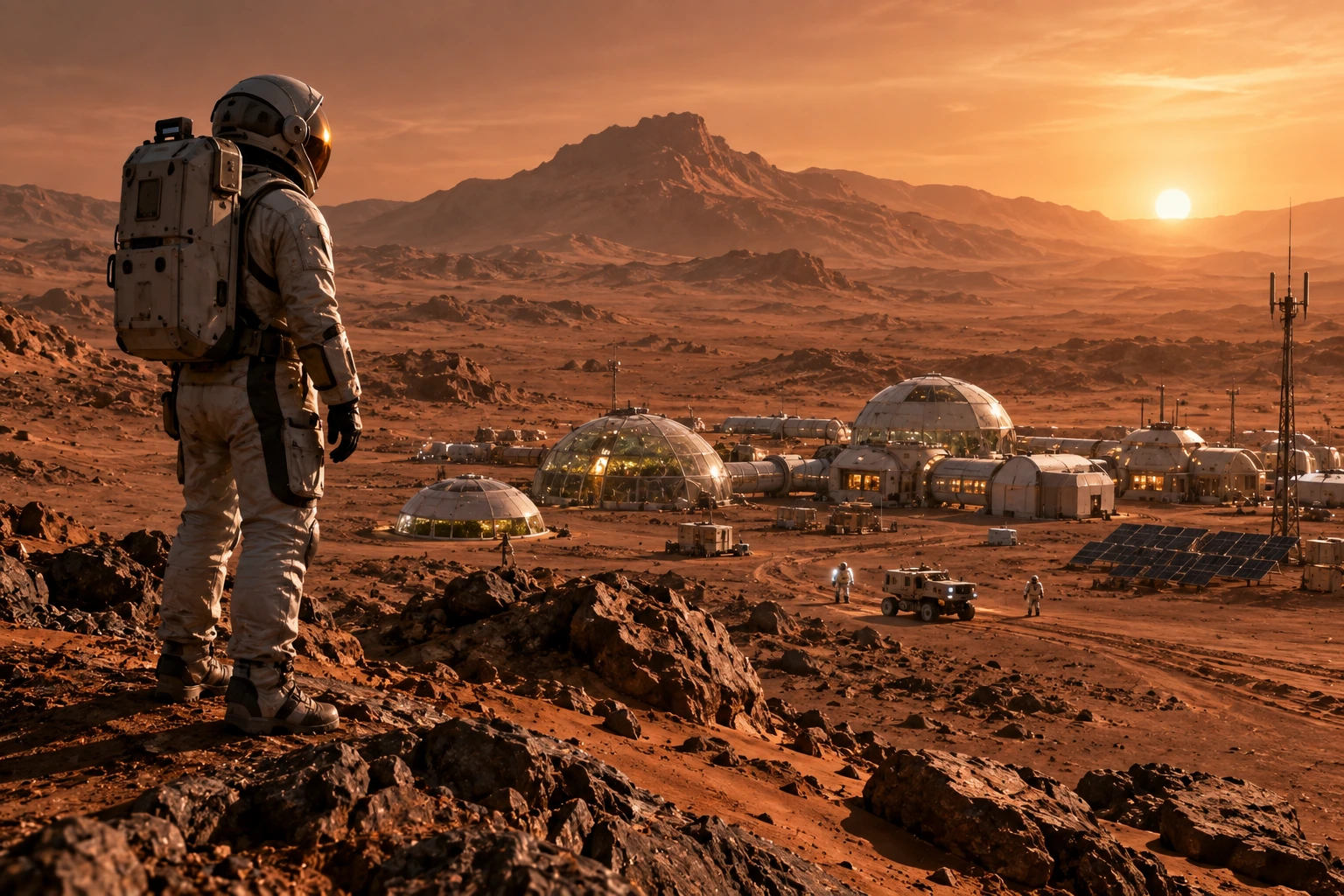
Some proposed Mars bases even envision burying habitats beneath several meters of Martian soil to reduce radiation exposure.
Ironically, future astronauts might spend much of their time living underground on an entirely new planet.
The Isolation Challenge Could Be Unlike Anything Humans Have Experienced
Humans are social creatures.
Our brains evolved in communities.
Even people who enjoy solitude generally know that family, friends, and society remain nearby.
Mars changes that equation completely.
Imagine knowing that every person you’ve ever loved is tens of millions of kilometers away.
No emergency flight home.
No quick evacuation.
No spontaneous reunion.
No possibility of immediate rescue.
For the first Mars crews, Earth will become a distant point of light in the sky.
Psychologists have spent years studying how prolonged isolation affects human behavior because they recognize this may become one of the defining challenges of interplanetary exploration.
The issue isn’t simply loneliness.
Isolation affects decision-making, emotional regulation, motivation, sleep quality, and group dynamics.
Over time, even small interpersonal conflicts can grow into major problems when there is no escape from the environment.
Communication Delays Change Everything
On the International Space Station, astronauts can communicate with mission control almost instantly.
Mars eliminates that luxury.
Depending on planetary positions, radio signals may take between 4 and 24 minutes to travel one way.
A conversation can require nearly an hour for a simple exchange.
Imagine facing a technical crisis and waiting 40 minutes for a response.
Imagine receiving news about family emergencies back on Earth and being unable to have a real-time conversation.
Future Mars crews will need to become far more autonomous than any astronauts before them.
They won’t just be explorers.
They’ll effectively become their own mission control.
That psychological burden could be enormous.
What Happens When Six People Can’t Leave?
Most discussions about Mars focus on technology.
Psychologists often focus on people.
Because history suggests humans themselves may become one of the biggest variables.
Picture a small crew of six astronauts living together for years.
The habitat is confined.
The environment outside is lethal.
Privacy is limited.
Stress is constant.
Every disagreement carries consequences.
Researchers studying Antarctic stations, submarine crews, and long-duration isolation experiments have repeatedly observed similar patterns:
- Mood fluctuations
- Social tensions
- Fatigue
- Reduced motivation
- Sleep disturbances
- Interpersonal conflict
These effects occur on Earth, where rescue remains possible.
Mars raises the stakes dramatically.
The success of future missions may depend as much on crew selection and psychological resilience as on engineering excellence.
The Mental Health Question
One of the most fascinating questions surrounding Mars exploration involves mental health.
How does the human brain respond to knowing it is living on another world?
No one truly knows.
Future astronauts will experience situations no human has ever encountered.
They may witness Earth appearing as a tiny star-like object.
They may spend years without feeling rain, wind, oceans, forests, or natural ecosystems.
Many psychologists believe humans derive subtle psychological benefits from nature.
Trees, birds, rivers, changing weather, and open landscapes provide sensory experiences deeply woven into our evolutionary history.
Mars offers none of these.
The landscape is breathtaking—but also barren.
For months at a time, astronauts may see little besides dust, rocks, machinery, and habitat walls.
Researchers are already exploring ways to counter these effects through virtual reality systems, indoor gardens, and habitat designs that prioritize mental well-being.
Reduced Gravity Creates Long-Term Health Risks
Mars gravity is only about 38% of Earth’s.
That sounds better than weightlessness, but it remains largely uncharted territory.
Scientists know prolonged exposure to microgravity causes:
- Muscle loss
- Bone density reduction
- Cardiovascular changes
- Vision problems
- Balance issues
What they don’t know is how the human body responds to years in partial gravity.
Mars sits between Earth and the zero-gravity environment of orbit.
Will astronauts remain healthy?
Will children born on Mars develop normally?
Could long-term residents eventually struggle to return to Earth?
These questions remain unanswered.
The first Mars settlers may become participants in one of the largest biological experiments in human history.
Medical Emergencies Become Entirely Different
On Earth, serious medical emergencies trigger a rapid response.
Ambulances arrive.
Hospitals provide specialized care.
Experts can be consulted instantly.
Mars changes every assumption.
Future astronauts will need advanced medical training because professional help may not exist.
A surgical emergency could become a mission-threatening event.
Equipment failures could have life-or-death consequences.
Even relatively routine illnesses become more dangerous when resources are limited and evacuation is impossible.
Future Mars crews may rely heavily on artificial intelligence-assisted diagnostics and advanced autonomous medical systems.
Yet even those technologies have limits.
The reality remains sobering.
A condition considered manageable on Earth could become fatal on Mars.
Survival Depends on Systems That Cannot Fail
Life on Earth benefits from countless natural systems.
We breathe freely.
Water cycles continuously.
Food grows across vast ecosystems.
Mars offers none of those advantages.
Everything needed for survival must be created artificially.
Air.
Water.
Food.
Heat.
Power.
Waste recycling.
A Mars habitat essentially functions as a miniature Earth enclosed inside machinery.
The challenge is maintaining those systems for years.
A small failure can cascade into a larger crisis.
A damaged oxygen generator.
A contaminated water supply.
A power system malfunction.
Each problem becomes exponentially more serious when replacement parts and emergency assistance are millions of kilometers away.
The first Mars habitats must achieve levels of reliability beyond anything humans have previously built.
Food May Become a Psychological Lifeline
Food isn’t merely nutrition.
It’s culture.
Comfort.
Routine.
Connection.
Many isolation studies reveal that meals play a surprisingly important role in psychological well-being.
Future Mars missions will likely depend heavily on locally grown crops.
Scientists are investigating methods for cultivating plants inside controlled habitats using hydroponics and other advanced agricultural systems.
Fresh vegetables could provide more than vitamins.
They may help maintain morale.
Astronauts repeatedly describe the emotional benefits of tending plants in space.
A greenhouse on Mars might become one of the most important rooms in an entire settlement.
Dust Could Become an Unexpected Enemy
Mars is famous for its dust.
At first glance, it seems harmless.
In reality, Martian dust presents numerous challenges.
The particles are extremely fine.
They cling to equipment.
They infiltrate machinery.
They can damage seals and moving components.
Some researchers worry about potential health effects if dust enters living spaces.
Mars also experiences massive dust storms capable of enveloping large regions of the planet.
Future settlers may spend considerable effort simply managing dust contamination.
It’s one of those practical challenges that receives less attention than rockets but may affect daily life constantly.
Why NASA Keeps Pushing Forward
Given all these obstacles, a reasonable question emerges.
Why go at all?
NASA and other space agencies argue that Mars represents the next major step in human exploration.
The technologies developed for Mars could improve life on Earth.
Closed-loop recycling systems, advanced medicine, sustainable agriculture, and autonomous infrastructure all have applications far beyond spaceflight.
Mars also offers a unique scientific opportunity.
Ancient riverbeds, mineral deposits, and geological evidence suggest the planet once possessed a much warmer and wetter environment.
Studying Mars may reveal whether life ever existed beyond Earth.
The discovery of even ancient microbial life would fundamentally change humanity’s understanding of its place in the universe.
The Real Test of Human Civilization
The popular image of Mars exploration often centers on machines.
Giant rockets.
Landing systems.
Robotic construction equipment.
Advanced habitats.
Those technologies matter.
But the deeper challenge may be human.
Can people remain psychologically healthy while living years away from Earth?
Can crews maintain trust under extreme stress?
Can communities thrive in one of the most hostile environments known?
Can humans adapt to becoming residents of another world?
These questions cannot be answered by simulations alone.
Eventually, someone will have to go.
Mars Is a Human Challenge, Not Just an Engineering Challenge
History tends to celebrate the moment explorers arrive.
The first step onto a new continent.
The first summit reached.
The first footprint on the Moon.
If humans land on Mars, headlines around the world will focus on that historic achievement.
Yet the landing may prove to be only the beginning.
The true test starts afterward.
It begins when astronauts wake up on a world where the air cannot be breathed, the soil cannot easily grow food, radiation constantly threatens their health, and Earth exists only as a distant blue dot in the sky.
The future of Mars exploration will not depend solely on rockets powerful enough to make the trip.
It will depend on whether humans can endure the psychological, biological, and environmental realities of living there.
The journey to Mars is an engineering problem.
Living on Mars is a human one.
And that may be the hardest challenge our species has ever attempted to solve.