Imagine waking up tomorrow morning and discovering that Earth has stopped spinning.
Not slowed down. Not gradually losing speed over millions of years. Completely stopped.
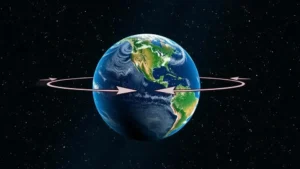
At first glance, it might not sound like the end of the world. After all, we don’t actually feel Earth’s rotation. Every day, the planet quietly turns on its axis at roughly 1,670 kilometers per hour (1,037 mph) at the equator, carrying oceans, continents, clouds, aircraft, and nearly every living thing along for the ride.
But what if that motion suddenly came to an end?
Scientists agree that such an event is virtually impossible under known laws of physics. Yet as a thought experiment, it reveals just how dependent our world is on a process we rarely think about.
If Earth stopped spinning instantly, the consequences would be catastrophic. The first 24 hours would reshape the planet in ways that are difficult to imagine. Oceans would surge across continents. Winds would become unimaginably violent. Entire cities could disappear. The familiar cycle of day and night would fundamentally change.
Here’s a scientific timeline of what might happen during the first 24 hours after Earth suddenly stops spinning.
Hour 0: The Moment Everything Changes
At the exact instant Earth’s rotation stops, a critical problem emerges.
Everything on the surface is still moving.
Even though the planet itself has stopped, the atmosphere, oceans, buildings, vehicles, and people retain the momentum they had before the event.
At the equator, that momentum is approximately 1,670 kilometers per hour.
Physics does not simply erase motion because the ground stops.
As a result, anything not securely attached to bedrock would continue moving eastward at tremendous speed.
The effect would resemble the most powerful shockwave in human history.
Vehicles would be thrown.
Trees would snap.
Structures would collapse.
Aircraft would struggle against radically changing atmospheric conditions.
For many regions, the initial seconds would be among the most destructive moments ever experienced on Earth.
Minute 1: Supersonic Winds Sweep Across the Planet
The atmosphere would not stop immediately.
Air masses would continue racing around the globe at the speed they had before Earth’s rotation ceased.
This creates winds far beyond anything recorded in modern meteorology.
The strongest hurricanes on Earth produce winds around 250 to 300 kilometers per hour.
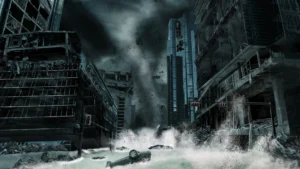
In this scenario, some regions could experience winds exceeding 1,000 kilometers per hour.
Entire forests would be flattened.
Glass skyscrapers would shatter.
Power grids would fail almost instantly.
Debris traveling at extreme speeds would turn cities into dangerous environments.
Many coastal regions would face a second threat simultaneously—the oceans.
Hour 1: The Oceans Begin Moving
Earth’s rotation influences the shape of the oceans.
Because of centrifugal force, our planet bulges slightly around the equator.
The oceans have adjusted to this shape over billions of years.
When rotation suddenly stops, that balance disappears.
Water begins migrating toward the poles.
The result is not a single giant wave but a global redistribution of the oceans.
Massive walls of water could move across coastlines.
Low-lying regions would be submerged.
Many of the world’s largest cities—including coastal megacities—would face catastrophic flooding.
Ports, airports, and industrial centers located near sea level would be among the first areas affected.
The geography of Earth would begin changing before the first hour has ended.
Hour 2: Communication Networks Collapse
Modern civilization depends on interconnected systems.
Satellite networks.
Internet infrastructure.
Power stations.
Cell towers.
Data centers.
Many of these systems would struggle to survive the chaos unfolding on the surface.
High winds, flooding, and widespread structural damage would interrupt communication almost everywhere.
Emergency services would become overwhelmed.
Navigation systems could become unreliable as atmospheric conditions shift dramatically.
Many regions would find themselves isolated within hours.
For the first time in generations, billions of people could lose access to real-time information.
Hour 3: Earth’s Weather System Begins to Break
The rotation of Earth helps drive atmospheric circulation.
The Coriolis effect influences wind patterns, ocean currents, storm systems, and climate zones.
Without rotation, these systems begin changing.
Weather patterns that have existed for thousands of years start to unravel.
Jet streams weaken.
Storm tracks shift.
Pressure systems behave differently.
Meteorologists would suddenly find themselves confronting conditions never observed in human history.
The atmosphere would be entering entirely new territory.
Hour 4: Fires Spread Across Multiple Continents
The combination of powerful winds, damaged infrastructure, and ruptured energy systems creates ideal conditions for widespread fires.
Natural gas lines break.
Electrical systems spark.
Industrial facilities suffer catastrophic failures.
Wildfires could spread at unprecedented rates under extreme wind conditions.
In some regions, firestorms may develop, consuming vast areas in a matter of hours.
Emergency responders, already struggling with flooding and infrastructure damage, would find it nearly impossible to contain multiple large-scale disasters simultaneously.
Hour 6: Day and Night Begin to Change

One of the strangest consequences now becomes apparent.
Earth’s rotation creates our familiar 24-hour day.
Without rotation, that cycle no longer functions as before.
One side of the planet remains facing the Sun for extended periods.
The opposite side remains in darkness.
While orbital motion around the Sun still continues, the experience of day and night changes dramatically.
Areas facing the Sun begin heating continuously.
Areas facing away begin cooling.
Although major temperature differences take longer to develop, the process starts immediately.
The climate future of the planet is beginning to diverge.
Hour 8: Ocean Currents Enter Chaos
The oceans are not static bodies of water.
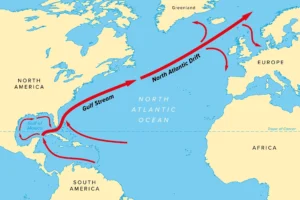
They are part of a complex global circulation system influenced by Earth’s rotation, temperature differences, and wind patterns.
Major currents such as the Gulf Stream play a critical role in regulating climate.
As atmospheric circulation changes and water redistributes toward the poles, these currents begin breaking down.
Marine ecosystems face immediate disruption.
Migration routes used by countless species become unstable.
The long-term consequences could be enormous, affecting fisheries, weather patterns, and global biodiversity.
Hour 10: Aircraft Face an Unprecedented Challenge
By now, aviation would be confronting extraordinary conditions.
Extreme turbulence.
Unpredictable wind patterns.
Disrupted navigation systems.
Potential loss of communication networks.
Many aircraft would attempt emergency landings.
Others might be unable to reach suitable airports due to flooding, debris, or severe weather.
Global air travel would effectively grind to a halt.
The skies would become one of the most dangerous environments on Earth.
Hour 12: Half a Day Into the Crisis
Twelve hours after Earth’s rotation stops, humanity begins to grasp the scale of the disaster.
Governments struggle to assess damages.
Communication between regions remains limited.
Millions—or potentially billions—of people face disrupted access to food, water, medical care, and shelter.
Scientists would urgently analyze new environmental data.
The realization becomes unavoidable:
This is not a temporary emergency.
The planet itself has fundamentally changed.
Hour 14: Massive Population Movements Begin
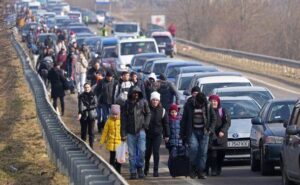
People naturally move away from danger.
Flood zones.
Fire zones.
Collapsing infrastructure.
Extreme weather.
As conditions worsen, large-scale migrations begin.
Road networks become congested.
Transportation systems fail under pressure.
Fuel supplies become uncertain.
Many regions discover that traditional evacuation plans are inadequate for a global catastrophe of this scale.
Population displacement becomes one of the defining challenges of the crisis.
Hour 16: Ecosystems Start Responding
Animals are highly sensitive to environmental changes.
Bird migration patterns.
Marine navigation.
Insect behavior.
Predator-prey relationships.
Many species rely on Earth’s daily cycles as biological cues.
The sudden disruption of those cycles begins affecting wildlife almost immediately.
Some animals become disoriented.
Others alter feeding and movement patterns.
Scientists studying ecosystems would witness behavioral changes unlike anything previously recorded.
Hour 18: The Temperature Divide Grows
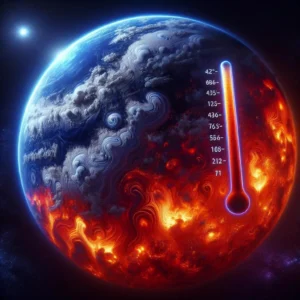
The side of Earth facing the Sun continues receiving solar energy.
The dark side continues losing heat.
Although oceans and atmosphere moderate temperature shifts initially, a growing contrast emerges.
The illuminated hemisphere becomes progressively warmer.
The dark hemisphere grows colder.
This difference fuels new atmospheric instabilities and strengthens unusual weather systems.
The longer the situation persists, the more extreme these temperature contrasts become.
Hour 20: Agriculture Faces an Uncertain Future
Food production depends on predictable environmental conditions.
Temperature.
Rainfall.
Daylight cycles.
Seasonal patterns.
A non-rotating Earth threatens all of these.
Farmers, governments, and scientists begin evaluating how crops might survive under radically altered conditions.
Many agricultural regions would already be dealing with flooding, drought, wind damage, or infrastructure collapse.
Concerns about future food security become increasingly urgent.
Hour 22: Scientists Reevaluate Everything
For centuries, many aspects of Earth science have assumed a rotating planet.
Meteorology.
Oceanography.
Climate science.
Geophysics.
Astronomy.
Now, researchers would be attempting to understand a world operating under entirely different conditions.
Supercomputers would run emergency simulations.
Observatories would collect unprecedented data.
The scientific community would be racing to answer humanity’s biggest question:
Can civilization survive on a non-rotating Earth?
Hour 24: A New Planet Emerges
One full day after Earth stops spinning, the world is almost unrecognizable.
Coastlines have changed.
Weather systems have shifted.
Infrastructure has suffered massive damage.
Communication remains fragmented.
Population movements continue.
The familiar rhythms that defined human civilization for thousands of years have been disrupted.
Yet the first 24 hours are only the beginning.
The true long-term effects would unfold over months, years, and centuries.
What Would Happen Next?
If Earth remained permanently motionless, the future would become even more dramatic.
Over time, the oceans would continue migrating toward the poles.
Large regions near the equator could become exposed land.
Areas facing the Sun for extended periods might become extremely hot.
Areas trapped in darkness could become intensely cold.
The atmosphere would reorganize into entirely new circulation patterns.
Many current ecosystems would disappear.
New environmental zones would emerge.
Human civilization would likely concentrate in regions where temperatures remained relatively moderate.
The planet would still orbit the Sun, but life would be adapting to a radically transformed world.
Could Earth Actually Stop Spinning?

Fortunately, the answer is almost certainly no.
Earth’s rotation contains an enormous amount of angular momentum.
Stopping it instantly would require an unimaginable force far beyond anything known in nature.
Large impacts can alter rotation slightly.
Gravitational interactions with the Moon gradually slow Earth’s spin over millions of years.
But a sudden complete stop is not considered a realistic scenario.
Scientists use thought experiments like this not because they expect them to happen, but because they help us understand how interconnected planetary systems truly are.
The Hidden Motion That Makes Life Possible
Most of us never think about Earth’s rotation.
It happens silently beneath our feet every second of every day.
Yet that motion helps shape weather patterns, ocean currents, climate systems, biological rhythms, and the cycle of day and night.
The thought experiment of a motionless Earth highlights a remarkable truth: many of the conditions that make our planet habitable depend on processes we rarely notice.
The spinning Earth is more than a celestial detail.
It is one of the fundamental engines of life on our world.
If that engine ever stopped, even for a single day, humanity would witness one of the most extraordinary and devastating transformations imaginable.
Thankfully, the planet beneath us continues turning—steadily, silently, and absolutely essential to everything we know.


