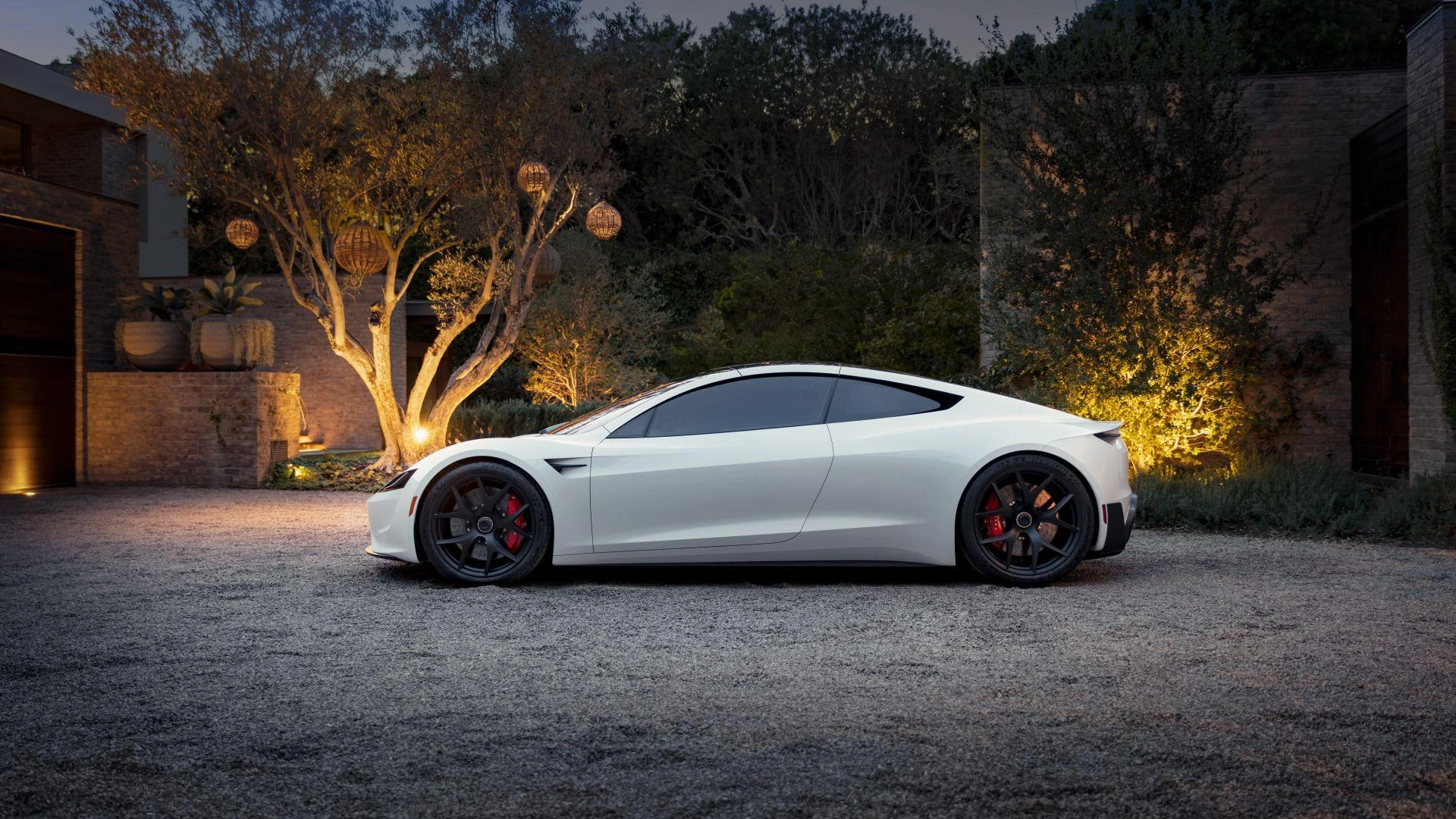
Tesla’s next-generation Roadster has taken the idea of a flying car into extraordinary territory. Demonstrated with SpaceX-inspired thrusters, the electric sports car can briefly lift off the ground and perform airborne manoeuvres. But the physics behind the spectacle is more fascinating than the claim that it defies gravity.
For decades, flying cars have occupied an awkward space between science fiction and engineering reality. They appear in futuristic films, promise to eliminate traffic jams and regularly feature in predictions about how people might travel in the future. Yet building a vehicle that can drive on roads and safely fly through the air has proved remarkably difficult.
Now, Elon Musk has given that idea a dramatic new twist.
On October 15, 2026, Tesla unveiled its long-awaited next-generation Roadster at a SpaceX testing facility in Texas. During the demonstration, the prototype drove up a curved ramp, appeared to travel upside down with the help of a suction system, then launched into the air, rotated and landed on its wheels.
A second demonstration showed it lifting over a line of other Tesla vehicles.
The technology draws on SpaceX-inspired propulsion systems, giving the Roadster capabilities that look more like those of a small rocket than a conventional sports car. Tesla has also promoted extraordinary performance claims, including acceleration from zero to 60 miles per hour in less than a second.
But there is an important distinction between a car that can briefly lift off the ground and one capable of flying across a city.
The demonstration raises fascinating questions about propulsion, gravity, vehicle stability and the future of transportation. How does the Roadster generate enough force to become airborne? Can it remain in the air for more than a few moments? And could this technology eventually change the way people travel?
What exactly did Elon Musk reveal?
The vehicle unveiled in Texas is the next-generation Tesla Roadster, a project first announced in 2017. Its development has taken considerably longer than originally anticipated, and the latest demonstration was intended to show how far the design has progressed.
According to reporting by Reuters, Tesla demonstrated a two-seat electric sports car equipped with thrusters developed in collaboration with SpaceX. The prototype performed airborne manoeuvres, including rotating in mid-air before returning to the ground.
Tesla expects production to begin in 2028, although a production date is not the same as a confirmed delivery schedule.
The company has also described different versions of the vehicle, including a highly specialised configuration associated with its flight capabilities. The most ambitious version is not intended to operate as an ordinary road car with unrestricted flight capability.
That distinction matters. A dramatic prototype demonstration can show that a mechanism works under controlled conditions, but it does not establish how reliably it will function in everyday use.
The full story is covered in Reuters’ report on the next-generation Tesla Roadster.
How can a car lift itself into the air?
The basic principle is surprisingly straightforward: a vehicle can rise if it produces enough upward thrust to overcome its weight.
A conventional car relies on its tyres to generate the forces needed for acceleration, braking and turning. Its engine or electric motors drive the wheels, while the road provides the reaction forces that allow the vehicle to move.
A flying vehicle needs a different source of force.
Aircraft generally generate lift through their wings, while helicopters use rotating blades. Multirotor drones rely on propellers that accelerate air downwards, creating an upward force on the vehicle.
The Roadster’s demonstrated system takes a different approach. Reports from the unveiling describe thrusters that use compressed gas to produce short bursts of force.
When gas is expelled rapidly in one direction, the vehicle experiences a reaction force in the opposite direction. If the upward component of that force is strong enough, the car can lift off the ground.
The principle is the same basic physics behind a balloon that shoots across a room when released before being tied. The difference is that a thruster system uses controlled valves and nozzles to direct the escaping gas.
The amount of force depends on factors such as the pressure and quantity of gas, the nozzle design and the rate at which the gas is released.
This is not gravity cancellation. It is propulsion.
Does the Tesla Roadster really defy gravity?
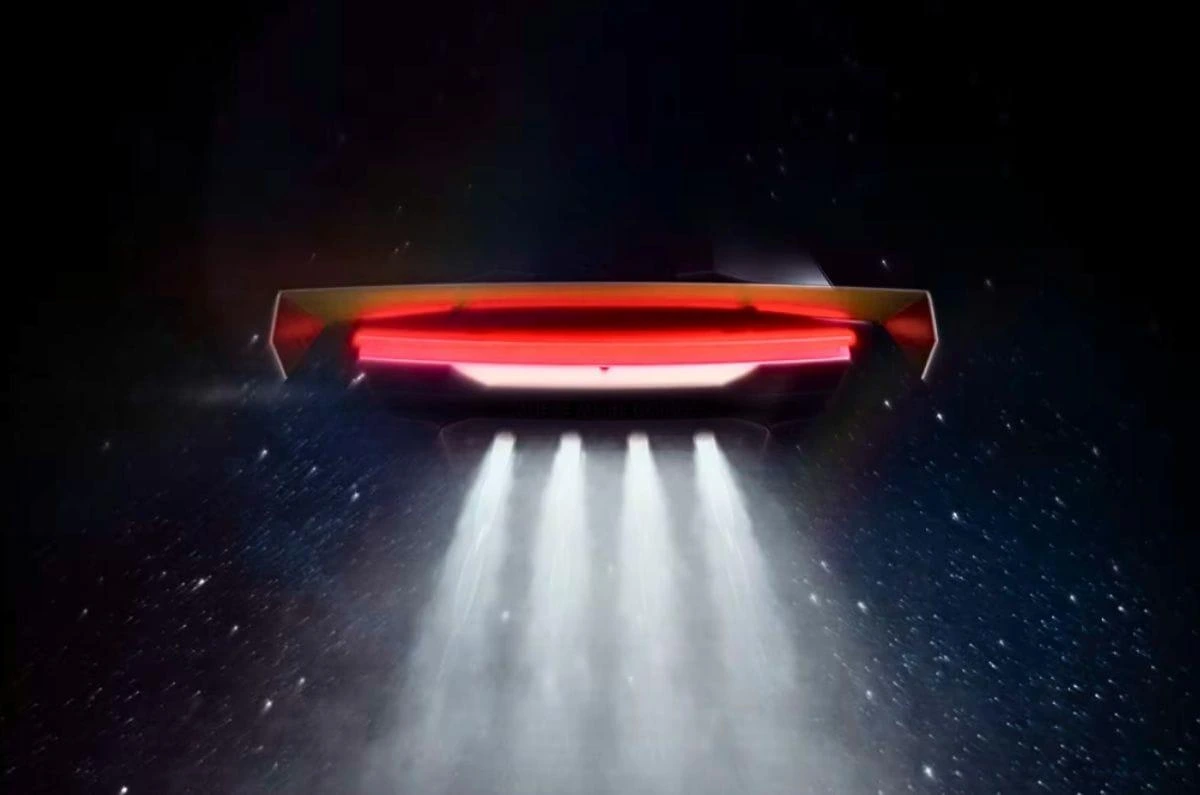
No vehicle can be said to defy gravity simply because it leaves the ground.
Gravity continues pulling the Roadster towards Earth throughout its flight. To rise, the car must produce enough upward force to overcome its weight and any other downward forces acting on it.
In simplified terms, if the upward thrust exceeds the vehicle’s weight, the car can accelerate upwards. If the forces balance, it may maintain altitude under suitable conditions. If thrust falls below its weight, it will accelerate downwards.
This is a fundamental consequence of Newton’s laws of motion.
The distinction is important because the phrase “defying gravity” is a compelling headline, but it can give readers the wrong impression about the technology.
The Roadster is not switching gravity off, manipulating spacetime or discovering a new force of nature. It is using propulsion to push against the surrounding environment.
That makes the demonstration impressive without requiring a revolution in our understanding of physics.
The surprising role of suction in the upside-down demonstration
One of the most unusual parts of the Roadster demonstration was its apparent ability to travel upside down along a curved ramp.
That manoeuvre involved a separate system from the thrusters used for airborne movement.
According to reporting by Hindustan Times, the vehicle used a fan-based suction system beneath the car to increase the force pressing it against the ramp.
The idea resembles the aerodynamic principle used by some racing cars, where carefully managed airflow creates downforce and increases tyre grip.
In this case, a suction system can create a pressure difference that pulls the vehicle towards the surface. The additional force helps the tyres remain in contact with the track even when gravity would otherwise pull the vehicle away from it.
The thrusters then provide the force needed for the airborne manoeuvre.
These systems solve different engineering problems. Suction can help the vehicle maintain contact with a surface, while thrusters can generate motion when the tyres are no longer providing the necessary forces.
The demonstration therefore combines several mechanisms rather than relying on one mysterious technology.
For more technical background, see Hindustan Times’ explanation of the Roadster’s thrusters and suction system.
Why use SpaceX-style thrusters instead of wings?
The attraction of thrusters is that they can generate force without requiring a conventional runway or the forward airflow needed by an ordinary aircraft wing.
They can also be arranged to help control a vehicle’s orientation. By changing the direction and intensity of thrust, a suitably designed system can influence pitch, roll and other aspects of movement.
Spacecraft use small thrusters to adjust their orientation and make controlled movements in space. NASA’s Small Spacecraft Technology programme describes propulsion technologies used by small spacecraft, including systems for attitude control and manoeuvring.
However, a system designed to control a spacecraft is not automatically suitable for carrying people in a road vehicle.
Spacecraft operate under different conditions, and the engineering requirements for a passenger vehicle are particularly demanding. A road car must be able to withstand collisions, protect occupants and operate reliably under a wide range of environmental conditions.
A vehicle intended to fly would face additional requirements involving stability, emergency procedures, flight controls and the protection of people nearby.
The Roadster’s technology is therefore an intriguing demonstration of propulsion engineering, but its practical usefulness will depend on much more than its ability to produce thrust.
Watch the Tesla Roadster’s airborne demonstration and thruster-assisted manoeuvres. The footage shows what Tesla presented at its October 2026 unveiling, but it does not independently establish the vehicle’s long-term flight capability or everyday road safety.
Could the Roadster fly over traffic?
This is where the difference between a flying demonstration and a practical flying car becomes especially important.
A brief airborne manoeuvre can be achieved under controlled conditions without proving that a vehicle can sustain flight over a meaningful distance.
To fly over traffic, the Roadster would need to maintain stable altitude, control its movement in changing conditions and manage its energy or propellant supply. It would also need a reliable way to take off and land safely.
Engineers would have to determine how much thrust the vehicle can generate, how long it can maintain that thrust and how the system behaves if a component fails.
There are also major questions about noise, exhaust or gas discharge, visibility, weather, obstacles and emergency landing locations.
A conventional aircraft has wings that generate lift during forward motion. A vehicle relying on thrusters for upward force would need to sustain that force for as long as it remained airborne.
That can demand considerable energy or propellant, depending on the propulsion system and vehicle mass.
The demonstration did not establish that the Roadster can travel long distances in the air, hover indefinitely or navigate urban streets from above.
For now, the evidence supports a more limited conclusion: the prototype demonstrated short airborne manoeuvres under controlled conditions.
What about the claim that it can accelerate to 60 mph in under one second?
The acceleration claim is another extraordinary feature of the unveiling.
Tesla has promoted a zero-to-60-mph time of less than one second. If achieved in a road-going vehicle, that would represent an extreme acceleration performance.
But acceleration is not determined by motor power alone. It also depends on traction, vehicle mass, the way force is delivered and the conditions under which the measurement is made.
On a normal road, the tyres can only transmit a limited amount of force before losing grip. A thruster system can provide additional force without relying entirely on tyre traction, but that introduces other engineering challenges.
The occupants would also experience substantial acceleration forces. A vehicle that can accelerate extraordinarily quickly is not necessarily comfortable or safe to operate in that manner under ordinary conditions.
Independent testing will be needed to establish the production vehicle’s actual performance, including whether its advertised figures can be reproduced consistently.
The same principle applies to its flight capabilities: a demonstration is a starting point for evaluation, not a substitute for independently verified performance data.
Could this technology change the future of transportation?
The Roadster could influence future vehicle engineering even if it never becomes a conventional flying car.
The integration of electric vehicle technology, advanced control systems and compact propulsion equipment may provide useful lessons about how vehicles can generate and manage forces in unusual circumstances.
However, the path from a demonstration to a practical transportation system is long.
A commercially viable flying car would need to meet strict safety standards, provide predictable handling and operate within an established regulatory framework. Engineers would also need to consider maintenance, operating costs, noise and the consequences of a failure while airborne.
The Federal Aviation Administration provides information about the regulatory landscape for emerging powered-lift and advanced air mobility aircraft in the United States.
The Roadster’s flight system is not a blanket authorisation to fly a car on public roads. Aviation rules, vehicle regulations and local restrictions may apply depending on the design and intended use.
It is also worth remembering that other companies are developing electric vertical take-off and landing aircraft, commonly known as eVTOLs. These vehicles are specifically designed for flight and generally rely on propellers or other systems that provide sustained lift.
A road car with thrusters faces a different set of trade-offs. Its design must accommodate road use while also carrying the hardware needed for airborne movement.
That combination may ultimately prove useful for specialised applications, or it may remain an expensive demonstration of what is technically possible.
The biggest questions Tesla still needs to answer
The unveiling has shown a prototype capable of remarkable manoeuvres, but important details remain unresolved.
How long can the vehicle stay airborne? What altitude can it reach? How far can it travel before its propellant supply or other operating limits become a constraint? What happens if the thrust-control system fails?
There are also questions about the production version. Will the flight-capable configuration be available to ordinary customers, or will it remain a limited, invitation-only model? What will the final specifications and price be? When will production vehicles be delivered?
Tesla’s stated production target is 2028, but future plans can change, and the company has not yet demonstrated a mass-produced flying Roadster in ordinary operating conditions.
Independent testing will be essential to establish how the technology performs outside a carefully controlled demonstration.
Until then, it is reasonable to regard the Roadster as an ambitious engineering project with demonstrated airborne capabilities, but not yet as a replacement for aircraft or a practical solution to road congestion.
Conclusion: A flying car, but not a machine that defeats gravity
Elon Musk’s new Tesla Roadster has brought the idea of a flying car closer to reality in a very specific sense: its prototype has demonstrated brief airborne manoeuvres using thrusters.
The underlying physics is well understood. Compressed gas expelled in one direction produces a reaction force in the opposite direction, and a sufficiently strong upward force can lift a vehicle against gravity.
The more difficult challenge is turning that principle into a safe, efficient and practical means of transportation.
A car that can jump into the air is not necessarily a car that can fly across a city. Sustained flight demands reliable propulsion, precise control, adequate energy or propellant, and rigorous safety testing.
The Roadster’s unveiling is therefore a fascinating moment for automotive and aerospace engineering. It shows what can happen when technologies from two industries are combined in an unconventional way.
Whether it becomes a genuinely useful flying vehicle remains an open question. For now, the most remarkable part is not that Tesla has defeated gravity, but that engineers are finding new ways to work with the laws of physics.