
For centuries, humanity has looked at the night sky and wondered whether someone, somewhere, might be looking back. The question has inspired ancient stories, scientific investigations, government inquiries and some of the most ambitious space missions ever undertaken.
But there is a fundamental difference between believing that aliens exist and proving that they do.
As of October 2026, scientists have not confirmed the discovery of extraterrestrial life. No verified alien organism, extraterrestrial civilization or scientifically authenticated signal from an intelligent species has been found.
Yet the scientific case for investigating life beyond Earth has become increasingly compelling. Astronomers have discovered thousands of planets orbiting distant stars. Spacecraft have explored ancient Martian environments, while researchers are investigating oceans hidden beneath the icy surfaces of distant moons.
The question is no longer simply whether other worlds exist. We know they do.
The bigger question is whether any of them have developed life.

The Scientific Case for Alien Life Is Growing
One of the most important developments in the search for extraterrestrial life has been the discovery of exoplanets.
An exoplanet is a planet that orbits a star outside our solar system. Before the 1990s, astronomers had no confirmed observations of planets around ordinary Sun-like stars. Today, the situation is dramatically different.
According to the NASA Exoplanet Archive, 6,451 planets had been confirmed as of October 15, 2026.
These discoveries have transformed our understanding of planetary systems. Planets are not unusual objects that exist only around our Sun. They appear to be widespread throughout the galaxy.
Some are enormous gas giants. Others are rocky worlds, potentially possessing conditions that could support liquid water.
The discovery of so many planets raises an important possibility: Earth may not be the only place where the necessary conditions for life have emerged.
However, finding a planet does not mean finding life. Even a world that appears similar to Earth might have an atmosphere, surface chemistry or geological history that makes it completely unsuitable for living organisms.
Scientists must therefore investigate individual environments rather than assume that every potentially habitable planet contains living creatures.
What Makes a Planet Suitable for Life?
When astronomers search for potentially habitable worlds, they often begin by examining the habitable zone.
This is the region around a star where temperatures could allow liquid water to exist on a planet’s surface, assuming suitable atmospheric conditions.
Water is important because every known form of life on Earth depends on it during at least part of its life cycle.
But the habitable zone is not a guarantee of habitability.
A planet might orbit at the correct distance from its star and still have no stable atmosphere, extreme radiation levels or an environment that cannot support biological processes.
Scientists also investigate several other factors:
- Whether the planet has an atmosphere.
- Whether essential chemical elements are present.
- Whether a source of energy is available.
- Whether liquid water could exist.
- Whether the environment remains stable for sufficiently long periods.
Interestingly, scientists are increasingly considering environments that do not resemble Earth’s surface.
Some of the most promising places in our own solar system may be hidden beneath thick layers of ice.
Could Life Exist Beneath the Surface of Mars?
Mars remains one of the most important destinations in the search for extraterrestrial life.
Today, the planet is cold, dry and exposed to radiation. Its thin atmosphere provides little protection from the harsh conditions of space.
However, ancient Mars was very different.
Geological evidence suggests that rivers, lakes and possibly extensive bodies of water existed on its surface billions of years ago.
NASA’s Curiosity and Perseverance rovers have investigated ancient environments, examined rocks and identified organic compounds.
Organic molecules are particularly interesting because carbon-based chemistry is fundamental to life as we know it.
However, organic compounds do not automatically indicate biological activity. They can also form through non-biological chemical processes.
This distinction is crucial.
Scientists are investigating whether ancient Martian environments ever supported microbial organisms and whether traces of such organisms might have survived in rocks beneath the planet’s surface.
If Mars once supported life, it would raise another extraordinary possibility: life may have developed independently on more than one world within our own solar system.
That discovery would fundamentally change how scientists estimate the possibility of life elsewhere.
Europa and Enceladus: Oceans Hidden Beyond Earth
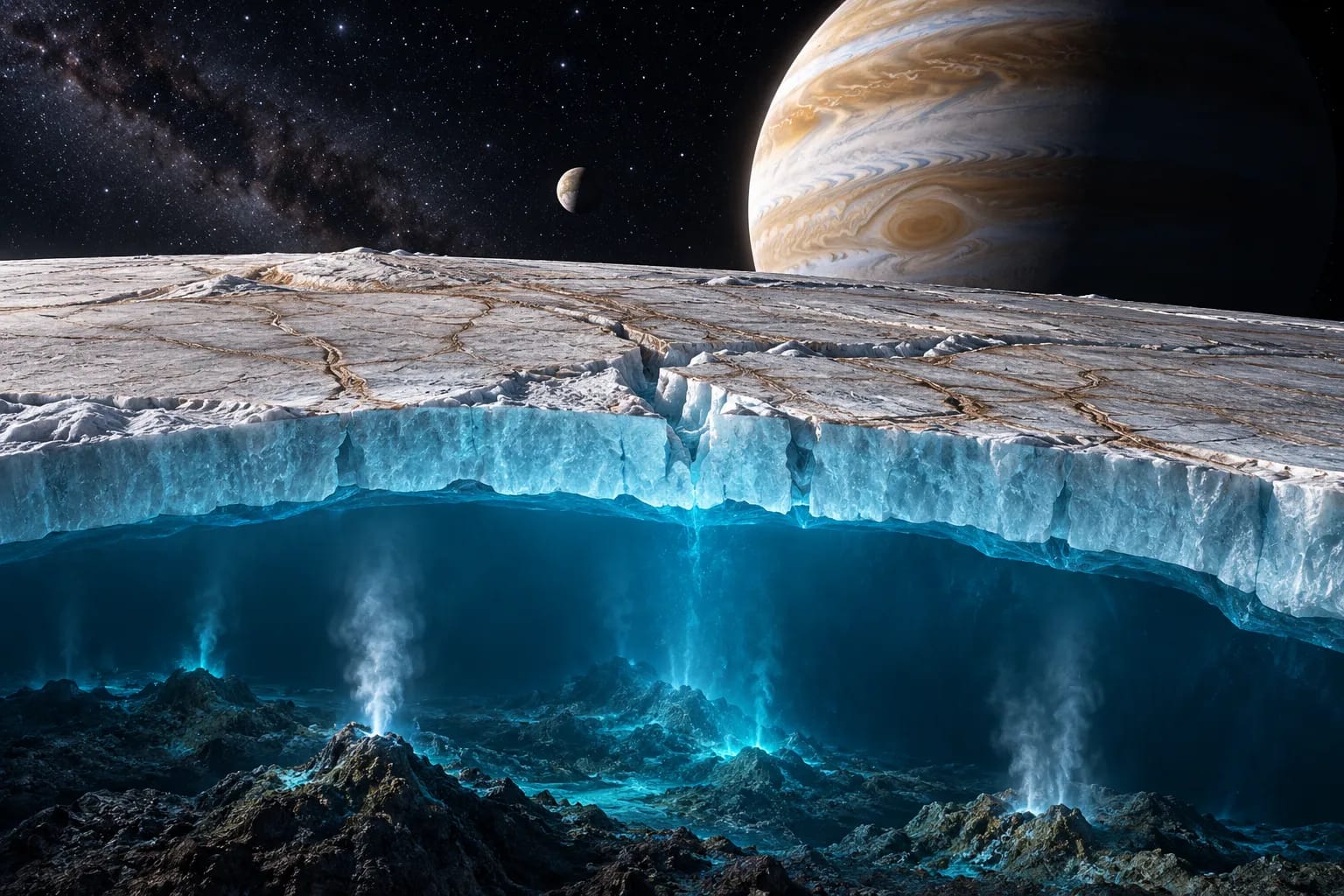
Some of the most fascinating potential habitats for extraterrestrial life are not planets at all.
They are moons.
Jupiter’s Europa and Saturn’s Enceladus are particularly interesting because scientists have strong evidence that both possess subsurface oceans beneath their icy crusts.
Europa is covered by a thick layer of ice. Beneath that frozen exterior, researchers believe a global ocean of liquid water exists.
The possibility of water, chemical ingredients and energy sources makes Europa an important target for astrobiology.
NASA’s Europa Clipper mission, launched in October 2024, is designed to investigate Europa’s ice shell, composition and potential habitability. It is expected to reach Jupiter in 2030.
Saturn’s moon Enceladus offers another remarkable opportunity.
NASA’s Cassini spacecraft discovered that Enceladus releases enormous plumes of water vapour and icy particles into space through fractures near its south pole.
Analysis of material from these plumes revealed water, salts and organic compounds. Scientists have also identified evidence of chemical processes that could provide energy in its subsurface ocean.
These discoveries do not prove that Enceladus contains living organisms.
Nevertheless, they demonstrate that potentially life-supporting environments may exist far beyond the traditional habitable zone surrounding a star.
Image 1 placement: Insert the attached illustration of an icy moon with a subsurface ocean and hydrothermal vents here.
Could the James Webb Space Telescope Find Alien Life?
The James Webb Space Telescope has opened a new chapter in the search for potentially habitable worlds.
Unlike conventional telescopes that primarily capture visible light, Webb observes infrared radiation, allowing astronomers to investigate the atmospheres of distant planets.
One technique involves studying starlight as it passes through a planet’s atmosphere during a transit.
Different atmospheric chemicals absorb different wavelengths of light. By examining these patterns, researchers can investigate the composition of an exoplanet’s atmosphere.
Scientists are particularly interested in possible biosignatures.
These are substances or combinations of environmental characteristics that could indicate biological activity.
Potentially interesting atmospheric gases include:
- Oxygen.
- Methane.
- Carbon dioxide.
- Water vapour.
However, none of these gases alone provides definitive evidence of extraterrestrial life.
For example, methane can be produced by biological organisms, but geological and chemical processes can also generate it.
Scientists therefore need to examine the wider atmospheric environment and investigate whether several independent observations support a biological explanation.
Even a promising atmospheric signal would require extensive verification before scientists could announce the discovery of life.
This is one reason why the search for extraterrestrial organisms is considerably more complicated than simply finding a planet with oxygen.
Have Scientists Detected Any Alien Signals?
Finding microbial life would be an extraordinary discovery, but detecting an intelligent civilization would represent an entirely different breakthrough.
For decades, researchers involved in the Search for Extraterrestrial Intelligence (SETI) have examined radio signals and other potential technological signatures from space.
The basic idea is straightforward.
If an advanced civilization develops radio communications, powerful transmitters or large-scale technological systems, some of its activities might produce detectable signals.
Astronomers can search for unusual radio emissions that appear different from natural astronomical sources.
Researchers also investigate potential technosignatures, which are observable indicators of technology beyond Earth.
These might include unusual radio signals, artificial atmospheric pollutants or other detectable technological activity.
However, no unambiguous signal from an extraterrestrial civilization has been confirmed.
There is also a major challenge involving distance.
A civilization could exist thousands of light-years away, but its signals might be too weak to detect. Alternatively, its transmissions may never cross Earth’s position.
It is also possible that an advanced civilization communicates using methods that current human technology cannot detect.
The absence of a confirmed signal therefore does not establish that intelligent extraterrestrial life is nonexistent.
It demonstrates that we have not found convincing evidence yet.
Are UFO Sightings Evidence That Aliens Have Visited Earth?
The subject of unidentified flying objects has become increasingly prominent in public discussions about extraterrestrial life.
The modern term UAP, or Unidentified Anomalous Phenomena, is used to describe observations that cannot immediately be identified or explained.
Government investigations have examined reports involving unusual objects, unexplained movements and observations made by military personnel.
However, an unidentified object is not automatically an extraterrestrial spacecraft.
There are several possible explanations for unusual observations:
- Aircraft or experimental aerospace technology.
- Weather balloons and atmospheric phenomena.
- Satellites and other space-related objects.
- Optical illusions and camera artefacts.
- Incomplete or inaccurate observational data.
NASA has stated that it has found no credible evidence of extraterrestrial life and no evidence establishing that UAPs are extraterrestrial.
This does not mean every observation has been explained. Some reports remain unresolved because the available data are insufficient.
But scientific investigation requires evidence that can be independently examined and tested.
An unexplained observation is a reason to investigate, not proof of an alien visitor.
The Fermi Paradox: If Aliens Exist, Where Is Everybody?
There is another question that makes the search for extraterrestrial life particularly fascinating.
If the universe contains so many stars and planets, why have we not encountered another civilization?
This is the central idea behind the Fermi Paradox.
The observable universe contains an enormous number of galaxies, and each galaxy contains vast numbers of stars. Many of those stars have planetary systems.
If intelligent life develops on even a small fraction of suitable worlds, one might expect evidence of other civilizations to exist.
Yet we have not detected an unambiguous extraterrestrial transmission or encountered independently verified evidence of alien technology.
Several explanations have been proposed.
Perhaps intelligent life is exceptionally rare.
Perhaps microbial organisms are relatively common, but the development of advanced intelligence requires a very unusual combination of evolutionary circumstances.
Another possibility is that technological civilizations tend to exist for relatively short periods before disappearing.
It is also possible that advanced civilizations are separated by distances so enormous that communication is impractical.
Some researchers suggest that extraterrestrial civilizations may deliberately avoid transmitting detectable signals.
These are hypotheses rather than established scientific conclusions.
The Fermi Paradox remains unresolved, partly because humanity has searched only a tiny fraction of the possible places, frequencies and timescales involved.
Could Alien Life Look Nothing Like Humans?
When people imagine extraterrestrial beings, they often picture intelligent creatures with eyes, limbs and bodies resembling our own.
But there is no scientific reason to assume that life elsewhere must follow Earth’s evolutionary pathway.
Life on Earth itself demonstrates extraordinary biological diversity.
Organisms survive in boiling environments, deep ocean trenches, acidic waters and places without sunlight.
Some microorganisms can survive extreme temperatures, high radiation exposure and environments that would be lethal to most familiar organisms.
These discoveries have expanded scientific understanding of where life might exist.
An extraterrestrial organism could potentially be a microscopic cell, a complex multicellular organism or something whose biological structure differs considerably from everything currently known.
Scientists also investigate whether life might use different chemical pathways from those found on Earth.
This remains speculative because Earth is still our only confirmed example of a living world.
Nevertheless, researchers must remain open to unfamiliar possibilities rather than searching exclusively for organisms that resemble terrestrial life.
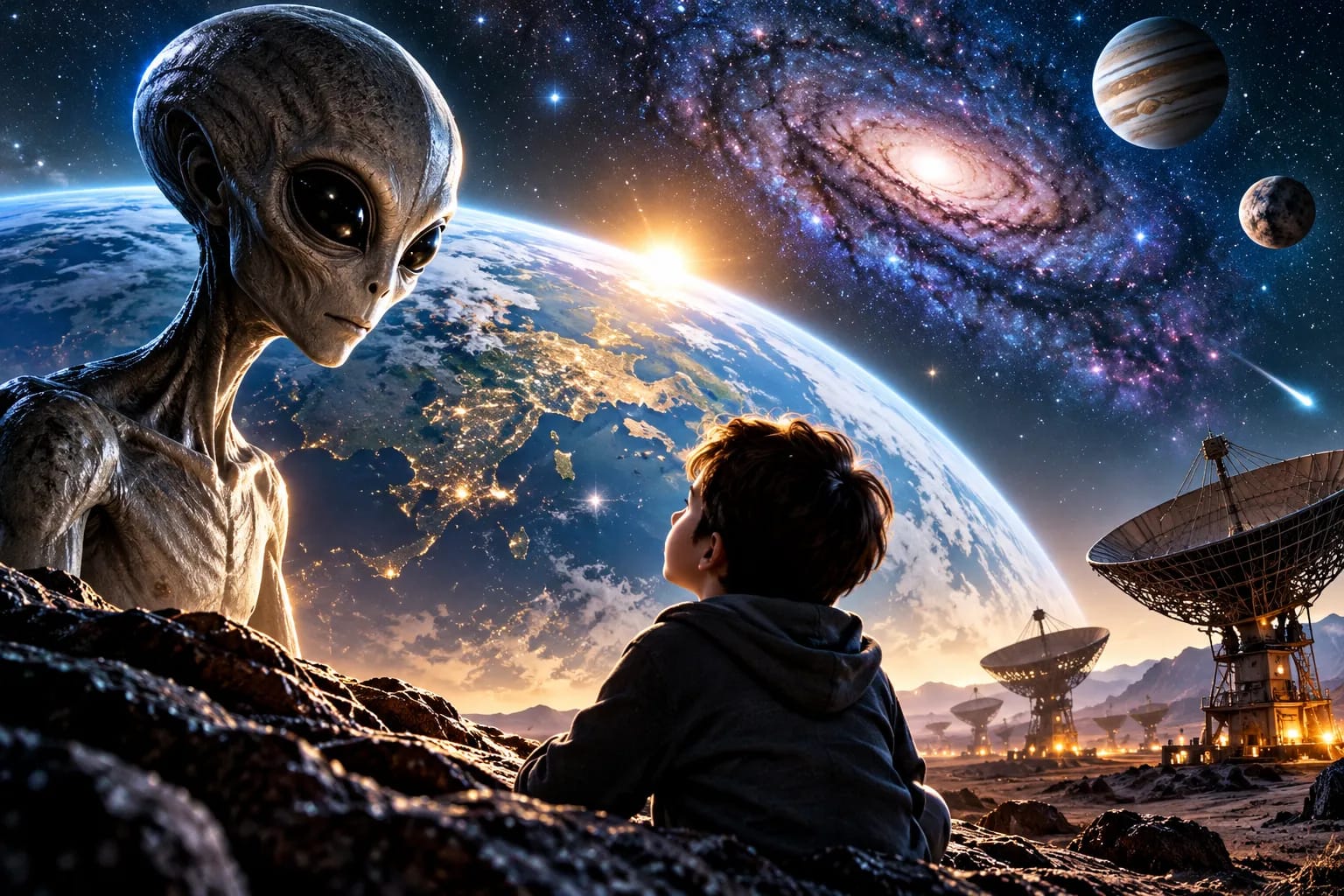
What Would Happen If Scientists Confirmed Alien Life?
The discovery of extraterrestrial life would probably become one of the most important scientific events in human history.
However, the consequences would depend heavily on what scientists actually discovered.
Finding microorganisms beneath the ice of Europa would be very different from receiving a verified message from an intelligent civilization.
A discovery of microbial life would help researchers understand whether life can develop independently under suitable conditions.
It could reveal whether the biological processes responsible for life on Earth are universal or whether our planet followed an unusually rare evolutionary pathway.
Discovering intelligent extraterrestrial life would raise even more complicated questions.
How old is the civilization? How does it communicate? Does it possess technology? Is it still active?
Scientists would also need to establish whether a detected signal was genuinely artificial and extraterrestrial.
The discovery would require independent verification, careful scientific analysis and international cooperation.
It would not necessarily mean that humanity could communicate with the civilization immediately. Even a signal from a relatively nearby star could take years to travel between the two locations.
First contact, if it ever happens, might begin with a message that humanity cannot answer for decades.
So, Are Aliens Real? What Is the Scientific Verdict?
The honest answer is that nobody knows yet.
There is currently no confirmed scientific evidence that extraterrestrial organisms exist, and no verified proof that intelligent aliens have visited Earth.
However, there are compelling scientific reasons to continue searching.
Thousands of exoplanets have been confirmed. Ancient Mars possessed environments that could have supported microbial life. Europa and Enceladus may contain oceans beneath their icy surfaces. Astronomers are developing increasingly sophisticated methods to investigate the atmospheres of distant planets.
Every discovery adds another piece to a much larger scientific investigation.
It is important not to confuse the possibility of extraterrestrial life with proof of its existence. But it would be equally premature to conclude that Earth is the only living world in an immense universe.
Perhaps the first discovery will not involve a spacecraft appearing above a major city or a mysterious radio message arriving from a distant star.
It might be a microscopic organism discovered in an ancient Martian rock, a chemical signature in the atmosphere of a distant planet or an unexpected biological clue hidden beneath the ice of an alien moon.
The first evidence of life beyond Earth could be incredibly small.
Its implications, however, would be enormous.
For the first time, humanity would know that life is not an isolated phenomenon confined to one small planet.
And that would change our understanding of our place in the universe forever.




