
Imagine a murder case that has remained unsolved for 30 years.
The crime scene has long since been cleared. Witnesses remember only fragments of what they saw. The original investigators have retired, some suspects have died, and crucial details remain buried in boxes of photographs, handwritten reports, old newspaper clippings, and evidence stored in police archives.
Then investigators turn to artificial intelligence.
A new system examines thousands of documents, compares photographs, analyses the timeline of known events, identifies inconsistencies in witness statements, and connects evidence that previous investigators may never have considered together. It produces a possible sequence of events: where the victim might have been, what could have happened next, and which unanswered questions deserve another look.
For the first time in decades, the case has a new lead.
Could this become a reality? In some respects, it already is. AI-assisted forensic analysis, digital evidence examination, and computational tools for identifying people and patterns are active areas of research and investigation. A 2025 systematic review examined AI applications across several forensic fields, including injury assessment and reconstruction, while researchers continue to study how language models might assist digital forensic investigations.
But there is a crucial difference between analysing evidence and recreating an event that nobody witnessed.
AI may help investigators reconstruct plausible sequences of events, but it cannot reliably recover missing facts simply because it can generate a convincing story.
What if future systems became powerful enough to combine every available clue into a detailed reconstruction of an unsolved murder? Could they help identify a killer, uncover a hidden motive, or finally explain what happened in the last minutes of a victim’s life?
The possibilities are remarkable. So are the risks.

1. How AI Could Reconstruct a Murder Scene
A murder investigation rarely depends on a single piece of evidence. It usually involves a collection of incomplete observations that must be interpreted together.
A photograph might reveal the position of an object. A phone record could establish when someone communicated with the victim. CCTV footage might show a vehicle passing a particular street. A forensic examination could establish an estimated time of death.
Individually, these details might not solve anything. Together, they may help establish a timeline.
AI could assist by analysing large volumes of information and identifying relationships that would otherwise take investigators considerable time to discover.
Reconstructing the timeline
Imagine that investigators possess security footage from three nearby locations, several phone records, and witness statements that describe movements around the time of a killing.
An AI-assisted system could organise these records chronologically, flag conflicting timestamps, identify gaps, and suggest questions that investigators should investigate.
For example, it might discover that a vehicle appeared in two separate recordings within a time window that challenges the existing timeline. That observation could lead investigators to review the footage, check the vehicle’s identity, or reconsider an earlier assumption.
The system would not automatically establish who was driving or whether the vehicle was connected to the crime. It would identify a potential inconsistency for human investigators to examine.
Re-examining photographs and physical evidence
Computer vision systems can analyse images for patterns, objects, and visual features. In forensic settings, researchers have investigated AI applications involving injury classification, image analysis, and aspects of crime-scene reconstruction. However, real-world reliability and the limitations of available datasets remain important concerns.
A future system might help compare photographs taken from different angles, identify objects that appear across several images, or highlight details that investigators overlooked.
But there is a fundamental limit: a photograph shows only what the camera captured.
AI cannot reliably determine what happened outside the frame, identify an unseen person without sufficient evidence, or establish a person’s intention merely by analysing an image.
Connecting documents and digital records
Large language models could help search extensive case files, summarise witness accounts, extract dates, and identify contradictions between documents.
A 2026 review of 33 studies on large language models in digital forensics identified opportunities for AI assistance in evidence examination and analysis, while also highlighting limitations in validation and forensic integrity.
For cold-case investigators, this could be especially useful when records span decades and involve different agencies.
The objective would not be to let a chatbot decide who committed a murder. It would be to help investigators find the evidence that deserves a closer look.
2. Could AI Reconstruct the Victim’s Final Moments?
This is where the idea becomes especially compelling—and where the distinction between science and speculation matters most.
Suppose a victim was found in a room with no eyewitnesses. Investigators have photographs of the scene, forensic examination results, partial CCTV footage, and messages exchanged earlier that evening.
A sufficiently capable analytical system could combine these sources to generate several possible timelines.
One scenario might suggest that the victim entered the room alone. Another might indicate that a second person arrived shortly before the estimated time of death. A third could reveal that the existing timeline depends on an assumption that has never been independently verified.
Investigators could then test these possibilities against physical evidence and witness accounts.
The result would be a collection of hypotheses, not a recovered recording of the past.

The difference between reconstruction and reality
Imagine an AI system generating a detailed visualisation of a victim’s final 20 minutes. It shows a person entering a room, placing an object on a table, moving toward a door, and leaving shortly before the estimated time of death.
The animation might look convincing. The movements might appear natural. Every scene might fit together perfectly.
Yet the system could have invented some of those details to fill gaps in the available information.
This is a particular danger with generative AI. These systems can produce plausible content that is not supported by the underlying evidence.
A scientifically responsible reconstruction would therefore need to label every element according to its evidential basis:
-
Observed: Directly supported by authenticated evidence, such as a verified recording.
-
Inferred: Supported by evidence but not directly observed.
-
Possible: Consistent with the available information but not established.
-
Unknown: Not determinable from the evidence currently available.
This approach would help prevent a computer-generated scene from being mistaken for a factual account.
The goal should be to reconstruct what the evidence supports—not to create the most dramatic explanation.
3. Could AI Identify a Killer Who Was Never Caught?
AI could potentially help identify investigative leads by connecting evidence that has remained separated across different records.
Consider a hypothetical unsolved murder from the 1990s. Investigators preserved biological evidence, but the original DNA analysis did not identify a suspect. Years later, new analytical methods become available.
AI could help organise genetic data, search lawful databases where permitted, and assist researchers in examining possible family relationships. Investigative genetic genealogy already combines DNA analysis with genealogical research to develop leads in some cold cases. The US National Human Genome Research Institute explains how this approach has been used in criminal investigations, alongside important privacy considerations.
AI could support parts of this process, such as prioritising research tasks or organising complex family-tree information. But genetic genealogy is not simply a matter of asking an algorithm to name a killer.
Investigators still need appropriate reference samples, corroborating evidence, and lawful procedures. A family relationship can point toward a line of inquiry without proving that a particular individual committed a crime.
Another promising application is identifying unknown deceased individuals. In India, a police-developed AI application known as RAIDS has been reported as helping investigators compare photographs of unidentified bodies, including remains affected by decomposition, with available images. Such identification work may help restore a person’s identity and open new investigative avenues.
These applications demonstrate a realistic role for AI: helping investigators search, compare, and prioritise information.
They do not establish that AI can independently solve a murder or reliably identify a perpetrator from incomplete evidence.
4. What If AI Could Detect a Pattern Humans Had Missed?
One of the greatest challenges in a cold case is that investigators may have already examined the obvious leads.
They interviewed the known witnesses, checked the available records, and pursued the suspects they considered plausible. When those efforts fail, the case may remain inactive for years.
AI could offer a different way to revisit the evidence.
Imagine a case involving several witness statements written by different people. Each statement describes a vehicle, but witnesses use different terms for its colour, model, or condition. A system might identify the descriptions as potentially referring to the same vehicle.
Or imagine that several documents contain slightly different versions of an event’s timeline. A system could flag the discrepancy and help investigators trace which version came from the original source.
It might also identify a connection between a location mentioned in an old report and a piece of evidence documented elsewhere in the archive.
These are plausible analytical tasks, although their usefulness would depend on the quality and completeness of the records.
The key advantage would be scale. A computer can process and compare large collections of material quickly, allowing investigators to devote more time to interpreting the results.
However, detecting a pattern is not the same as proving that the pattern is meaningful.
If an AI system searches enough records, it may find coincidences that have nothing to do with the crime. Investigators must establish whether a proposed connection is supported by independent evidence.
5. Could AI Reconstruct the Crime From Bloodstains, Injuries and Forensic Evidence?
Physical evidence may reveal details about an incident that witnesses cannot provide.
Forensic specialists can examine bloodstain patterns, injuries, fingerprints, fibres, DNA, and other traces to evaluate competing explanations of what occurred. AI research is exploring ways to assist with some of these tasks.
A 2025 systematic review of AI in forensic pathology described applications involving injury classification, post-mortem analysis, and other forensic assessments. The review also highlighted limitations arising from small datasets, variable performance, and the need for further validation.
In a future investigation, AI might help compare a set of physical observations against different proposed scenarios.
For example, investigators could ask whether a proposed sequence of movements is consistent with the locations of documented bloodstains and the injuries described in a medical report.
The system could highlight contradictions or identify additional examinations that might distinguish between competing hypotheses.
But the interpretation of physical evidence is often complex. A bloodstain can be affected by movement, surfaces, impact conditions, and later disturbance. Injury patterns may have multiple possible explanations.
AI should therefore support trained forensic specialists rather than replace their judgment.
The same principle applies to estimates of the time of death. These estimates are often uncertain and depend on several factors. An algorithm cannot transform an imprecise estimate into an exact timestamp simply by processing more data.
The technology’s value would lie in helping experts evaluate the evidence—not in promising certainty where science cannot provide it.
6. The Biggest Danger: AI Could Accuse the Wrong Person
The prospect of solving a decades-old murder is compelling. But the same technology that helps investigators find patterns could also send them down the wrong path.
Imagine an AI system examining an old case and identifying a person whose vehicle, location history, and relationship to the victim appear suspicious. The system ranks that person as a promising suspect.
Investigators may then focus heavily on that individual, interpreting new information through the assumption that the algorithm has already found the answer.
This is known as automation bias: people can place too much confidence in a computer-generated recommendation.
The problem becomes more serious when the system cannot clearly explain why it reached a conclusion.
A reference guide on AI in scientific evidence published through the US National Academies’ National Center for Biotechnology Information discusses concerns about manipulated media, authentication, and the risks of AI-generated material influencing human memory and legal judgments.
There are several risks investigators would need to manage:
-
False connections: An algorithm may link unrelated people, locations, or events.
-
Incomplete records: Missing evidence may produce a misleading reconstruction.
-
Biased data: Historical records may reflect earlier investigative assumptions or unequal scrutiny.
-
Fabricated detail: Generative AI may create plausible but unsupported explanations.
-
Evidence contamination: Investigators who see an AI-generated theory may unintentionally interpret later evidence in its favour.
A responsible system would need independent validation, transparent records of how its outputs were generated, and procedures that allow experts to challenge its conclusions.
Most importantly, an AI-generated suspicion must never be treated as proof of guilt.
7. What Would a Future AI Murder Reconstruction System Look Like?
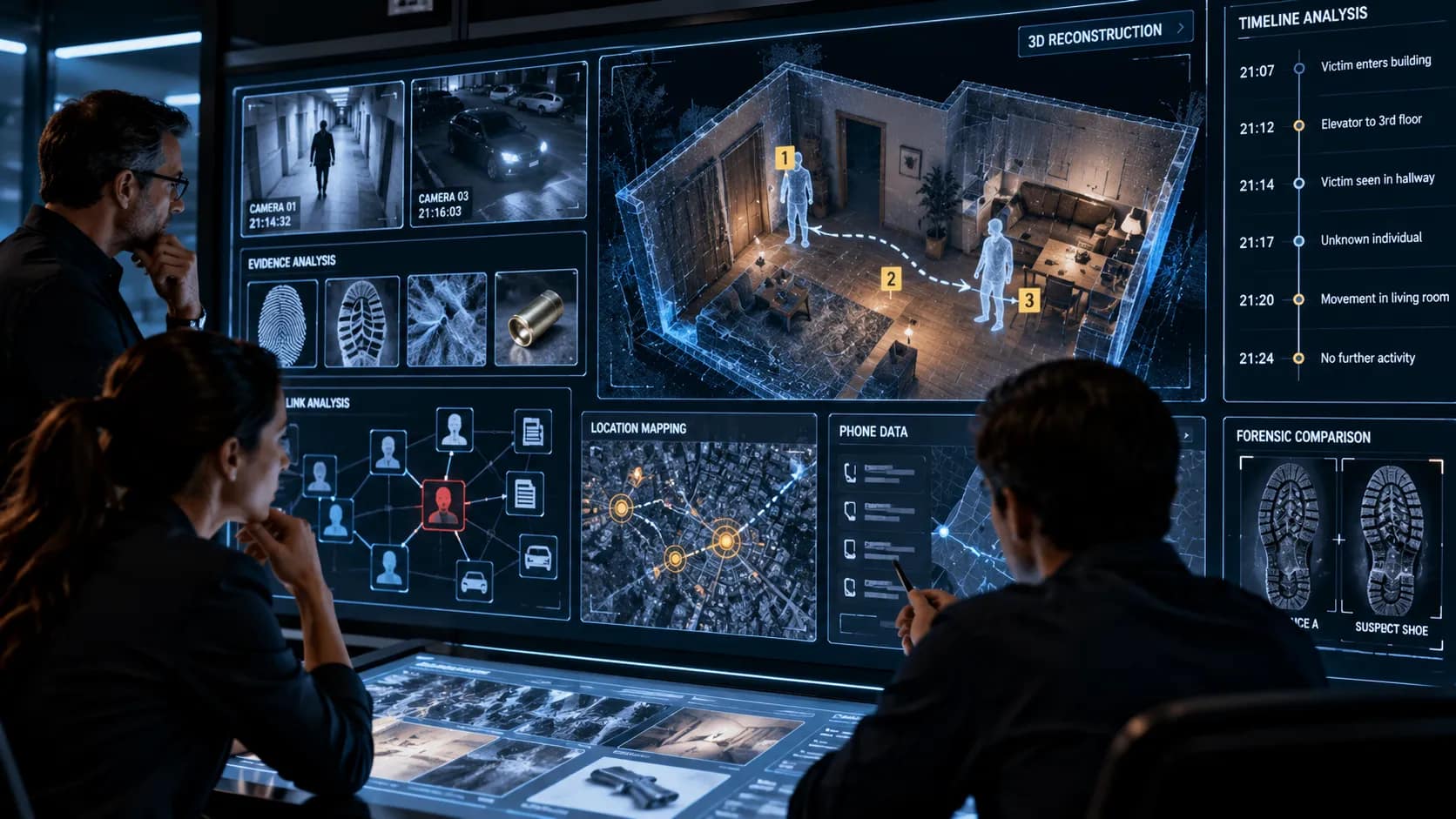
Imagine a future system designed specifically for complex cold cases.
Investigators upload verified case records through a secure system. The software catalogues photographs, witness statements, forensic reports, and digital records. Every item retains its source information and chain-of-custody documentation.
The system builds a timeline, marks contradictions, and creates a visual map of how people, objects, and locations relate to one another.
Investigators can compare different hypotheses. If one scenario conflicts with an authenticated recording, the system flags the inconsistency. If a question cannot be answered from the available evidence, it marks the gap instead of inventing an explanation.
Every conclusion remains traceable to the evidence that supports it. Human experts review the findings, and independent forensic testing is used wherever possible.
Such a system would not be an all-knowing digital detective. It would be an advanced investigative assistant—one capable of helping humans navigate complex evidence without pretending to know what cannot be known.
The National Institute of Standards and Technology’s review of digital investigation techniques provides a useful foundation for understanding why digital forensic work requires validated methods and careful interpretation of recovered evidence.
The most valuable feature of this imagined technology would not be its ability to produce a realistic animation. It would be its ability to explain exactly which parts of a reconstruction are supported by evidence and which remain uncertain.
8. Will AI Eventually Solve Murders That Humans Could Not?
AI will likely become increasingly useful in forensic investigations as analytical tools improve and more evidence becomes available in searchable digital formats.
However, there is no sound basis for claiming that AI will solve every cold case—or that it will reconstruct every victim’s final moments accurately.
Some crimes leave very little usable evidence. Records may have been destroyed, witnesses may be unavailable, and the decisive information may never have been collected.
No algorithm can reliably recover information that does not exist in the evidence, although it may help discover previously overlooked clues.
There is also a difference between generating a plausible explanation and establishing what actually happened. The first is a computational task. The second requires evidence that survives scientific and legal scrutiny.
Future systems could make significant contributions by identifying unknown victims, organising complex records, finding investigative leads, and helping experts evaluate alternative explanations.
Whether those advances translate into more solved murders will depend on the quality of the evidence, the validity of the methods, and the decisions investigators make.
The Final Verdict: AI May Reconstruct the Possibilities, but Evidence Must Reveal the Truth
Could artificial intelligence reconstruct the final moments of an unsolved murder?
In a limited sense, yes. Existing forensic methods and emerging AI tools can already assist with parts of the investigative process, including image analysis, digital evidence examination, and the interpretation of complex records.
A more advanced system could eventually help investigators assemble detailed, evidence-based timelines and compare competing reconstructions of a crime.
But there is a boundary that technology cannot simply wish away.
A computer-generated scene is not a recording of the past. A statistical pattern is not proof of guilt. And a convincing explanation is not necessarily the correct one.
The real breakthrough would be an AI system capable of helping investigators discover overlooked evidence while clearly acknowledging uncertainty, documenting its reasoning, and allowing its conclusions to be independently tested.
For families who have waited decades for answers, even one reliable lead could matter enormously.
The future of AI in criminal investigation should therefore be measured not by how convincingly it can recreate a murder, but by whether it can help uncover verifiable facts without creating new injustices.
The most powerful artificial detective will not be the one that always has an answer. It will be the one that knows the difference between what the evidence reveals, what it suggests, and what remains unknown.




