
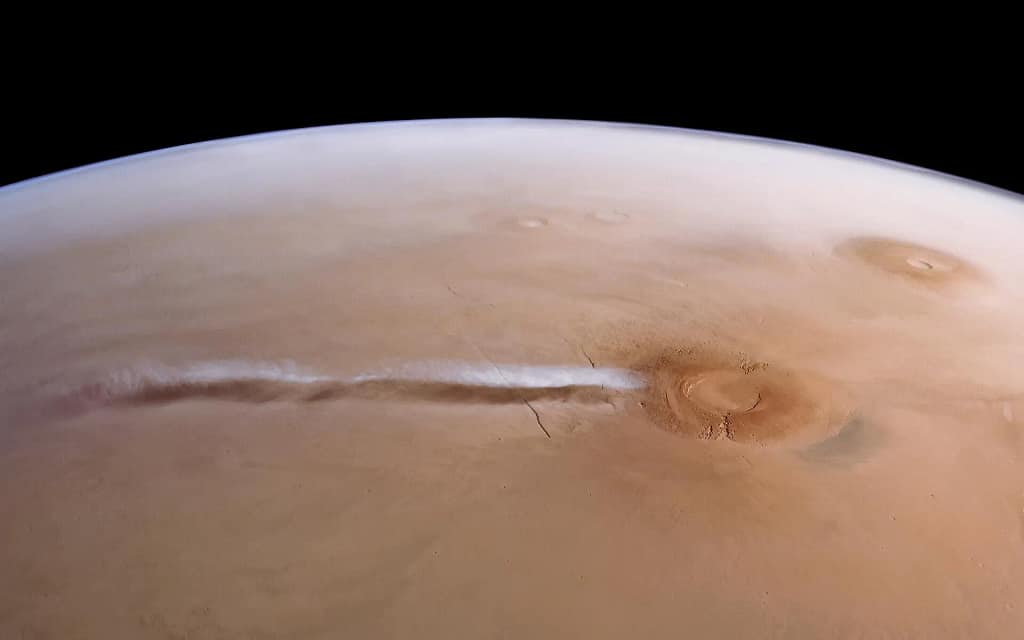
Imagine looking at Mars and discovering a gigantic white cloud stretching across the planet’s reddish landscape for more than 1,500 kilometres.
It appears near an enormous extinct volcano, grows rapidly during the Martian morning and then seems to disappear as the day progresses. The following morning, the phenomenon can return, sometimes extending across a distance comparable to the width of several European countries.
This is not a storm of dust, an eruption of volcanic ash or evidence of an active volcano.
It is an unusual atmospheric phenomenon known as the Arsia Mons Elongated Cloud (AMEC).
Scientists have observed this extraordinary formation for decades, but its behaviour continues to attract scientific interest. The cloud is associated with Arsia Mons, one of the largest volcanoes in the Tharsis region of Mars.
What makes it particularly fascinating is that it can develop into an enormous, elongated structure despite the planet having an atmosphere far thinner than Earth’s.
Its formation offers an opportunity to understand Martian weather, atmospheric circulation and the unusual interactions between mountains and planetary atmospheres.
And although scientists have developed a convincing explanation for how it forms, several details about its behaviour remain under investigation.

Meet Arsia Mons: The giant volcano behind the mysterious cloud
To understand the phenomenon, we first need to look at the enormous geological structure responsible for it.
Arsia Mons is one of the major volcanoes in the Tharsis region, a vast volcanic province near the Martian equator.
It rises approximately 20 kilometres above the surrounding terrain, making it nearly two and a half times as tall as Mount Everest when measured from its base.
Arsia Mons is an ancient shield volcano, formed through repeated eruptions of relatively fluid lava over geological timescales.
It is not currently known to be erupting.
However, its enormous size has a major influence on the atmosphere moving around it.
On Earth, mountains can force moist air upwards, causing it to cool and form clouds. A similar phenomenon happens on Mars, but the planet’s atmospheric conditions make the process particularly unusual.
The Arsia Mons cloud develops on the volcano’s western side before extending westward across the surrounding landscape.
Its extraordinary length is what makes it stand out among Martian atmospheric phenomena.
How big is this cloud?
Scientists have measured the Arsia Mons Elongated Cloud at lengths reaching approximately 1,800 kilometres.
That is substantially longer than the distance from London to Rome.
Its width is considerably smaller, typically remaining below 200 kilometres, giving it the appearance of a gigantic white ribbon floating above the Martian surface.
The cloud is also remarkably high, forming around 45 kilometres above the Martian surface reference level.
The Arsia Mons Elongated Cloud in numbers
1,800 km
Maximum observed length
45 km
Approximate altitude
20 km
Arsia Mons volcano height
2.5 hours
Rapid expansion phase
Measurements from published observations. Maximum cloud length varies between observations.
That is roughly 612 kilometres per hour.
It is important to understand that this does not mean the entire cloud moves as one solid object at that speed. The measurement describes the apparent westward expansion of its elongated structure.
What makes the phenomenon even more unusual is its predictable daily behaviour.
A cloud that appears almost like clockwork
One of the most fascinating discoveries about AMEC is that it does not appear randomly.
Instead, it follows a remarkably consistent daily cycle during particular seasons of the Martian year.
Researchers have reconstructed this behaviour using observations from ESA’s Mars Express and other spacecraft.
The process begins around the early morning hours.
Before sunrise: A bright cloud head begins forming near the western slope of Arsia Mons.
After sunrise: The cloud rapidly stretches westward, developing its distinctive elongated tail.
Around two to three hours later: Its expansion slows, and the cloud begins separating from its original formation region.
Later in the morning: Winds carry the cloud farther westward, while increasing temperatures cause the water-ice particles to evaporate or sublimate.
By the afternoon, the spectacular formation has largely disappeared.
The following morning, the process can begin again.
Researchers found this repeated pattern through observations covering multiple Martian years.
This behaviour is particularly interesting because Mars has a much thinner atmosphere than Earth.
The fact that such an enormous cloud can repeatedly form and disappear within a few hours demonstrates how powerful local atmospheric conditions can be.
Why does the cloud form? The role of Arsia Mons
For years, scientists have investigated how the enormous volcano creates the conditions necessary for this cloud to develop.
The leading explanation involves a process called orographic lifting.
This happens when moving air encounters a mountain or other elevated terrain and is forced upwards.
As the air rises, atmospheric pressure decreases. The air expands and cools, potentially allowing water vapour to condense into tiny ice particles.
In the case of Arsia Mons, the volcano’s enormous height disrupts the surrounding atmospheric circulation.
Researchers believe that winds interacting with the volcano produce powerful upward and downward movements of air.
These movements create a particularly favourable environment for cloud formation on the western side of the mountain.
Computer simulations published in 2022 showed that the atmospheric circulation associated with Arsia Mons could produce a temperature drop of approximately 30 degrees Celsius in the region where the cloud forms.
That rapid cooling helps explain the appearance of the cloud head.
However, the simulations could not fully reproduce the extraordinary length of the cloud’s tail.
This left scientists with an important unanswered question: how does a relatively small cloud-forming region develop into a structure stretching more than 1,000 kilometres across Mars?
The October 2026 discovery: Scientists may have found an unusual cloud-forming mechanism
A new development has made the Arsia Mons cloud even more interesting.
On October 7, 2026, the European Space Agency announced new findings from researchers combining Mars Express observations with an advanced meteorological model of the Red Planet.
The research suggests that the cloud may form through an unusual physical process called homogeneous nucleation.
To understand why this matters, it helps to know how clouds normally form.
On Earth, water vapour generally needs tiny particles in the atmosphere to provide surfaces on which water droplets or ice crystals can develop.
These particles are known as cloud condensation or ice-nucleating particles. They can include dust, salt and other microscopic material.
This is known as heterogeneous nucleation.
But the new research suggests that the Arsia Mons cloud may not need those particles to begin forming.
Instead, under extraordinary atmospheric conditions, water vapour may transform directly into ice particles without requiring a pre-existing dust particle as a starting point.
This is homogeneous nucleation.
It is a particularly surprising possibility because the process requires extremely high levels of supersaturation: the atmosphere must contain vastly more water vapour than it can normally sustain in that state.
According to the new modelling, the relative humidity conditions could reach levels more than 100,000 times those typically experienced in everyday conditions on Earth.
This is not simply another explanation for an unusual cloud.
If confirmed, it could provide evidence of a cloud-formation process occurring naturally under extreme conditions in another planet’s atmosphere.
What happens inside the Martian atmosphere?
The new model offers a fascinating explanation.
As winds encounter the massive Arsia Mons volcano, the mountain triggers powerful atmospheric waves.
These waves can rapidly lift pockets of moist air several kilometres higher into the atmosphere.
As the air rises, it expands and cools dramatically.
The new modelling indicates that temperatures can fall by around 30 degrees Celsius in approximately 10 minutes.
Under these conditions, the water vapour becomes extraordinarily supersaturated.
Rather than waiting for microscopic dust particles to initiate cloud formation, water molecules may begin forming ice particles spontaneously through homogeneous nucleation.
Once the ice particles develop, high-altitude winds help spread them westward, producing the elongated structure visible in spacecraft images.
The process offers a possible explanation for why the cloud forms so quickly and develops such an unusual shape.
However, an important qualification remains: this is a model-supported explanation, not direct laboratory confirmation of every step occurring inside the Martian cloud.
The researchers also acknowledge that aspects of the simulated cloud still do not perfectly match observations.
Why does the cloud appear only during certain Martian seasons?
Another mystery involves timing.
The Arsia Mons Elongated Cloud is not visible throughout the entire Martian year.
It appears mainly during spring and summer in the planet’s southern hemisphere, particularly around the southern solstice and the dusty season.
Researchers have identified its occurrence within a seasonal window corresponding approximately to solar longitude 220–320 degrees.
Solar longitude is a way of describing the position of Mars in its orbit around the Sun, allowing scientists to track its seasons.
Several environmental factors may explain this seasonal behaviour:
-
Atmospheric circulation: Seasonal changes alter wind patterns around Arsia Mons.
-
Water vapour availability: The amount and distribution of atmospheric moisture change throughout the Martian year.
-
Temperature: The atmospheric conditions required for ice formation are only available during particular periods.
-
Dust activity: Martian dust storms can alter atmospheric temperatures and circulation.
Researchers have also noticed that the cloud’s behaviour can change between Martian years.
For example, the major global dust storm of 2018 coincided with unusual variations in its development.
This suggests that the cloud is influenced by the wider Martian climate, not simply by the presence of the volcano.
How did scientists manage to observe something so temporary?
The discovery and investigation of AMEC demonstrate the importance of long-running planetary missions.
The Mars Express spacecraft, launched in 2003, has played a particularly important role.
Its Visual Monitoring Camera, originally designed for engineering and monitoring purposes, became an unexpectedly useful scientific instrument for observing Martian atmospheric phenomena.
Researchers combined its observations with data from several other missions, including:
-
NASA’s Mars Reconnaissance Orbiter.
-
NASA’s MAVEN.
-
The Viking 2 mission.
-
India’s Mars Orbiter Mission.
The research team also revisited archival spacecraft images dating back to the 1970s.
This allowed scientists to establish that the phenomenon was not a recent development but a recurring feature of the Martian atmosphere.
In fact, the cloud had been photographed decades before researchers understood its complete daily cycle.
What remains unexplained?
Despite the progress, the Arsia Mons cloud still presents several scientific challenges.
1. Why is its tail so extraordinarily long?
The 2022 atmospheric simulations reproduced important aspects of the cloud’s formation but struggled to recreate its full elongated tail.
The 2026 modelling offers a possible explanation involving homogeneous nucleation, but researchers still need to understand all the physical processes responsible for its extreme expansion.
2. How frequently does homogeneous nucleation occur on Mars?
If the proposed mechanism is correct, scientists need to establish whether similar conditions exist elsewhere on the planet.
Could other mountains produce comparable clouds? Or does Arsia Mons occupy an unusually favourable position?
3. How does dust influence the phenomenon?
Mars is famous for its enormous dust storms. Researchers still need to understand how suspended dust particles interact with the cloud-forming process and whether they influence its development.
4. Can future spacecraft observe the entire process?
Because the cloud changes so quickly, capturing its complete development requires observations at carefully selected times.
Long-term monitoring will be important for testing the new models and identifying differences between Martian seasons.
Could this discovery change what we know about weather on other planets?
The significance of the Arsia Mons cloud extends beyond Mars.
Cloud formation is a fundamental atmospheric process, but the conditions under which clouds develop can vary dramatically between planets.
Earth has a dense atmosphere containing abundant water vapour and microscopic particles.
Mars has a much thinner atmosphere, different temperature conditions and a distinctive pattern of atmospheric circulation.
Venus has an extremely dense atmosphere dominated by carbon dioxide, with clouds containing sulphuric acid.
Studying the unusual Martian cloud could help scientists understand how atmospheric waves, temperature changes and microscopic particle formation interact under conditions very different from those on Earth.
The possibility of homogeneous nucleation is particularly interesting because it could expand our understanding of how clouds form in planetary atmospheres.
It may also help researchers improve atmospheric models used to understand Mars and other worlds.
A mysterious white ribbon that reveals how much we still have to learn about Mars
Mars is often portrayed as a dry, dusty and lifeless world.
But its atmosphere is far more dynamic than that simple description suggests.
The Arsia Mons Elongated Cloud demonstrates how a single geological feature can influence atmospheric circulation on an enormous scale.
For years, scientists understood that the towering volcano was responsible for creating the conditions behind the cloud. Yet explaining its extraordinary length and rapid daily appearance remained difficult.
The October 2026 findings have introduced a fascinating new possibility: water vapour may be transforming directly into ice particles through an unusual nucleation process under extreme atmospheric conditions.
That explanation is not yet the final word. Some aspects of the cloud remain difficult to reproduce in computer simulations, and further observations will be necessary.
But this is precisely what makes planetary science so exciting.
Sometimes, an enormous discovery begins with something that looks deceptively simple: a thin white cloud floating above a distant volcano.
And on Mars, that cloud may be revealing atmospheric physics that scientists have never directly observed on another planet.




