
A Wheat Field Discovery That Raised More Questions Than Answers
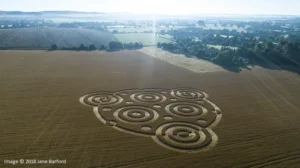
On a quiet summer morning in southern England, a farmer walked into a field expecting an ordinary day. Instead, he found a massive geometric pattern stretching across acres of wheat. Perfect circles intersected with intricate lines, forming a design so precise that it seemed almost impossible to create overnight.
At first glance, the formation looked like another crop circle—one of thousands reported around the world over the past several decades. But investigators who later examined the site claimed something unusual. The plants were bent rather than broken. Certain soil samples appeared different from nearby unaffected ground. Some researchers reported localized electromagnetic irregularities, while others noted strange changes in seed germination rates.
These observations fueled a debate that continues today.
Most crop circles can be explained as human-made creations. Yet a small number of formations have generated scientific curiosity because of reported physical effects that appear difficult to reproduce through conventional methods. While none of these observations provide evidence of extraterrestrial involvement, they raise legitimate questions about whether all crop circles are created in exactly the same way.
The mystery lies not only in the patterns themselves but in the physical traces some formations allegedly leave behind.
The Modern Crop Circle Phenomenon
Crop circles are patterns created by flattening crops such as wheat, barley, corn, or rapeseed. Reports of circular formations date back centuries, but the modern phenomenon gained worldwide attention during the late 1970s and 1980s.
Most contemporary crop circles have been documented in:
- England
- Germany
- Canada
- Australia
- United States
- Netherlands
The region surrounding Wiltshire, England, became particularly famous because of the large number of formations appearing near ancient landmarks such as Stonehenge and Avebury.
As public interest grew, many artists and pranksters admitted to creating crop circles using simple tools including ropes, wooden planks, and measuring equipment. These admissions convinced much of the scientific community that crop circles were largely a cultural phenomenon rather than a scientific mystery.
Yet some researchers argued that certain formations displayed characteristics not easily explained by mechanical flattening alone.
Beyond Geometry: The Physical Evidence Debate
The visual appearance of a crop circle is often the least interesting aspect for investigators.
Researchers interested in anomalous formations focus on physical evidence that may remain after the pattern appears.
Reported anomalies include:
- Altered soil chemistry
- Unusual electromagnetic readings
- Changes in plant growth
- Modified seed germination rates
- Magnetic particle concentrations
- Bent plant nodes
- Elevated radiation measurements
- Soil dehydration patterns
Not every formation displays these effects.
In fact, most do not.
The mystery centers on a relatively small number of cases where researchers claim measurable differences exist between crops inside and outside the formation.
The Curious Case of Bent Plant Nodes
One of the most frequently discussed observations involves plant stems.
In many human-made crop circles, crops are crushed or broken by physical pressure.
However, investigators examining certain formations reported something different.
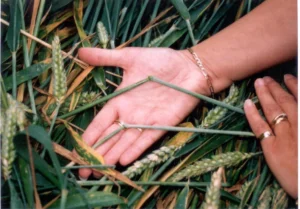
Instead of breaking, some plants appeared bent at their nodes—the joint-like structures connecting segments of the stem.
Researchers observed:
- Elongated nodes
- Curved stems
- Continued plant growth after flattening
- Minimal structural damage
This distinction became important because some scientists proposed that heating or rapid exposure to energy could theoretically soften plant tissues, allowing bending without breaking.
Several laboratory experiments demonstrated that microwave heating can cause node expansion under specific conditions.
However, critics argue that environmental stress, moisture, growth conditions, and mechanical pressure can also produce similar effects.
The debate remains unresolved because field conditions vary dramatically from one formation to another.
Reports of Electromagnetic Anomalies
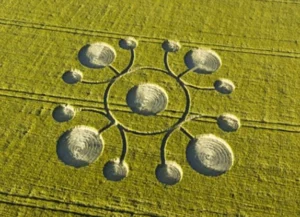
Perhaps the most intriguing claims involve electromagnetic measurements.
Over the years, independent investigators have reported localized electromagnetic irregularities inside certain crop circles.
These observations have included:
- Compass deviations
- Temporary equipment malfunctions
- Magnetic field variations
- Static electricity buildup
- Unusual battery drainage reports
In some cases, researchers detected magnetic particles embedded within soil samples.
Tiny iron-rich spheres have attracted particular attention.
These microscopic particles resemble materials sometimes produced during high-temperature industrial processes, lightning strikes, or other energetic events.
The question is whether their presence is genuinely unusual or simply part of the natural environmental background.
Many scientists remain skeptical because measurements have often been collected after public access to the site, making contamination difficult to rule out.
Nevertheless, the repeated appearance of similar claims across multiple investigations continues to attract interest.
Soil Changes That Defy Easy Explanation
Soil is an environmental archive.
Every process occurring within a field leaves traces that can often be detected through chemical analysis.
Researchers studying selected crop circles have reported changes including:
Altered Mineral Concentrations
Some studies found differences in:
- Calcium levels
- Potassium content
- Iron concentrations
- Trace metals
These variations were not always statistically significant, but they fueled speculation that unusual processes may have affected the soil.
Moisture Differences
Certain formations appeared to dry differently than surrounding areas.
Researchers observed:
- Reduced moisture retention
- Localized dehydration zones
- Changes in soil compaction
These effects could potentially result from mechanical compression, weather patterns, or other natural factors.
Magnetic Soil Components
Perhaps most controversial are reports of magnetic particles embedded within affected areas.
Some investigators suggested these particles may have been exposed to high temperatures.
Others argue they are common environmental contaminants.
The lack of consistent, peer-reviewed replication remains a major obstacle to drawing firm conclusions.
The Seed Germination Experiments
One of the most fascinating areas of crop circle research involves plant biology.
Investigators collected seeds from inside and outside various formations and compared their growth patterns under controlled conditions.
Several experiments reported:
- Faster germination
- Slower germination
- Abnormal root development
- Differences in plant height
- Altered growth rates
The results were often inconsistent.
Some formations showed effects while others did not.
This inconsistency creates a major challenge.
If a single mechanism were responsible for all crop circles, researchers would expect more uniform results.
Instead, findings vary widely.
That variability suggests either multiple causes or significant environmental influences unrelated to the formation itself.
Could Natural Electromagnetic Events Be Responsible?
One proposed explanation involves naturally occurring electromagnetic phenomena.
Earth’s atmosphere constantly generates electrical activity.
Potential sources include:
- Lightning
- Plasma discharges
- Ball lightning
- Geomagnetic fluctuations
- Atmospheric electricity
Some researchers have suggested that rare plasma vortices could theoretically flatten crops while generating localized electromagnetic effects.
The idea gained attention because plasma can:
- Produce heat
- Generate magnetic fields
- Alter nearby materials
- Create luminous effects
Interestingly, some eyewitnesses have reported glowing spheres near crop circle sites.
However, eyewitness testimony alone cannot establish causation.
Furthermore, no verified observation has conclusively demonstrated a plasma event creating a crop circle from start to finish.
The theory remains speculative but scientifically plausible enough to warrant continued investigation.
The Ball Lightning Hypothesis
Ball lightning is one of the least understood atmospheric phenomena.
Witnesses describe glowing spheres ranging from a few centimeters to several meters in diameter.
These objects have reportedly:
- Floated through the air
- Changed direction unexpectedly
- Persisted longer than ordinary lightning
- Produced electromagnetic effects
A handful of scientists have proposed that ball lightning-like phenomena could contribute to at least some crop circle formations.
The theory suggests that rotating plasma structures may:
- Flatten vegetation
- Heat plant tissues
- Affect soil chemistry
- Create magnetic signatures
Despite decades of research, ball lightning itself remains poorly understood.
As a result, using it to explain crop circles introduces one mystery to solve another.
Why Human Hoaxes Cannot Be Ignored
Any serious discussion of crop circles must acknowledge a critical reality.
Many formations are undeniably human-made.
Professional crop circle artists have demonstrated remarkable skill and precision.
Using:
- GPS equipment
- Measuring tape
- Laser alignment tools
- Mathematical planning
Teams can create stunning designs within hours.
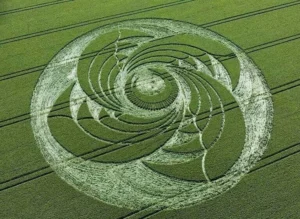
This means visual complexity alone is not evidence of anything unusual.
A formation’s appearance cannot determine its origin.
The real question concerns the reported physical anomalies.
Can all observed soil and plant effects be reproduced through conventional means?
Some researchers believe yes.
Others remain unconvinced.
What Mainstream Scientists Say
Most scientists approach crop circles with caution.
Their concerns are understandable.
Common criticisms include:
Lack of Controlled Data
Many investigations begin after:
- Tourists enter the field
- Media coverage starts
- Environmental conditions change
This complicates scientific analysis.
Replication Problems
A hallmark of science is reproducibility.
Many crop circle findings have not been consistently replicated across independent studies.
Publication Challenges
Much crop circle research appears outside mainstream peer-reviewed journals.
This limits scientific scrutiny.
Selection Bias
Investigators may focus disproportionately on unusual cases while ignoring ordinary formations.
Such bias can distort conclusions.
These criticisms do not necessarily disprove reported anomalies, but they highlight why scientific consensus remains elusive.
The Mystery of Magnetic Microspheres
Among all crop circle claims, magnetic microspheres may be one of the most intriguing.
Researchers have occasionally discovered tiny spherical particles composed largely of iron.
These particles are noteworthy because:
- They often form under high temperatures.
- They possess magnetic properties.
- They appear in some reported anomalous formations.
Possible explanations include:
Industrial Pollution
Factories release microscopic particles into the atmosphere.
Vehicle Emissions
Modern transportation generates metallic particulates.
Lightning Activity
High-energy electrical events can melt materials.
Natural Geological Processes
Earth itself produces magnetic minerals.
Determining whether microspheres originated from unusual events or ordinary environmental sources remains difficult.
Yet their repeated mention in crop circle investigations continues to attract scientific interest.
Could Unknown Atmospheric Physics Be Involved?
History offers numerous examples of natural phenomena that puzzled scientists for centuries.
Examples include:
- Meteorites
- Ball lightning
- Deep-sea hydrothermal vents
- Rogue ocean waves
All were once considered doubtful or poorly understood.
This historical perspective motivates some researchers to keep an open mind regarding crop circle anomalies.
The possibility exists that rare atmospheric interactions involving:
- Plasma
- Electromagnetism
- Weather dynamics
- Soil conductivity
could produce effects not yet fully understood.
Importantly, this does not require extraterrestrial involvement.
Nature itself often proves stranger than expected.
Why Alien Explanations Remain Unsupported
Crop circles are frequently linked to extraterrestrials in popular culture.
Books, documentaries, and television programs often suggest alien intelligence may be responsible.
However, there is currently no credible scientific evidence supporting that conclusion.
No verified investigation has produced:
- Alien technology
- Non-human biological material
- Extraterrestrial signals
- Direct observational proof
The existence of unexplained physical traces does not automatically imply extraterrestrial origins.
Science requires evidence, not assumptions.
While the mystery remains fascinating, extraordinary claims demand extraordinary proof.
That proof has not been found.
Modern Technology Is Changing the Investigation
The future of crop circle research may look very different from the past.
Advanced technologies now allow investigators to collect data with unprecedented precision.
These include:
Drone Mapping
High-resolution aerial imaging provides detailed formation analysis.
Ground-Penetrating Radar
Researchers can examine subsurface structures.
Soil Spectroscopy
Chemical signatures can be analyzed rapidly.
Electromagnetic Sensors
Continuous monitoring may detect transient events.
Satellite Observation
Space-based imaging enables large-scale comparisons.
These tools could help determine whether reported anomalies are genuine environmental phenomena or artifacts of observation.
A Mystery That Refuses to Disappear
Despite decades of investigation, crop circles continue to occupy a strange space between art, folklore, atmospheric science, and mystery.
Most formations can likely be attributed to human creators. That conclusion is supported by numerous documented hoaxes and public demonstrations.
Yet a small subset of reported cases continues to challenge easy explanations.
Researchers have documented claims involving:
- Electromagnetic irregularities
- Altered soil properties
- Magnetic microspheres
- Unusual plant behavior
- Changes in seed development
None of these findings have conclusively overturned conventional explanations.
At the same time, not every observation has been fully explained to everyone’s satisfaction.
Science advances by examining anomalies rather than ignoring them.
Whether future investigations ultimately reveal overlooked environmental processes, misunderstood biological effects, rare atmospheric events, or entirely new insights into how complex natural systems interact remains unknown.
For now, crop circle formations and electromagnetic soil anomalies remain one of the most intriguing unsolved questions at the intersection of agriculture, physics, and environmental science. Beneath the flattened wheat and intricate geometry lies a deeper mystery—not necessarily about visitors from other worlds, but about how much there is still to learn about the world beneath our own feet.
