
A wrench breaks during a mission to Mars.
On Earth, that’s a minor inconvenience. Someone orders a replacement, and a delivery truck solves the problem.
Thirty million miles from home, it’s a very different story.
The damaged tool might be essential for repairing life-support equipment. There are no hardware stores in deep space. No emergency shipments. No overnight deliveries. If astronauts don’t have a spare part onboard, they may have to improvise—or abandon the repair altogether.
Enjoying WhatIfScience?
Add as a preferred source on GoogleGet more science, space and discovery stories in Google Search.
For decades, this has been one of the biggest hidden challenges of human spaceflight. Every mission must carry thousands of spare components because once a spacecraft leaves Earth, resupply becomes difficult or impossible.
Now, a breakthrough aboard the International Space Station may be pointing toward a future where astronauts manufacture what they need, when they need it.
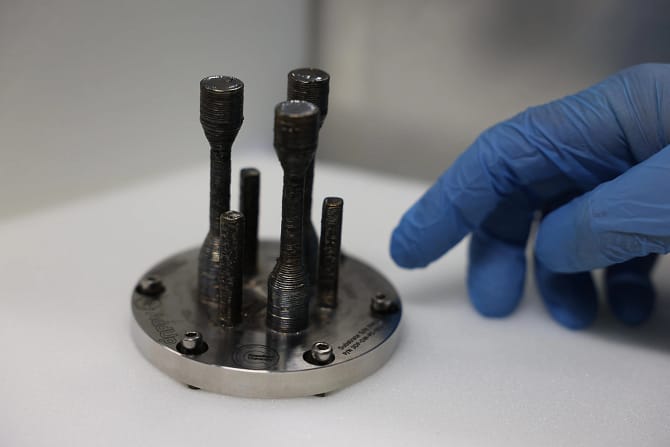
For the first time in history, humans have successfully produced a metal part in space.
It may sound like a small achievement. The printed object itself wasn’t particularly large or complex.
But the technology behind it could eventually allow future crews to build tools, replacement components, scientific equipment, and perhaps even parts of spacecraft while millions of miles from Earth.
In other words, humanity may have just taken its first step toward becoming a truly self-sufficient spacefaring species.
Why Space Missions Have a Spare Parts Problem
Every object launched into orbit comes with a cost.
Getting just one kilogram of material into space can cost thousands of dollars, depending on the launch system and destination. For missions to the Moon or Mars, the expense grows dramatically.
As a result, spacecraft designers face a difficult question:
How many spare parts should a mission carry?
Bring too few, and astronauts risk running out of critical equipment.
Bring too many, and the spacecraft becomes heavier, more expensive, and less efficient.
This challenge becomes even more serious for long-duration missions.
A six-month stay aboard the International Space Station can be supported through regular cargo deliveries from Earth.
A mission to Mars cannot.
Depending on planetary alignment, a round-trip Mars expedition could last more than two years.
Future crews will need the ability to repair and replace components without relying on Earth-based supply chains.
That requirement has pushed engineers toward an idea that once sounded like science fiction:
Manufacturing in space.
From Plastic Printing to Metal Manufacturing
The concept isn’t entirely new.
Enjoying WhatIfScience?
Add as a preferred source on GoogleGet more science, space and discovery stories in Google Search.
Astronauts have already experimented with 3D printers aboard the International Space Station.
Several years ago, plastic printing systems demonstrated that tools and simple objects could be created in orbit.
This was an important milestone.
Instead of storing every possible item that astronauts might need, crews could manufacture certain objects on demand.
But plastic has limitations.
Many spacecraft components must withstand:
- Extreme temperatures
- High mechanical stress
- Radiation exposure
- Continuous wear and tear
Plastic simply isn’t suitable for many critical applications.
Metal is.
On Earth, metal additive manufacturing—commonly known as metal 3D printing—has transformed industries ranging from aerospace to medicine.
Engineers can create highly complex parts with less waste than traditional manufacturing methods.
The challenge was adapting this process for space.
And that turned out to be much harder than it sounds.
Why Printing Metal in Space Is So Difficult

Manufacturing metal parts typically involves melting or fusing metallic materials using intense heat.
On Earth, gravity quietly helps manage many aspects of the process.
Molten metal behaves in predictable ways because gravity pulls it downward.
Heat flows through materials in familiar patterns.
Particles settle.
Liquids pool.
In microgravity, those assumptions disappear.
Without gravity, molten material behaves differently.
Heat distribution changes.
Particles can move unpredictably.
Even tiny changes in the manufacturing process can affect the quality of the final product.
Engineers couldn’t simply take an Earth-based metal printer and place it aboard the ISS.
A new system had to be designed specifically for space.
The result was a compact metal 3D printer developed to operate safely in orbit while handling the unique challenges of microgravity.
When it finally began producing metal samples aboard the station, it marked a historic achievement.
For the first time, astronauts weren’t merely assembling hardware launched from Earth.
They were creating new metal hardware in space itself.
A Small Part With Enormous Implications

The first metal object printed in orbit wasn’t a giant spacecraft component.
It wasn’t a Moon base module.
It wasn’t a revolutionary engine.
And that’s exactly why the achievement matters.
Every major technological transformation begins with something small.
The Wright brothers’ first airplane flew only a short distance.
The first computers occupied entire rooms while performing calculations simpler than those on modern watches.
The first internet connections linked only a handful of machines.
History often remembers the breakthrough, not the humble first step.
The initial metal prints aboard the ISS are best understood as proof of concept.
Scientists now have the opportunity to compare space-manufactured parts with identical components produced on Earth.
By studying differences in strength, durability, and internal structure, researchers can learn how microgravity affects manufacturing.
The knowledge gained from these experiments will shape future generations of space-based factories.
The End of Waiting for Earth
Imagine a future Mars expedition.
Months after arrival, a critical valve fails.
Instead of searching through a limited inventory of spare parts, astronauts access a digital library.
They select the necessary component.
A manufacturing system begins work.
Hours later, a replacement part is ready.
The crew installs it and continues the mission.
This capability would fundamentally change how exploration missions are planned.
Rather than carrying every possible replacement component, astronauts could carry raw materials and digital designs.
Thousands of potential parts could exist as files rather than physical objects.
The reduction in cargo mass alone could save enormous amounts of money and launch capacity.
More importantly, it would give astronauts greater independence.
Future explorers will need the ability to solve problems without waiting for instructions or supplies from Earth.
Space manufacturing could become one of the most important tools for achieving that goal.
Building the Infrastructure of Deep Space
The long-term potential extends far beyond replacement parts.
One of the greatest obstacles facing future exploration is construction.
Every habitat, laboratory, storage module, and support structure must currently be launched from Earth.
That approach becomes increasingly impractical as humanity expands deeper into the Solar System.
Space manufacturing offers an alternative vision.
Instead of launching finished structures, future missions might transport manufacturing systems capable of producing what they need on-site.
A lunar base could manufacture tools and equipment from local materials.
Mars settlements could gradually expand using components produced on the planet itself.
Orbiting facilities might create large structures that would be impossible to launch fully assembled from Earth.
Some researchers even envision enormous space telescopes constructed in orbit using advanced manufacturing technologies.
The first metal print aboard the ISS doesn’t accomplish these goals.
But it points in that direction.
Why Mars Changes Everything
Mars is where this technology becomes truly transformative.
A mission to the Moon is relatively close to Earth.
Depending on orbital positions, communications delays are measured in seconds.
Resupply missions can arrive within days.
Mars is different.
Communication delays can exceed twenty minutes each way.
Cargo deliveries may take months.
Emergency assistance becomes far more difficult.
Future Martian crews will need to operate with a level of autonomy unlike anything experienced by astronauts today.
Manufacturing capabilities will be essential.
A settlement that can repair and reproduce its own equipment is far more resilient than one dependent on constant shipments from Earth.
In many ways, the history of civilization has always been linked to manufacturing.
Communities capable of producing their own tools become stronger, more adaptable, and more independent.
The same principle may eventually apply on other worlds.
The Dream of Space Factories
The concept of manufacturing beyond Earth has fascinated scientists for decades.
As far back as the 1970s, researchers imagined orbital factories producing materials impossible to create under Earth’s gravity.
Microgravity can influence crystal growth, material structures, and manufacturing processes in unusual ways.
Some scientists believe future space factories may eventually produce products with properties unattainable on Earth.
Others envision asteroid mining operations supplying raw materials for construction projects in orbit.
In such a future, spacecraft would no longer be entirely Earth-made.
Parts of them could originate in space itself.
The first successful metal printing experiments aboard the ISS offer a glimpse of that possibility.
A Shift in How Humanity Thinks About Space
Perhaps the most significant aspect of this breakthrough isn’t technical at all.
It’s psychological.
For most of human history, space has been viewed as a destination.
We build things on Earth.
We launch them into space.
Then we use them.
Manufacturing in orbit changes that relationship.
Space begins to transform from a place where humans travel into a place where humans create.
That distinction may seem subtle, but it represents a profound shift.
Permanent human presence beyond Earth will require more than transportation.
It will require industry.
It will require repair.
It will require production.
And ultimately, it will require self-sufficiency.
The ability to manufacture metal in orbit moves humanity one step closer to that future.
The First Spark of a Larger Revolution
The metal component recently produced aboard the International Space Station is unlikely to become famous on its own.
Most people will never know its shape or dimensions.
It won’t be displayed beside the Apollo Moon rocks or remembered like the first footprints on the Moon.
Yet decades from now, historians of space exploration may look back on this moment differently.
They may see it as the beginning of a transition.
A moment when humanity stopped bringing everything it needed from Earth and started learning how to build beyond it.
The object itself was small.
The idea behind it is not.
Because somewhere in the vast distance between Earth and Mars lies a future where astronauts no longer depend entirely on home.
A future where broken tools are replaced, habitats are expanded, spacecraft are repaired, and entire settlements grow using materials manufactured far from our planet.
And if that future arrives, the first chapter may have begun with a modest metal part quietly printed aboard a laboratory orbiting 400 kilometers above Earth.