
Forget the Sky: The Most Terrifying UFOs Are Actually Hiding in Our Oceans
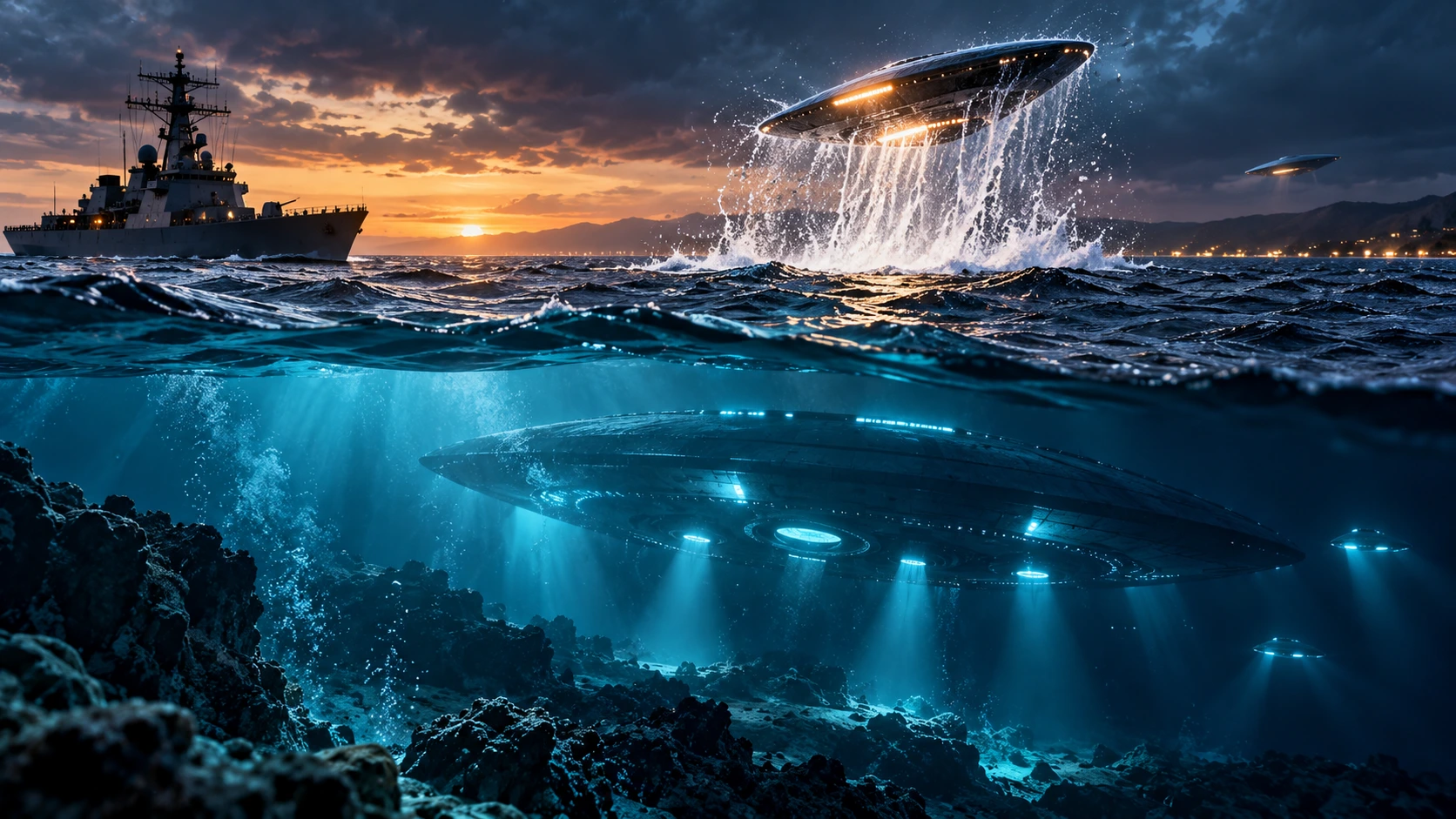
Forget looking at the stars for a moment. While astronomers scan distant galaxies for signs of life and researchers search the universe for radio signals, another mystery is drawing attention closer to home: the possibility that some unidentified objects reported in our skies may also be operating beneath the surface of our oceans.
The subject of Unidentified Anomalous Phenomena (UAP) has moved beyond science fiction and into serious discussions about aviation safety, national security, and scientific investigation. Military personnel have reported unusual objects, government agencies have examined unexplained encounters, and researchers have begun asking whether some sightings could involve objects moving between air and water.
These reports have inspired a particularly unsettling question: what if some of the most difficult objects to identify are not simply passing overhead but disappearing beneath the waves?
There is an important distinction between an unexplained observation and evidence of an extraordinary technology. No publicly established scientific evidence confirms that extraterrestrial craft are living in Earth's oceans. Nevertheless, reports of unidentified submerged objects, unusual acoustic contacts, and alleged transmedium encounters raise questions worth examining carefully.
The ocean is vast, difficult to observe, and still incompletely explored. That makes it an ideal setting for genuine scientific mysteries—and an environment where incomplete information can easily become speculation.
The No-Splash Mystery: Can Objects Move Between Air and Water?
One of the most intriguing ideas in UAP research is known as transmedium travel. The term describes an alleged ability to move between different environments, such as air and water, without the limitations normally associated with conventional aircraft or underwater vehicles. Imagine witnessing an object moving through the sky before apparently entering the ocean. What would happen if the object maintained its speed and direction after crossing the water's surface? For an ordinary aircraft, the transition would be catastrophic. Water is far denser than air, and striking it at high speed can produce enormous forces. Conventional aircraft cannot simply dive underwater at flight speeds and continue operating as though nothing has changed. But the physics of an actual encounter depends on details that eyewitnesses may not be able to establish: the object's true speed, altitude, distance, shape, trajectory, and whether it entered the water at all. A distant light that appears to descend toward the ocean may be moving parallel to the horizon. A radar track can be affected by sensor limitations, while a video may lack the depth information needed to establish an object's precise location. These possibilities do not mean that every report is mistaken. They mean that reliable conclusions require multiple independent observations and measurements.What About the Navy's Reports?
U.S. Navy encounters have helped bring UAP into public discussion, particularly after military footage and pilot testimony attracted widespread attention. Former Navy Rear Admiral Tim Gallaudet has also discussed UAP, maritime security, and the need for more serious scientific investigation of unexplained encounters. Gallaudet's background gives his perspective relevance to maritime operations. However, a credible witness's testimony is not, by itself, proof that an object possesses extraordinary capabilities. Claims of objects entering the water without splashing, changing direction instantaneously, or moving through different environments without losing speed require detailed evidence. Such evidence would ideally include calibrated radar, optical and infrared recordings, sonar measurements, precise timing, and independently verified trajectories. Some researchers have proposed that advanced craft might manipulate gravity, inertia, or spacetime to overcome conventional physical limitations. These ideas are speculative. No publicly demonstrated technology has established that a vehicle can create a protective warp bubble and move freely between air and water in the manner sometimes described in UAP accounts. The real mystery is therefore not whether exotic propulsion has been proven. It has not. The important question is whether sufficiently documented encounters exist that can be independently tested and explained.The 2026 Surge: What Is the Enigma App Finding?
Public interest in unidentified phenomena has grown alongside the availability of online reporting platforms. One example is Enigma, a UAP reporting and data-mapping platform that allows people to submit observations and examine reported sightings. Such platforms can be useful because they bring together accounts that might otherwise remain scattered across social media, local news, and individual reports. However, a database of sightings is not the same thing as a verified catalogue of physical objects.Understanding the Reported Underwater Sightings
Claims circulating online have attributed thousands of reports of underwater or water-associated anomalies to crowdsourced databases, including reports said to occur near U.S. coastlines. Before interpreting a figure such as 9,000 underwater sightings, researchers need to establish what the number actually represents. Does it refer exclusively to submerged objects, all UAP reports near coastlines, or a broader collection of reports categorized by location? They must also determine whether reports have been independently verified, whether duplicate accounts have been removed, and how the platform defines an underwater sighting. Without a clearly documented methodology and a verifiable dataset, a numerical claim should not be treated as proof that thousands of unidentified vehicles are operating beneath the sea. Nevertheless, coastal reports can provide useful starting points for further investigation. Busy maritime regions contain naval installations, commercial shipping lanes, offshore infrastructure, aircraft routes, and complex environmental conditions. These factors create opportunities for unusual observations, but they also introduce many ordinary explanations.California: Catalina Island and Malibu
The waters off Southern California have attracted considerable public attention in discussions of UAP and alleged underwater anomalies. Catalina Island lies off the coast of Los Angeles, while Malibu occupies a stretch of coastline near the Pacific Ocean's deep offshore waters. The region's combination of coastal communities, maritime traffic, military activity, and underwater terrain makes it a plausible area for investigating unusual reports. Yet a concentration of reports does not necessarily indicate a concentration of unexplained physical objects. Sightings may be more common where more people are looking, recording, and submitting reports. A credible investigation would compare reports against shipping records, aviation data, weather conditions, oceanographic measurements, and available sensor records.Florida and the Atlantic Coast
Florida also attracts reports of unusual aerial and maritime observations. Its long coastline, busy ports, tourism industry, military facilities, and extensive boating activity make it a natural location for collecting reports. However, claims of specific underwater hotspots near Fort Lauderdale or other coastal cities need to be evaluated against documented datasets before being described as confirmed concentrations of anomalous craft. The distinction is crucial. Mapping where people report unusual events can help researchers decide where to investigate, but the map itself does not establish what caused those events.The Sycamore Knoll Mystery
One particularly intriguing story circulating in online discussions concerns a supposed underwater structure known as Sycamore Knoll, allegedly located several miles off Malibu at a depth of roughly 2,000 feet. Some online accounts have claimed that the structure disappeared from Google Earth imagery in 2025 and have speculated that it might be connected to a hidden underwater installation. These claims require substantial caution. Google Earth is a visualization platform that combines imagery and geographic datasets from different sources and dates. Underwater terrain views may rely on bathymetric data, interpolated surfaces, and other representations rather than direct, high-resolution photographs of the entire seabed. Changes in how an underwater area appears on a map do not establish that a physical structure has vanished. Differences in data coverage, processing, resolution, and visualization can alter the appearance of seafloor features. Likewise, an unusual-looking shape on a map does not establish that it is artificial, much less extraterrestrial. To substantiate the Sycamore Knoll claims, researchers would need precise coordinates, identifiable source datasets, historical imagery or bathymetric records, and preferably independent sonar surveys. Without that evidence, claims of a disappearing underwater base remain unverified. The story is intriguing precisely because it raises questions about what we can observe beneath the ocean. But it should not be presented as evidence of a secret installation.Sonar Ghosts: The Mystery of Underwater Fast Movers
Not all underwater anomalies begin with a visual sighting. Some reports concern unusual acoustic contacts detected by sonar systems. Sonar uses sound waves to detect and track objects or features underwater. It is an essential tool for submarines, naval vessels, marine researchers, and oceanographers. Under the right conditions, sonar can reveal objects that are invisible to cameras. It can also produce confusing readings when sound travels through layers of water with different temperatures, salinity, and pressure. This complexity has inspired stories about underwater objects called "fast movers," allegedly detected by military sonar operators and said to travel at extraordinary speeds. Some accounts claim speeds of hundreds of knots—far beyond the capabilities of conventional submarines. If an object were reliably measured moving underwater at several hundred knots, that would be a major engineering and scientific finding. Water creates enormous resistance at high speeds, and cavitation, heating, structural stress, propulsion requirements, and control would become serious challenges. However, the critical word is measured. A sonar contact's estimated speed can depend on the sensor geometry, the observer's own motion, the quality of the tracking data, and the assumptions used to calculate the object's trajectory. An unusual acoustic signal may also have a natural or conventional source. A report that an object moved exceptionally quickly is therefore not equivalent to an independently verified measurement of its speed.Could an Object Really Travel at 500 Knots Underwater?
Five hundred knots is approximately 926 kilometers per hour. Sustaining that speed underwater would be an extraordinary technical challenge. Some specialized underwater systems have explored very high speeds, but conventional underwater vehicles generally operate far below this level. The fastest reported experimental systems face substantial trade-offs in range, noise, control, and operating conditions. For a claimed 500-knot underwater object to become convincing evidence of a new technology, investigators would need reliable tracking data, a known sensor configuration, independently confirmed calculations, and enough information to rule out measurement errors. Publicly available evidence has not established that unidentified underwater vehicles routinely travel at such speeds. That does not make acoustic anomalies unworthy of study. It means the scientific priority should be to obtain the original measurements rather than rely on secondhand descriptions.Why the Ocean Could Hide Unusual Objects
If an unknown intelligence wanted to observe Earth without attracting attention, the ocean might seem like an attractive place to investigate. But what makes the underwater environment so difficult to explore?1. Darkness and Limited Visibility
Sunlight penetrates only the upper portion of the ocean. Below the sunlit surface layer, light levels decline dramatically, and much of the deep sea is in near-total darkness. Researchers must rely on specialized lighting, sonar, remotely operated vehicles, and autonomous underwater systems to investigate these environments. A small vehicle can remain difficult to observe visually, especially in deep water. However, darkness does not make an object undetectable to every sensor.2. Immense Depth and Pressure
The ocean contains trenches more than 10,000 meters deep. At such depths, pressure is enormous, and equipment must be specifically engineered to survive. Human divers cannot freely explore the deepest parts of the ocean, and even sophisticated robotic systems face limitations in endurance, communication, and maneuverability. This creates large practical challenges for exploration. It does not mean that the deep ocean is completely unknown or that every unexplored location contains something extraordinary.3. Difficult Communication
Radio waves do not propagate efficiently through seawater over ordinary communication distances. Underwater vehicles therefore often rely on acoustic communication, physical cables, or periodic surfacing to transmit data. Acoustic links have limited bandwidth and can be affected by noise, water conditions, and distance. An underwater vehicle that communicates with a surface station must also manage power, navigation, and data transfer. These constraints help explain why deep-sea exploration remains technically demanding.4. A Vast Area to Investigate
Earth's oceans cover approximately 71 percent of the planet's surface. Although substantial areas have been mapped at varying resolutions, detailed, high-resolution observations of the entire seabed remain incomplete. There is an important difference between having a broad map of the ocean floor and having detailed imagery of every feature. This gap leaves room for new discoveries involving geological formations, hydrothermal vents, deep-sea ecosystems, and previously undocumented habitats. It also makes the ocean fertile ground for speculation. The fact that much remains to be explored is a reason to conduct better research—not a reason to assume that unidentified craft are hiding there.Are They From Space or Are They Interterrestrial?
One of the more unconventional ideas in UAP discussions is the interterrestrial hypothesis. In its broadest form, the hypothesis suggests that an unknown intelligence might inhabit Earth itself rather than originate from another planet. Some versions place such a hypothetical intelligence in the deep ocean, underground environments, or other locations difficult for humans to access. The idea has attracted attention because it offers an alternative to the conventional extraterrestrial explanation for unidentified objects. If an unknown intelligence had existed on Earth for an extremely long time, proponents speculate, it might have developed in an environment largely separated from human civilization. But this scenario remains speculative. There is no verified evidence establishing that a technologically advanced nonhuman civilization inhabits Earth's oceans.Could an Intelligent Species Evolve in the Ocean?
The ocean contains extraordinary biological diversity. Marine animals demonstrate sophisticated sensory systems, complex communication, problem-solving abilities, and behaviors that scientists continue to investigate. Octopuses, for example, display impressive learning and problem-solving capabilities. Dolphins and several whale species use complex vocalizations and social behaviors. These examples demonstrate that intelligence is not limited to humans or to terrestrial environments. However, the existence of intelligent marine animals does not demonstrate that a separate technological civilization evolved underwater. Developing advanced technology would require more than intelligence. A civilization would need ways to obtain and process materials, generate energy, manufacture tools, transmit knowledge, and maintain complex systems. An underwater species might face significant challenges in developing technologies that depend on high-temperature furnaces, combustion, or conventional electronics manufacturing. Hypothetical solutions can be imagined, but no evidence establishes that such a civilization exists.Why the Interterrestrial Hypothesis Captures the Imagination
The hypothesis challenges the assumption that every potential nonhuman intelligence must originate from another star system. It also draws attention to the fact that humans have explored only a small portion of the ocean in detail. But an idea's ability to explain a mystery is not evidence that the idea is correct. The interterrestrial hypothesis would need positive, independently verifiable evidence—such as an authenticated artifact, a confirmed biological discovery, or repeatable observations of technology that cannot be explained through conventional means. Until then, it belongs in the category of speculative possibilities rather than established science.What Does the Pentagon Actually Know About Underwater UAP?
Government interest in unidentified phenomena is real, but the distinction between investigating a report and confirming its extraordinary interpretation is essential. The Pentagon's All-domain Anomaly Resolution Office (AARO) investigates reports of unidentified anomalous phenomena across different environments. Its work includes assessing possible national-security implications and examining whether reported incidents can be explained through available evidence. AARO's existence does not establish that extraterrestrial vehicles have been discovered. Likewise, the release or acknowledgment of military footage does not automatically confirm every interpretation attached to it.The USS Omaha Video
In 2019, a video associated with a U.S. Navy encounter involving the USS Omaha circulated publicly and became part of wider UAP discussions. Online commentary has sometimes described the footage as showing an object entering the ocean and disappearing. The important distinction is between what a video actually records and what observers infer from it. A video may show a light or object near the horizon, but without reliable range information and additional sensor data, it can be difficult to determine its true distance, size, motion, or whether it entered the water. The existence of a military recording does not, by itself, establish that the object was a transmedium vehicle. Claims that the footage definitively demonstrates a craft plunging into the ocean should therefore be treated cautiously unless supported by authenticated, contextualized evidence.What Would Convince Scientists?
A convincing investigation of an alleged underwater UAP would ideally combine several types of evidence:- Optical recordings: Multiple cameras providing synchronized views from known locations.
- Radar measurements: Calibrated tracking data that helps establish the object's position and trajectory.
- Sonar observations: Original acoustic records with known sensor characteristics and environmental conditions.
- Oceanographic data: Measurements of currents, temperature, salinity, visibility, and other factors that may influence observations.
- Independent analysis: Experts able to examine the original records and test competing explanations.
Could Unidentified Submerged Objects Threaten Maritime Security?
Even without an extraterrestrial explanation, unidentified objects in maritime environments can present legitimate security questions. Naval forces, commercial ships, offshore energy facilities, and underwater communications cables all operate in an environment where reliable situational awareness matters. An unidentified contact near a sensitive installation could represent a conventional vessel, an autonomous underwater vehicle, a natural acoustic event, or a sensor error. Determining which explanation is correct may be important for operational safety and national security.The Growing Role of Underwater Drones
Uncrewed underwater vehicles are increasingly useful for scientific research, infrastructure inspection, ocean mapping, and military applications. These systems can operate without an onboard human crew, gather data in difficult environments, and perform tasks that might be expensive or dangerous for conventional vessels. As the technology advances, distinguishing an unfamiliar autonomous vehicle from an unknown natural or sensor-generated phenomenon may become more challenging. This is a credible reason for governments to improve underwater monitoring and data-sharing systems. It is not necessary to assume an extraterrestrial origin to recognize that unidentified objects in sensitive maritime areas deserve careful investigation.What About Threats to Ships?
There are no publicly established cases proving that extraterrestrial USOs have attacked ships. Claims of unusual objects operating in restricted maritime zones should be evaluated individually, using the best available evidence. A genuine security risk may arise if an unidentified object interferes with navigation, approaches sensitive infrastructure, or compromises communications. Those possibilities can be investigated using conventional maritime-security methods. The key is to separate the practical question—whether an object poses a threat—from the much more difficult question of what the object actually is.Could We Discover Something Extraordinary Beneath the Waves?
The possibility of an unexpected discovery is one of the strongest reasons to continue exploring the ocean. Scientists have found previously unknown marine species, unusual geological formations, hydrothermal vent ecosystems, and evidence of complex biological processes in environments once thought inhospitable. Future missions may reveal additional discoveries that change our understanding of life and the planet. Could a future underwater investigation uncover an object that cannot be explained by known technology? In principle, scientific exploration can produce unexpected results. But the possibility of a discovery should not be confused with evidence that it has already occurred. If researchers encounter an apparently artificial object, the first steps would be to document its location, obtain detailed imagery, collect measurements, preserve relevant samples where appropriate, and invite independent examination. If the object showed features that could not be explained by known materials or engineering, the discovery would demand extraordinary scientific attention. Until such evidence emerges, the most responsible approach is to remain curious without assuming the conclusion.The Future of UAP Research: Better Sensors, Better Evidence
UAP research is entering a period in which better instruments and more systematic reporting could improve the quality of investigations. Satellite observations, airborne sensors, radar systems, underwater acoustic networks, autonomous vehicles, and artificial intelligence may all contribute to analyzing unusual events. However, collecting more data is not automatically the same as collecting better data. Sensors need calibration, records require context, and automated classification systems must be tested for errors. Researchers also need to distinguish genuine unknowns from incomplete observations. An event may remain unidentified because the available data are insufficient, not because it violates the laws of physics.How Artificial Intelligence Could Help
Machine-learning systems can help process large volumes of radar, sonar, and optical data. They may identify patterns, flag unusual measurements, and compare new observations with known objects or environmental events. For example, an analysis system might compare an acoustic contact with the signatures of commercial vessels, marine animals, underwater equipment, or common oceanographic phenomena. Such tools could help researchers prioritize observations for human review. However, an AI system cannot establish an object's origin simply by assigning it an unfamiliar classification. If the training data are incomplete or the measurements are poor, a system may confidently misclassify an ordinary event. Reliable conclusions will still depend on original measurements, validated methods, and independent verification.Final Thoughts: The Ocean Is Still a Frontier
The idea that unidentified craft could be moving beneath our oceans is compelling because it brings together two enduring mysteries: the nature of UAP and the enormous complexity of the deep sea. There are legitimate reasons to investigate unusual underwater observations. Military personnel and researchers can encounter incomplete sensor readings, unfamiliar vehicles, and events that are difficult to explain from a single recording. Better technology and systematic data collection may eventually resolve some of these cases. But the distinction between an unexplained observation and an extraordinary discovery must remain clear. There is currently no publicly verified scientific evidence establishing that extraterrestrial craft operate in Earth's oceans, that a hidden nonhuman civilization lives beneath the waves, or that alleged underwater objects routinely travel at hundreds of knots. That does not make ocean exploration less exciting. Quite the opposite: the ocean contains real scientific mysteries that can be investigated through measurement, experimentation, and evidence. Perhaps the most important discovery will not be a hidden alien base. It may be a better understanding of the ocean itself, improved methods for tracking underwater objects, or a clearer picture of how unusual observations become extraordinary stories. And if a genuinely unexplained object is eventually discovered beneath the waves, the most convincing evidence will not be a viral video or a dramatic theory. It will be the kind of evidence that scientists around the world can examine, test, and independently verify. Until then, the deep ocean remains a frontier worth exploring—not because we know that something extraordinary is hiding there, but because we still have so much to learn.Frequently Asked Questions: The Truth About USOs
1. What exactly is a USO?
USO commonly stands for Unidentified Submerged Object, although the term is sometimes expanded as Unidentified Submersible Object. It describes an object reported underwater or in connection with an apparent entry into or exit from the water that has not been reliably identified. The label describes an unresolved observation, not proof of an unusual vehicle.2. Has the government confirmed that USOs are extraterrestrial craft?
No. Government agencies investigate unidentified anomalous phenomena, including reports with potential maritime or national-security implications. Investigating a report does not establish that the object is extraterrestrial or that it possesses advanced propulsion technology.3. Did the USS Omaha video prove that a UFO entered the ocean?
The footage has been discussed extensively in UAP circles, but claims that it conclusively demonstrates an object entering the ocean require corroborating evidence. Video alone may not establish an object's distance, trajectory, or interaction with the water.4. Can an object really travel at 500 knots underwater?
Such a speed would represent an extraordinary engineering challenge. Claims that unidentified underwater objects routinely reach hundreds of knots have not been established through publicly verified measurements. Reliable sensor records and independent calculations would be needed to substantiate them.5. Is there a confirmed underwater UFO base near Malibu?
No publicly verified evidence establishes that an extraterrestrial base exists near Malibu. Stories about alleged underwater structures, including claims involving Sycamore Knoll, require precise coordinates and independently verifiable geological or sonar data before any extraordinary interpretation can be justified.6. What is the interterrestrial hypothesis?
The interterrestrial hypothesis proposes that a hypothetical nonhuman intelligence might originate on Earth rather than from another planet. Some versions speculate about oceans or underground environments. It remains an unverified idea without established evidence of a hidden technological civilization.7. Why is the deep ocean so difficult to explore?
The deep ocean presents extreme pressure, darkness, communication limitations, and logistical challenges. Specialized submersibles, remotely operated vehicles, autonomous underwater vehicles, and sonar systems help researchers explore it, but detailed observations of the entire seabed remain incomplete.8. Could underwater drones explain some USO sightings?
Possibly. Autonomous underwater vehicles, conventional submarines, surface vessels, marine animals, and environmental effects can all be relevant possibilities when investigating an underwater report. Each observation needs to be assessed using its own evidence.9. Is there scientific proof of aliens living in Earth's oceans?
No verified scientific evidence currently establishes that extraterrestrial beings or a technologically advanced nonhuman civilization live in Earth's oceans. The possibility is a subject of speculation, not an established scientific finding.10. How can scientists determine whether an underwater sighting is genuine?
Investigators can combine calibrated sonar, synchronized video, radar where relevant, precise location and timing data, oceanographic measurements, and independent analysis. The goal is to identify the object or determine what further evidence is required to explain the observation.References and Further Reading
The following resources provide starting points for investigating UAP reports, ocean exploration, and maritime technology. Specific claims about Enigma sighting totals, Sycamore Knoll, and alleged underwater speeds should be checked against original records before publication.- AARO — All-domain Anomaly Resolution Office: https://www.aaro.mil/
- NASA — Unidentified Anomalous Phenomena: https://science.nasa.gov/uap/
- NOAA Ocean Exploration: https://oceanexplorer.noaa.gov/
- National Oceanic and Atmospheric Administration: https://www.noaa.gov/
- The Sol Foundation: https://thesolfoundation.org/
- Enigma — UAP Reporting Platform: https://enigmalabs.io/

Silent Black Triangle UFO: Did Federal Agents Witness Advanced Technology?
Read story →
Is the Grey Alien Just a Mask? The Terrifying Theory of the Biological Interface
Read story →
Are Aliens Real? What Science Actually Knows About Life Beyond Earth
Read story →