On November 23, 2023, a ripple passed through Earth that lasted barely a fraction of a second.
No telescope saw it. No human eye could have witnessed it. Yet buried inside that fleeting distortion of space-time was evidence of something that many astronomers believed should not exist.
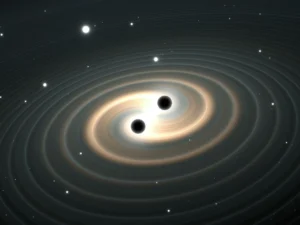
Two enormous black holes collided somewhere billions of light-years away. One weighed roughly 100 times the mass of our Sun. The other was estimated at around 140 solar masses. Together, they created a monster black hole about 225 times the Sun’s mass—the largest black hole merger ever detected through gravitational waves.
The discovery, known as GW231123, immediately sent shockwaves through the astrophysics community.
The reason was simple: according to long-standing theories of stellar evolution, black holes this massive should be extraordinarily difficult—or perhaps impossible—to create through ordinary star death.
Astronomers suddenly found themselves confronting a cosmic mystery that may force a major rethink of how black holes grow, merge, and evolve across the universe.
A Signal Unlike Any Before
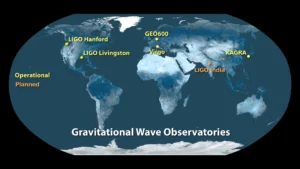
The detection came from the LIGO-Virgo-KAGRA collaboration, an international network of gravitational-wave observatories designed to listen for distortions in space-time.
Since the first historic detection of gravitational waves in 2015, researchers have recorded hundreds of black hole mergers. Each event has helped reveal a little more about some of the universe’s most extreme objects.
But GW231123 stood apart almost immediately.
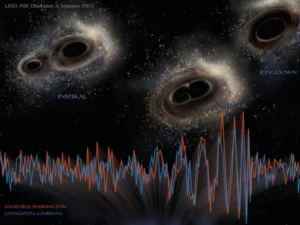
When scientists analyzed the signal, they realized the colliding black holes were far heavier than expected. The final object produced by the merger was roughly 225 times the mass of the Sun, making it the most massive black hole merger ever confirmed through gravitational-wave observations.
The event was so extraordinary that researchers began questioning whether their models were missing something fundamental.
The Forbidden Region of Black Hole Physics
To understand why this discovery caused such excitement, it helps to know about one of astronomy’s strangest theoretical predictions.
For decades, astrophysicists have believed that nature creates a “forbidden zone” for black hole masses.
This concept emerges from a process known as pair-instability.
When extremely massive stars reach the end of their lives, conditions inside their cores become so energetic that high-energy photons transform into electron-positron pairs. This process destabilizes the star.
Instead of collapsing into a black hole, the star may partially or completely destroy itself in a violent explosion. The result is that black holes within a certain mass range should be rare or absent. This predicted region is often called the pair-instability mass gap.
Traditional models suggest that black holes between roughly 50 and 130 solar masses should be difficult to form directly from collapsing stars.
Yet GW231123 appears to contain black holes squarely within or beyond this forbidden territory.
That is what makes the event so puzzling.
When Theory Meets Reality
Science advances when observations challenge expectations.
GW231123 is a perfect example.
If existing models are correct, then the black holes involved in this merger should not have formed through ordinary stellar collapse.
Yet there they were.
Scientists now face several possibilities:
Possibility 1: Black Holes Can Grow Through Repeated Mergers
One explanation is that these giant black holes were not born directly from stars.
Instead, they may be the products of earlier black hole collisions.
Imagine two smaller black holes merging. The resulting black hole survives and later merges again. Over millions or billions of years, repeated mergers could gradually create increasingly massive objects.
Researchers call these hierarchical mergers. Recent gravitational-wave studies suggest that some black holes occupying the mass gap may indeed have formed this way.
If GW231123 resulted from such a process, it would offer compelling evidence that black holes can grow through cosmic “family trees” stretching across multiple generations.
Possibility 2: Our Stellar Evolution Models Need Revision
Another possibility is even more dramatic.
Perhaps the models themselves are incomplete.
The lives and deaths of massive stars remain one of the most challenging areas of astrophysics. Tiny uncertainties in nuclear reactions, stellar winds, rotation rates, and magnetic fields can significantly affect the final outcome.
Some researchers argue that certain stars may survive pair-instability processes in ways not fully captured by current simulations.
If true, the universe may be capable of producing much larger black holes directly from stellar collapse than previously believed.
That would require rewriting parts of modern stellar evolution theory.
The Spin Problem
Mass was not the only surprise.
The black holes involved in GW231123 also appeared to be spinning extremely rapidly. Researchers analyzing the event reported spins near the upper limits allowed by physics.
This creates another challenge.
Standard stellar-collapse models generally struggle to produce black holes that are both extremely massive and rapidly rotating.
However, hierarchical mergers naturally predict high spins.
When black holes merge, the resulting object often inherits enormous rotational energy. If that remnant merges again later, the spin can become even more extreme.
The unusually high spins observed in GW231123 therefore strengthen the case that these objects may themselves be products of previous mergers.
A New Class of Cosmic Giants?
GW231123 may also represent something astronomers have been searching for: evidence of intermediate-mass black holes.
Black holes generally fall into two categories:
- Stellar-mass black holes
- Supermassive black holes
The first form from dying stars.
The second sit at the centers of galaxies and can weigh millions or billions of times the Sun’s mass.
But astronomers have long suspected the existence of a missing middle category called intermediate-mass black holes.
The final black hole created by GW231123 falls within this intermediate range. Its existence provides valuable clues about how these elusive objects may form.
Many scientists believe repeated mergers could act as stepping stones, gradually building intermediate-mass black holes that may eventually grow into the supermassive monsters found in galactic centers.
Could Primordial Black Holes Be Involved?
Not every researcher agrees on the explanation.
Some theoretical studies have proposed a more exotic possibility.
Instead of forming from stars, certain black holes might have originated shortly after the Big Bang itself. These hypothetical objects are known as primordial black holes.
A recent analysis suggested that the masses and spins observed in GW231123 could potentially be consistent with primordial origins under certain models.
This idea remains highly speculative.
No direct evidence currently proves that primordial black holes exist.
Nevertheless, discoveries like GW231123 force scientists to consider possibilities that once seemed far outside the mainstream.
The Role of Gravitational Waves
One of the most remarkable aspects of this discovery is how it was made.
No visible light reached Earth from the merger.
No telescope captured an image.
Instead, scientists detected tiny distortions in space-time itself.
These distortions, known as gravitational waves, were first predicted by Albert Einstein more than a century ago.
When massive objects accelerate through space—especially when black holes orbit and collide—they create ripples that spread across the cosmos at the speed of light.
By measuring those ripples, researchers can reconstruct details about objects that would otherwise remain invisible.
Gravitational-wave astronomy has transformed black holes from theoretical curiosities into observable laboratories of extreme physics.
GW231123 demonstrates just how powerful this new form of astronomy has become.
A Growing Pattern
The discovery does not stand alone.
In recent years, gravitational-wave observatories have repeatedly detected black holes occupying regions that once appeared forbidden.
Several studies now suggest evidence for a mass gap consistent with pair-instability theory, while simultaneously showing that some black holes populate that very gap through alternative formation channels.
This emerging pattern hints that the universe may be far more creative than astronomers imagined.
Rather than invalidating existing theories, these observations may be revealing a richer and more complicated cosmic story.
Nature often refuses to fit neatly into human categories.
What Happens Next?
GW231123 is unlikely to remain unique for long.
LIGO, Virgo, and KAGRA continue to improve their sensitivity.
Future observatories, including planned next-generation gravitational-wave detectors, are expected to discover thousands of additional mergers.
Each new detection will help answer critical questions:
- How common are ultra-massive black hole mergers?
- Do hierarchical mergers dominate their formation?
- Does the pair-instability mass gap truly exist?
- Are primordial black holes real?
- How do intermediate-mass black holes grow?
The next decade could provide answers that reshape astrophysics.
The Bigger Mystery
The most fascinating scientific discoveries are often those that create more questions than answers.
GW231123 did exactly that.
What began as a brief tremor in space-time has evolved into one of the most intriguing puzzles in modern astronomy.
For years, textbooks suggested there were limits to the masses black holes could achieve through ordinary stellar evolution. Then the universe responded with a collision involving objects that appear to sit beyond those limits.
Perhaps these black holes are survivors of multiple ancient mergers. Perhaps stellar evolution is more flexible than expected. Perhaps an entirely new mechanism is waiting to be discovered.
Whatever the answer turns out to be, GW231123 serves as a reminder that the cosmos remains wonderfully unpredictable.
Somewhere in the darkness between galaxies, two impossible black holes met, merged, and vanished.
Yet in doing so, they left behind a ripple that traveled billions of years across the universe—and arrived just in time to challenge everything we thought we knew.
