

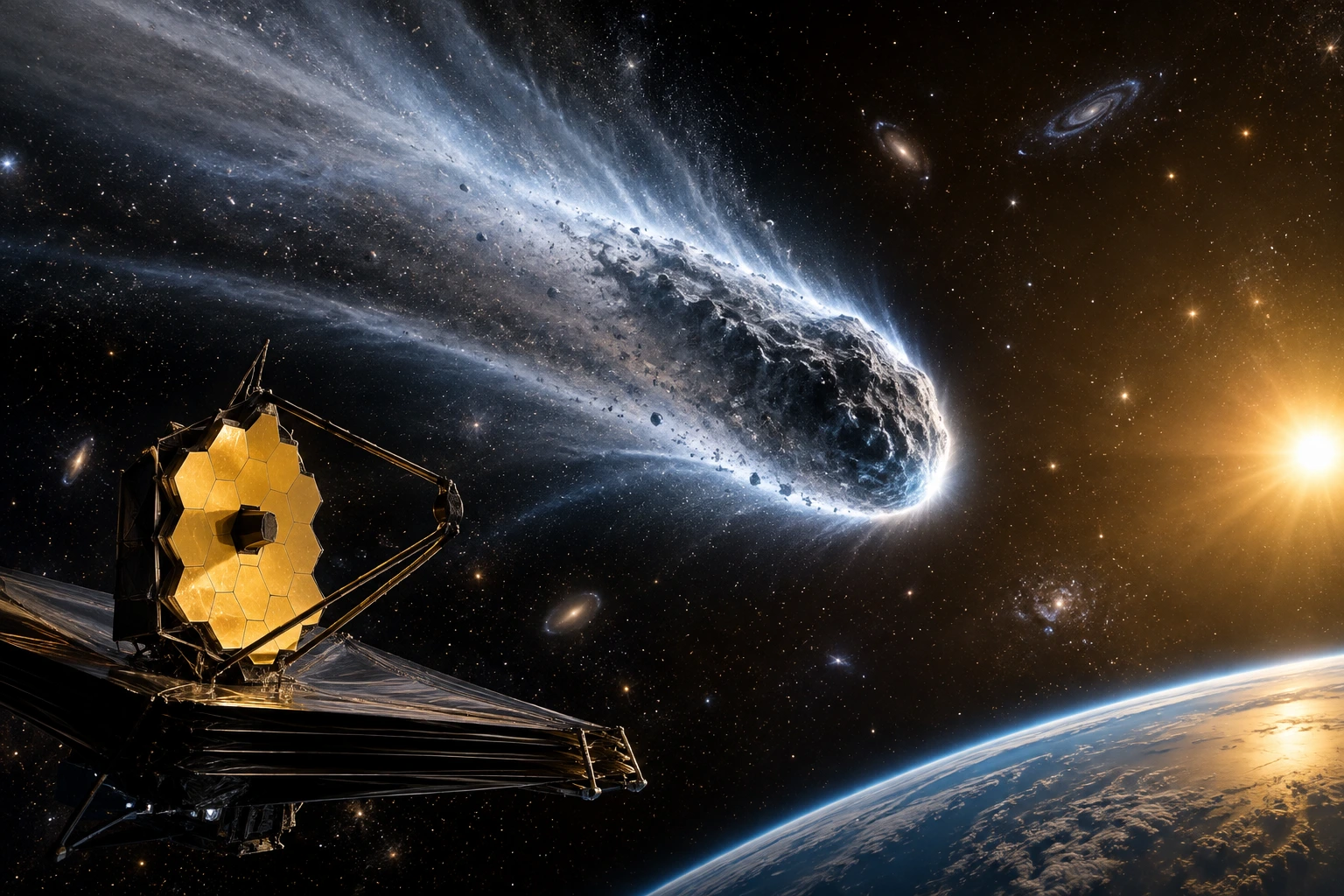
New observations of 3I/ATLAS reveal unusual chemistry, ancient origins, and clues about a planetary system beyond our own.
Somewhere beyond the edge of our Solar System, long before Earth formed, a chunk of ice, rock, and dust was born around a distant star.
Today, astronomers know that object as 3I/ATLAS, the third confirmed interstellar visitor ever discovered entering our Solar System.
But after fresh observations from the James Webb Space Telescope (JWST), scientists are beginning to suspect that 3I/ATLAS is far more than just another comet. It appears chemically unusual, unexpectedly ancient, and unlike anything researchers have previously studied up close.
The deeper astronomers investigate this interstellar object, the stranger the story becomes.
Astronomers named it 3I/ATLAS, the third confirmed interstellar object ever discovered entering our Solar System. According to NASA, its hyperbolic trajectory clearly shows that it originated outside our Solar System, making it only the third known interstellar visitor ever observed.
https://science.nasa.gov/solar-system/comets/3i-atlas/
At first, researchers expected another fascinating but relatively straightforward cosmic visitor.
Instead, every new observation has made the object stranger.
Now, fresh analyses of data gathered by the James Webb Space Telescope (JWST) and other observatories suggest that 3I/ATLAS may be unlike any comet humanity has ever studied. It appears chemically unusual, unexpectedly active, and possibly older than our Solar System itself.
The deeper astronomers look, the less familiar this visitor becomes.
3I/ATLAS: The Third Confirmed Interstellar Visitor
Before 2017, interstellar objects were purely theoretical.
Astronomers expected them to exist, but none had ever been confirmed.
Then came ʻOumuamua, the mysterious object that sparked years of scientific debate.
Two years later, 2I/Borisov became the first confirmed interstellar comet.
Then, in 2025, sky surveys detected a new object racing through the Solar System.
Its trajectory immediately stood out.
The object was moving too fast and following too extreme a path to be gravitationally bound to the Sun. It had clearly originated around another star before beginning an unimaginable journey through the Milky Way.
Unlike ʻOumuamua, which left scientists frustrated by limited observations, 3I/ATLAS arrived with a visible coma and tail, giving researchers a rare opportunity to directly study material formed around a completely different stellar system.
For planetary scientists, this was the equivalent of receiving a geological sample from another solar system.
JWST Reveals the Strange Chemistry of 3I/ATLAS
The James Webb Space Telescope has transformed astronomy by revealing details that were previously invisible.
Instead of merely photographing objects, Webb can analyze their chemical makeup by splitting light into spectra and identifying molecular fingerprints.
When JWST targeted 3I/ATLAS, astronomers expected to see a composition broadly similar to comets from our own Solar System.
That is not what happened.
Webb’s observations revealed chemical signatures unlike those seen in typical Solar System comets, including unusual carbon and deuterium ratios that immediately caught astronomers’ attention.
The observations showed a coma rich in carbon dioxide gas, accompanied by water vapor, carbon monoxide, methane, water ice, and dust.
Most surprising was the sheer abundance of carbon dioxide.
The CO₂-to-water ratio measured by JWST ranks among the highest ever observed in any comet.
NASA later confirmed that 3I/ATLAS remains extraordinarily rich in carbon dioxide compared with most known Solar System comets.
That finding immediately raised questions.
Why would an interstellar comet contain so much carbon dioxide?
Did it form in a radically different environment?
Was its home planetary system chemically unlike our own?
Or was it preserving a record of conditions that existed billions of years ago?
Astronomers suddenly realized they might be looking at something much more important than a wandering comet.
They might be looking at a fossil from another world.
Webb Found Something Else
As researchers continued studying the object, another surprise emerged.
JWST directly detected methane within 3I/ATLAS.
That may not sound dramatic at first, but methane is an important volatile molecule that can reveal clues about a body’s formation environment and thermal history.
Webb’s methane detection represents the first such observation in an interstellar object.
Scientists believe the finding suggests that volatile material remained preserved beneath the comet’s surface for billions of years.
In essence, the object appears to have carried chemical information across the galaxy and delivered it directly into the reach of modern telescopes.
The Comet That Refuses to Behave Normally
Researchers also noticed something unusual about the comet’s activity.
Comets generally become more active as they move closer to the Sun because solar heating causes ice to vaporize.
But 3I/ATLAS appears unusually energetic even at significant distances.
Instead of relying primarily on water ice, the object seems to be driven by more volatile substances such as carbon dioxide and carbon monoxide.
These compounds can sublimate at lower temperatures, allowing activity to continue farther from the Sun.
Recent observations also identified persistent jets of material streaming from specific regions on the comet’s surface.
Rather than behaving chaotically, the object appears to possess stable active zones that continuously release gas and dust.
That consistency provides valuable clues about its internal structure.
Is 3I/ATLAS Older Than the Solar System?
Then came perhaps the most astonishing possibility.
Some scientists studying the object’s trajectory concluded that 3I/ATLAS may belong to the Milky Way’s ancient thick disk population, a region populated by some of the galaxy’s oldest stars.
If this interpretation is correct, the object could be between 10 and 12 billion years old.
Think about that for a moment.
Earth is approximately 4.5 billion years old.
The Solar System formed around 4.6 billion years ago.
A 12-billion-year-old object would predate our Solar System by more than seven billion years.
Independent analyses of Webb data indicate that the comet may have formed during an era when the Milky Way itself was still relatively young.
If true, 3I/ATLAS may be one of the oldest objects ever studied from within our Solar System.
It would essentially be a surviving relic from a completely different chapter of galactic history.
The Dust Is Strange Too
The mysteries don’t end with chemistry and age.
Researchers examining the dust surrounding 3I/ATLAS found properties unlike those typically observed in many Solar System comets.
Evidence suggests that the dust contains large amounts of amorphous silicates rather than the crystalline silicates commonly found in native comets.
That distinction is important because crystalline silicates generally form in warmer environments closer to stars.
Amorphous silicates suggest a different thermal history.
In other words, the material that formed 3I/ATLAS appears to have experienced conditions fundamentally different from those that shaped the early Solar System.
The European Space Agency notes that the object’s unusual chemistry and composition are helping scientists understand how diverse planetary systems across the galaxy may be.
https://esawebb.org/news/weic2613/
Rather than representing an oddity, 3I/ATLAS may reveal that our own Solar System is just one of many possible ways planets and comets can form.
A Message From an Alien Planetary System
Every planetary system leaves fingerprints behind.
The composition of its comets reflects:
- The temperature of its protoplanetary disk
- The abundance of heavy elements
- The migration of giant planets
- The chemistry of its star-forming region
- Billions of years of evolution
Those fingerprints appear preserved within 3I/ATLAS.
Its unusual carbon dioxide abundance, methane inventory, ancient age, dust composition, and persistent activity all point toward a formation environment unlike anything astronomers have directly studied before.
Researchers are essentially conducting planetary archaeology.
Except instead of digging through ancient rocks on Earth, they are decoding a frozen relic from another star.
Why This Discovery Matters
Most exoplanets are so distant that astronomers can only study them indirectly.
Even the most advanced telescopes typically see them as tiny points of light.
Scientists can estimate atmospheric chemistry and temperatures, but detailed examination remains difficult.
3I/ATLAS changes the equation.
This is not a distant observation.
This is actual material from another planetary system passing through our backyard.
Researchers can measure its gases.
Analyze its dust.
Study its ice.
Track its evolution.
Observe how it reacts to sunlight.
The scientific value is extraordinary.
Instead of speculating about another solar system, astronomers can directly investigate a piece of one.
The Mystery Keeps Growing
Normally, scientific mysteries become less mysterious as new data arrives.
3I/ATLAS seems to be doing the opposite.
First, it was simply an interstellar visitor.
Then it became a carbon-dioxide-rich comet.
Then a methane-bearing relic.
Then a candidate for one of the oldest objects ever observed in the Solar System.
Then a mineralogical puzzle with dust unlike that of many known comets.
Every answer has generated new questions.
And that is precisely why scientists cannot stop studying it.
Why 3I/ATLAS Matters to Astronomy
The discovery of 3I/ATLAS is about more than a single interstellar comet.
Every exoplanetary system evolves differently, but direct evidence from those systems is incredibly difficult to obtain. Most exoplanets appear only as tiny points of light.
3I/ATLAS changes that.
Instead of studying another planetary system from afar, astronomers are examining actual material that formed around another star.
The object’s unusual chemistry, methane content, carbon dioxide abundance, dust composition, and possible ancient age are providing clues about how planetary systems formed billions of years ago.
For planetary science, 3I/ATLAS may become one of the most important interstellar objects ever discovered.
A Frozen Messenger From Deep Time
Imagine discovering a sealed bottle drifting across an ocean.
Now imagine that bottle has been drifting not for decades, but for ten billion years.
Its contents come from a place you’ve never visited.
Its story began before your world even existed.
That is what 3I/ATLAS represents.
A messenger from another star.
A survivor from a different age of the galaxy.
A frozen archive carrying chemical records from a planetary system that may have vanished billions of years ago.
Readers interested in following the object’s ongoing journey can explore NASA’s continuously updated observation archive, which tracks discoveries from JWST, Hubble, ground-based observatories, and planetary missions.
https://science.nasa.gov/solar-system/comets/3i-atlas/
The James Webb Space Telescope looked at 3I/ATLAS expecting to learn about an interstellar comet.
Instead, it may have uncovered one of the oldest and most revealing cosmic artifacts ever to enter our Solar System.
And with every new observation, this visitor from the stars seems determined to become even stranger.


