
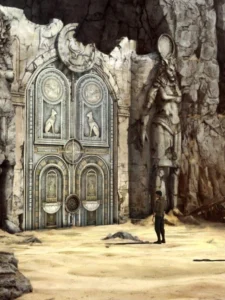
For centuries, explorers, scholars, treasure hunters, and adventurers have searched for Zerzura—a legendary lost city said to be hidden somewhere within the vast Sahara Desert. Described in ancient Arabic texts as an oasis of white buildings, wealth, and mystery, Zerzura remains one of the most fascinating unsolved geographical enigmas in history. Was it a real city swallowed by shifting sands, a misunderstood oasis, or merely a desert myth that grew larger with every retelling?
A Legend Hidden in an Ocean of Sand
The Sahara Desert stretches across North Africa like a golden sea. Covering approximately 9.2 million square kilometers, it is larger than the United States. Its endless dunes, rocky plateaus, dry valleys, and remote mountain ranges have concealed countless secrets throughout human history.
Among those secrets, none has captured the imagination quite like Zerzura.
Unlike Atlantis, which is often viewed as mythology, Zerzura occupies a curious middle ground between legend and possibility. Historical references to the city exist in genuine medieval manuscripts, and multiple expeditions have attempted to locate it.
Yet despite decades of searching, no definitive evidence of Zerzura has ever been found.
Its mystery continues to inspire archaeologists, historians, and explorers today.
The First Mentions of Zerzura
The story of Zerzura originates primarily from medieval Arabic writings dating back several centuries.
Descriptions vary, but many accounts refer to a hidden oasis city located west of the Nile and deep within the Egyptian or Libyan desert.
The name “Zerzura” is often translated as “City of Little Birds” or “Oasis of Birds.”
Ancient texts describe the location as:
- Hidden among valleys
- Protected by mountains
- Rich in water and vegetation
- Filled with white buildings
- Guarded by mysterious inhabitants
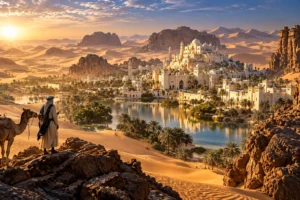
One frequently cited description tells of a city with white houses shining beneath the desert sun.
Some accounts mention treasure hidden within the city.
Others suggest that its inhabitants possessed unusual knowledge or wealth.
These stories transformed Zerzura into one of the Sahara’s most enduring legends.
Why the Story Fascinated Explorers
Lost cities have always held a powerful attraction.
Stories of El Dorado, Atlantis, and the Seven Cities of Gold inspired countless expeditions.
Zerzura offered something different.
Unlike mythical kingdoms described only in folklore, Zerzura appeared in historical documents.
That gave explorers hope that it might actually exist.
By the late nineteenth and early twentieth centuries, European interest in North African exploration was growing rapidly.
Maps of the Sahara still contained enormous blank areas.
Entire regions remained largely unexplored by modern scientific expeditions.
Many believed Zerzura might be waiting somewhere beyond the next dune.

The Sahara Was Once Very Different
One reason the Zerzura legend seems plausible is that the Sahara has not always been a desert.
Thousands of years ago, much of the region was greener and wetter.
Archaeological discoveries reveal evidence of:
- Lakes
- Rivers
- Grasslands
- Wildlife populations
- Human settlements
Rock art found across the Sahara depicts giraffes, elephants, cattle, and other animals that could not survive in today’s harsh environment.
This period is often called the African Humid Period.
As climate conditions changed, the landscape gradually dried out.
Communities were forced to migrate or adapt.
Many settlements disappeared.
Because ancient civilizations once lived where only sand exists today, researchers cannot completely dismiss the possibility that forgotten cities remain buried beneath the desert.
The White City Legend
One of the most intriguing aspects of Zerzura is the repeated description of white buildings.
Medieval accounts frequently refer to:
- White walls
- White structures
- White stone architecture
This detail has fascinated historians because it appears consistently across multiple versions of the story.
Some researchers speculate that travelers may have encountered a real oasis settlement whose architecture stood out dramatically against the desert landscape.
Others believe the white city imagery could symbolize purity, wealth, or paradise rather than an actual location.
The true meaning remains uncertain.
Treasure, Gold, and Ancient Secrets
Like many lost-city legends, stories of Zerzura often became intertwined with tales of hidden treasure.
Certain accounts suggest the city contained:
- Vast riches
- Precious metals
- Ancient artifacts
- Secret chambers
Such claims inevitably attracted fortune seekers.
However, historians note that treasure legends frequently emerge around mysterious places.
The promise of hidden wealth tends to amplify existing stories.
No archaeological evidence has ever confirmed reports of treasure associated with Zerzura.
Nevertheless, the possibility helped fuel decades of exploration.
The Search Intensifies
The modern search for Zerzura gained momentum during the early twentieth century.
Advances in transportation made deeper exploration of the Sahara possible.
Vehicles, improved maps, and aerial reconnaissance allowed adventurers to reach areas that had previously been inaccessible.
One of the most famous figures connected to the search was Hungarian explorer László Almásy.
Almásy became renowned for his expeditions into remote desert regions.
His adventures later inspired elements of the novel and film The English Patient.
During the 1920s and 1930s, Almásy and other explorers searched vast sections of the Libyan Desert looking for clues.
The Discovery That Changed Everything
In 1933, Almásy made an important discovery.
He identified previously unknown valleys in the Gilf Kebir region near the Egyptian-Libyan border.
These valleys included:
- Wadi Abd el Malik
- Wadi Hamra
- Other hidden desert basins
The valleys contained vegetation and evidence of ancient human activity.
For some researchers, this discovery seemed remarkably similar to descriptions associated with Zerzura.
Could these isolated valleys be the source of the legend?
The idea remains one of the leading explanations today.
The Cave of Swimmers Connection
Another major discovery added further intrigue.
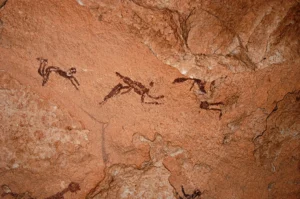
Explorers found prehistoric rock art in caves throughout the region.
Among the most famous examples is the Cave of Swimmers.
The artwork depicts human figures appearing to swim.
At first glance, this seems impossible.
Modern visitors see only dry desert.
Yet the paintings suggest that water once existed in areas now completely arid.
These discoveries confirmed that the Sahara had undergone dramatic environmental changes.
If ancient lakes and communities once flourished there, the existence of forgotten settlements became far more plausible.
Could Zerzura Have Been an Oasis?
Many modern historians believe Zerzura may not have been a city at all.
Instead, it could have been an oasis remembered and exaggerated over generations.
Travelers crossing the desert often relied on scarce water sources.
A fertile valley surrounded by barren sand would have seemed almost magical.
Stories about such places could easily grow over time.
An oasis with a few buildings might eventually become a city of white palaces in local folklore.
This process has occurred in many cultures throughout history.
The Problem With Ancient Descriptions
A major challenge in solving the Zerzura mystery is the reliability of historical accounts.
Medieval travelers frequently mixed:
- Observations
- Rumors
- Local legends
- Religious symbolism
Locations were often described imprecisely.
Distances could be estimated incorrectly.
Names changed over centuries.
A city mentioned in one manuscript might refer to an entirely different place in another.
This makes it difficult for modern researchers to determine whether all references to Zerzura describe the same location.
Satellite Technology Enters the Search
Today, archaeologists possess tools that earlier explorers could only dream about.
Satellite imagery allows researchers to examine enormous regions of desert from space.
Scientists use remote sensing technology to identify:
- Ancient riverbeds
- Buried structures
- Geological anomalies
- Potential archaeological sites
In some parts of the world, satellite analysis has revealed entire cities hidden beneath forests and deserts.
As imaging technology improves, interest in locating Zerzura has revived.
Researchers continue examining the Sahara for clues.
Why Finding Zerzura Is So Difficult
Even with modern technology, the Sahara remains one of the most challenging environments on Earth.
Several factors complicate exploration.
Vast Size
The desert spans multiple countries and millions of square kilometers.
A single expedition can only investigate a tiny fraction of the region.
Shifting Sands
Wind constantly reshapes dunes.
Any ancient structures could be deeply buried.
Harsh Conditions
Extreme temperatures and remote terrain make fieldwork difficult and expensive.
Limited Historical Data
Ancient descriptions often lack precise coordinates.
Researchers must work with incomplete information.
Together, these challenges explain why the mystery persists.
Alternative Theories
Over time, several competing explanations have emerged.
Theory 1: Zerzura Was Real
Supporters believe an actual settlement once existed in the Sahara.
Climate change, abandonment, and desertification may have erased most traces.
Theory 2: Zerzura Was a Hidden Oasis
The legend may describe fertile valleys discovered by desert travelers.
Over centuries, stories transformed the oasis into a lost city.
Theory 3: Zerzura Was Symbolic
Some historians suggest the city represented an idealized paradise rather than a physical location.
In this interpretation, Zerzura functioned more as a literary motif than a geographical reality.
Theory 4: Multiple Places Became One Legend
Different settlements, valleys, and oases may have been merged into a single story over time.
This could explain inconsistencies among historical accounts.
The Archaeological Perspective
Most archaeologists approach the Zerzura legend cautiously.
Extraordinary claims require evidence.
To date, no excavation has uncovered ruins that definitively match historical descriptions of Zerzura.
That does not mean the story is false.
It simply means the evidence remains inconclusive.
Many ancient sites have remained hidden for centuries before being discovered.
Examples include:
- Troy
- Machu Picchu
- Petra
- Numerous Egyptian tombs
History has repeatedly shown that lost places can sometimes be found.
Why the Mystery Endures
The Zerzura story survives because it combines several powerful elements.
It involves:
- Ancient manuscripts
- Desert exploration
- Hidden landscapes
- Possible lost civilizations
- Unsolved history
Unlike myths that have been fully disproven, Zerzura occupies a space where uncertainty remains.
There is enough historical evidence to keep researchers interested.
Yet there is not enough evidence to solve the mystery.
That balance continues to captivate audiences around the world.
What Future Discoveries Could Reveal
Emerging technologies may eventually shed new light on the mystery.
Researchers are increasingly using:
- Artificial intelligence
- High-resolution satellite imagery
- Ground-penetrating radar
- Geographic information systems
- Climate reconstruction models
These tools can reveal patterns invisible to earlier generations of explorers.
Ancient river systems, migration routes, and settlement locations may become easier to identify.
If Zerzura was based on a real place, future discoveries could bring researchers closer than ever before.
A Mystery Buried Beneath the Sands
As the sun sets over the Sahara, shadows stretch across dunes that have shifted for thousands of years. Somewhere beneath those sands may lie forgotten valleys, abandoned settlements, and stories waiting to be rediscovered. Whether Zerzura was a thriving city, a hidden oasis, a misunderstood legend, or a combination of all three, its mystery continues to endure.
The search for Zerzura is ultimately about more than finding a lost city. It represents humanity’s enduring fascination with the unknown. Every generation inherits questions that remain unanswered, and the Sahara’s greatest mystery is one of them.
Perhaps the white city described in ancient manuscripts never existed exactly as the legends claim. Or perhaps, beneath layers of sand and time, traces of a forgotten world still wait to be uncovered. Until convincing evidence emerges, Zerzura will remain one of history’s most captivating unsolved mysteries—a reminder that even in the age of satellites and artificial intelligence, our planet still holds secrets capable of inspiring wonder.
