
Your brain may be holding onto more plastic than you’d like to think about. A peer-reviewed study published in Nature Medicine found that human brain tissue contains dramatically higher concentrations of microplastics than the liver or kidneys, with levels rising sharply over less than a decade, and even higher concentrations in the brains of people who had dementia. The findings have circulated widely, often reduced to one alarming line: there’s a spoon’s worth of plastic in your head. Here’s what the study actually found, what leading researchers say it does and doesn’t prove, and what’s realistic to do about it.
What the Study Actually Did
The research was led by Matthew Campen, a professor of pharmaceutical sciences at the University of New Mexico, working with colleagues from Oklahoma State University, Duke University and Universidad del Valle in Colombia. The team analyzed postmortem brain, liver and kidney tissue donated through the New Mexico Office of the Medical Investigator, which is legally required to retain autopsy tissue for seven years.
To detect the plastics, researchers used a technique called pyrolysis gas chromatography–mass spectrometry, which breaks down tissue samples and identifies the chemical signatures left behind by different plastic polymers. They also used electron microscopy to directly visualize the particles, confirming they appeared largely as nanoscale, shard-like fragments rather than the larger microplastic pieces more commonly discussed in ocean pollution research.
Brain samples came specifically from the frontal lobe, and the study compared tissue collected in 2016 against tissue collected in 2024.

The Headline Numbers
The results, as reported in the study and in interviews with Campen, include several striking figures:
- Brain tissue contained roughly ten times more microplastics than matched liver or kidney samples from the same individuals.
- The average concentration of plastic in brain samples was described as comparable to the weight of a standard plastic spoon, or, in another comparison Campen gave, roughly equivalent to an unused crayon.
- Microplastic concentrations in brain tissue were about 50% higher in 2024 samples than in 2016 samples, a pattern the researchers say mirrors the rise in global plastic production over the same period.
- Polyethylene, the most common plastic in the world, found in everything from packaging and containers to flooring, made up roughly 75% of the plastic identified in brain tissue.
- Brain samples from people who had been diagnosed with dementia showed substantially higher plastic concentrations than samples from people without dementia. Different reports of the study cite figures ranging from five to ten times higher in dementia cases, depending on which comparison group and brain region is being measured.

Why the Brain, Specifically?
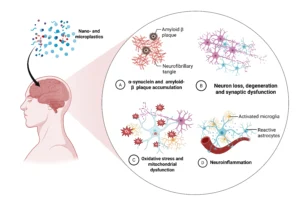
One of the more unusual findings is that the brain appears to accumulate more plastic than organs like the liver and kidney, which are generally better equipped to filter and process foreign material. Campen has theorized that this may relate to the blood-brain barrier and the brain’s high fat content. Microplastics, and polyethylene in particular, appear to accumulate in fatty tissue, including the brain’s myelin sheath, the fatty insulation that wraps around neurons and supports signal transmission.
Campen has also suggested, speculatively, that plastic particles might interfere with blood flow through the brain’s smallest capillaries, and that some particles have been observed inside macrophages, the immune cells that respond to inflammation, in affected brain regions.

The Dementia Question: Correlation, Not Cause
This is the detail that deserves the most careful framing. The study found a correlation between higher microplastic concentrations and a dementia diagnosis. It did not, and cannot, establish that microplastics cause dementia or contribute to its progression.
Campen himself has been direct about this limitation. He has noted that dementia itself involves brain tissue atrophy, a breakdown in the blood-brain barrier, and impaired waste-clearance mechanisms in the brain. Any of these disease processes could independently cause plastic to accumulate more heavily in an already-compromised brain, rather than the plastic being a cause of the damage. The dementia comparison in the study was also based on a small number of brains, commonly cited as around 12, which limits how much weight the finding can carry on its own.
Independent Scientists Are Urging Caution
Outside experts who were not involved in the research have pushed back against some of the more dramatic framing the study received in media coverage. Several points have come up consistently:
- Sample size is small. The full study examined tissue from a few dozen individuals, and subgroup comparisons, like the dementia analysis, involved even smaller numbers. That limits how confidently the findings can be generalized to the wider population.
- The people studied were otherwise healthy before death. Researchers who reviewed the study have pointed out that the individuals whose brains were sampled did not have documented plastic-related illness, meaning the health significance of the measured plastic levels remains unclear.
- The field is genuinely new. Detection methods for nanoplastics are still developing, and some scientists have cautioned that current techniques may miss certain particle types or misidentify materials, which affects how precise the reported concentrations really are.
- A data integrity issue was flagged. Science journalism outlet The Transmitter reported that the published paper contained duplicated images. Experts who reviewed the concern said it did not appear to affect the study’s core conclusions, but it’s a legitimate point that responsible coverage should mention.
- Getting from gut to brain is not simple. As some independent reviewers have noted, for microplastics to reach the brain, they must cross the gut wall, travel through the bloodstream, and then cross the blood-brain barrier, three biological checkpoints that are normally tightly regulated. That doesn’t mean it isn’t happening, but it underscores that the pathway involved is more complex than “you eat plastic and it ends up in your head.”
One epidemiologist who studies potential links between microplastics and cancer, speaking about the broader research area, noted plainly that there’s no standard methodology yet across labs studying this question, and that researchers are still developing their approach as they go.
Where Microplastics in Your Body Actually Come From
Regardless of the unresolved questions about brain accumulation specifically, it’s well established that microplastics are now present throughout the human body and environment. Documented sources include:
- Bottled and tap water
- Food packaging and plastic containers, especially when heated
- Meat and dairy from animals that themselves accumulate microplastics
- Household dust and synthetic textiles
- Personal care products containing plastic microbeads
Because exposure is so pervasive, complete avoidance isn’t realistic. But researchers who study this area generally point to a few practical, evidence-based steps that can meaningfully reduce exposure without requiring drastic lifestyle changes:
- Avoid heating food in plastic containers, since heat increases the rate at which plastic sheds particles into food.
- Choose glass, stainless steel or ceramic for food storage and drinking water where practical.
- Filter tap water using a filter rated to remove microplastic particles, since bottled water has in some studies shown comparable or higher microplastic content than tap water.
- Reduce use of single-use plastics generally, which lowers both personal exposure over time and environmental plastic load.
- Vacuum and dust regularly, since household dust is a recognized route of microplastic exposure indoors.
None of these steps are framed by researchers as guaranteed health protections. They’re presented as reasonable precautions given how much remains unknown.

The Bigger Picture
What makes this story different from many viral health scares is that the core finding, rising and measurable plastic accumulation in human tissue, including brain tissue, is peer-reviewed and published in a respected journal, not a fringe claim. What’s speculative is the leap from “we found this” to “this is dangerous” or “this causes dementia.” Campen and his co-authors have been careful not to make that leap themselves, even as media coverage sometimes has.
The honest summary: microplastics are accumulating in human brains, the levels appear to be rising alongside global plastic production, and the presence of more plastic in dementia-affected brains is a real and concerning observation. Whether any of this causes disease, worsens disease, or is simply a byproduct of how sick brains process material differently, is a question actively being researched, not one that’s been answered.
Frequently Asked Questions
Is it true there’s a spoon’s worth of plastic in my brain?
The study’s lead author used that comparison to describe the average concentration found in brain tissue samples, roughly 4,800 micrograms of microplastic per gram of tissue. It’s a rough visual comparison, not a literal claim that a spoon-shaped object exists in anyone’s head.
Does this study prove microplastics cause dementia?
No. The study found a correlation between higher microplastic levels and dementia diagnoses in a small sample, but the researchers explicitly say this doesn’t establish causation. Dementia-related brain changes could themselves cause plastic to accumulate more heavily.
How did the plastic get into people’s brains?
Researchers believe microplastics enter through food, water and air, cross the gut lining into the bloodstream, and in small amounts cross the blood-brain barrier. The exact mechanism is still being studied.
Was this a large study?
No. It examined tissue from a relatively small number of individuals, and the dementia comparison involved an even smaller subgroup, which limits how broadly the findings can be applied.
Should I be worried?
Most researchers say the findings are concerning enough to warrant more research, but not yet a reason for alarm about specific health outcomes. Reducing everyday plastic exposure is a reasonable precaution regardless.
Can the body remove microplastics once they’re in the brain?
This isn’t yet well understood. Researchers don’t currently know whether the brain has an effective way to clear accumulated plastic particles over time.
This article is based on the peer-reviewed study “Bioaccumulation of microplastics in decedent human brains,” published in Nature Medicine, along with reporting on the research from National Geographic, EurekAlert, and other science outlets. If you’re concerned about your own health related to any topic discussed here, consider speaking with a physician rather than relying on media coverage of emerging research.
