
Noah’s Ark is trending again. A team drilling into a boat-shaped hill in eastern Turkey has reported a mysteriously hard layer underground, organic-rich samples and radar anomalies, and headlines have run far ahead of the evidence. This updated article lays out when each event happened, what was actually found, and what remains unproven.
Timeline at a Glance
| Date | Event |
|---|---|
| 1959 | The formation is spotted in a Turkish military aerial mapping survey |
| 1977 | Ron Wyatt begins studying the site |
| 1988 | An earlier drilling attempt reaches only a few holes |
| September 1994 | David Fasold visits with geologist Ian Plimer and begins to doubt the Ark theory |
| 1996 | Collins and Fasold publish a geological paper calling it a natural structure |
| 2005 | Mount Ararat and Noah’s Ark Symposium at Istanbul University |
| 2019 | First major radar survey |
| 2026 (earlier in the year) | Deeper radar survey by Khosrow Bakhtar, plus GPS mapping and 3D modelling |
| 21 September 2026 | Expedition work and core drilling reported to begin |
| 22 September 2026 | Lauren Witzke posts an update celebrating the start of core drilling |
| 23 September 2026 | Press release announces drilling and the broken drill bit |
| 24 September 2026 | Follow-up reporting on the drill bit and hard layer |
| 25 September 2026 | Critical analysis published examining the evidence and funding |
| 26 September 2026 | Reports of the Gopher robot’s second mission (about 12 metres deep) and samples heading to Ankara |
When Did the Drilling Start?
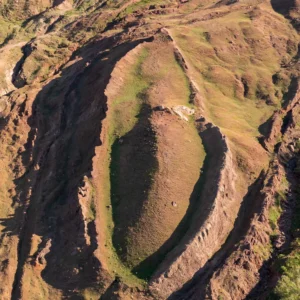
Scientists affiliated with universities in Turkey and the US-based Noah’s Ark Scans project began work at the Durupınar site on September 21, according to The Catholic Herald. A social media post from the group is dated the same day, and Western Journal reported on it. Catholic Herald
The next day, Tuesday, 22 September, Witzke celebrated the start of core drilling with a post reading “Good morning from the outer rims of Noah’s ark,” according to Joe.co.uk.
The formal announcement came on Wednesday, 23 September 2026. A press release datelined Doğubayazıt, Türkiye, said an international team from Noah’s Ark Scans, in partnership with Turkish universities, had begun collecting core samples at depths of up to 18 metres. You can read it in full on GlobeNewswire. The Astorian
The Hole That Started the Buzz: The Broken Drill Bit
The viral moment came during the first week of drilling. According to the team, a hole drilled inside the boat-shaped outline reached a depth of roughly 4 to 5 metres, where the drill struck a layer so hard that the bit broke. GlobeNewswire
On Wednesday, 23 September, Witzke reported that the layer was harder than limestone, that no bedrock had been detected, and that researchers were testing it for petrified or mineralised wood. Reporting also says the drill bit was later repaired and drilling continued. Catholic Herald
A key point often lost in headlines: the broken bit shows only that the drill met resistance. One critical analysis notes that the material remains unidentified. Rock, cemented sediment and mineral concentrations can all damage a drill bit. All Told
What Else Has Been Reported
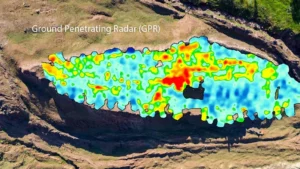
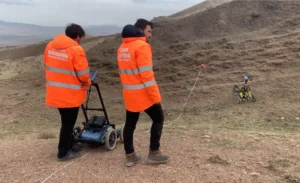
Radar background (2019 and 2026). The first major radar survey in 2019 detected linear and angular anomalies that researchers interpreted as possible walls, passageways and compartments. A deeper survey this year, led by Khosrow Bakhtar with radar technology developed through U.S. Air Force research, reportedly detected massive layered reflectors and sediment-filled cavities. Coverage in Yahoo News summarizes these claims. The team says the press release’s own preliminary radar report found no bedrock at the site, a claim awaiting independent review. Yahoo!
Core samples. Samples were taken from inside and outside the outline, and the team says the cores contain layers with large amounts of organic material. By 26 September, reports described the samples being labelled, double-bagged and packed for shipment to a laboratory in Ankara, according to Above the Norm News, which updated its coverage that day. Euro Weekly News
The Gopher robot. The team built a small underground robot called Gopher to fit through the narrow drill holes. Reporting says it has been sent down twice, with the second mission reaching about 12 metres. Importantly, the same coverage says the deployment does not confirm Gopher has entered a mapped void, and no chamber discovery has been announced. Above The Norm News
Celebrity attention. By 26 September, adventurer Bear Grylls had reportedly visited the formation, adding to the media frenzy.
Where Is the Durupınar Formation, and How Did It Become Famous?
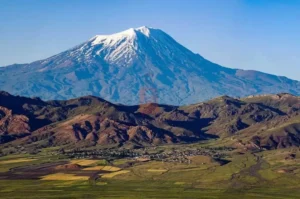
The formation lies in Ağrı province, about 29 kilometres south of Mount Ararat. It was first identified in 1959 by Turkish Army Capt. İlhan Durupınar and measures roughly 157 metres (515 feet). Other sources give slightly different figures, such as about 164 metres, so the size comparison to the biblical cubit measurements depends on how the boundary is drawn. FinancialContent
1977: Ron Wyatt arrives
In 1977, amateur archaeologist and nurse anesthetist Ron Wyatt began studying the site. He claimed the unusual rock was petrified gopher wood from the Ark. Background is available on Wikipedia’s Ron Wyatt page.
1988: The earlier drilling attempt
The 2026 press release says a 1988 drilling attempt reached only a few holes and a fraction of the depth now being sampled, and that those 1988 core samples were corrupted by cooling water. One independent explainer describes 2026 as the first time drilling has taken place there since 1988. FinancialContent
1994 and 1996: A former believer changes his mind
After expeditions in the 1990s that included drilling and excavation, David Fasold began to doubt the Ark theory. Following a September 1994 site visit with geologist Ian Plimer, he reportedly called it possibly the oldest running hoax in history. In 1996, he co-authored a paper with geologist Lorence Collins concluding the formation was an upswelling of mud. See Wikipedia’s David Fasold page.
The geological verdict
Writing in the Journal of Geoscience Education in 1996, Collins identified the structure as a doubly plunging syncline, a natural downfold of sedimentary rock shaped by erosion. His paper addresses the supposed artifacts one at a time, attributing them to natural minerals and local rock. Turkish geologist Murat Avcı has separately described the landform as part of the Telçeker earth flow, a remnant of hard limestone carried down by a landslide. A good overview is at Living Passages. Living Passages
Who Is Behind the 2026 Expedition?
According to the team’s release, the 2026 programme is led by Turkish archaeologist Prof. Dr. Cenker Atila of Sivas Cumhuriyet University, with the university’s rector, Prof. Dr. Ahmet Şengönül, in support, and Andrew Jones as Vice President of the Noah’s Ark Research Project. The team says it has official authorization from Turkish government agencies.
Christian activist Lauren Witzke is a prominent public voice. She has claimed the work will force university curricula to be rewritten and dismantle Darwinism. That is advocacy, not a scientific result, and it is one reason the story spread so quickly. AOL’s coverage captures that framing.
Is Noah’s Ark “100% Confirmed”?
On 26 September 2026, Euro Weekly News published a piece whose headline used that phrase. The article itself notes that the team claimed the work had “100 percent confirmed” the formation is man-made, and adds an important catch: nobody has actually uncovered Noah’s Ark yet. Euro Weekly News
Reasons for caution:
- Radar is not a photograph. It detects changes in materials and boundaries, so features must be physically investigated before anyone knows what produced them.
- A hard layer is not proof of wood. Lab identification and dating come first.
- Even worked material would need context. Evidence of a vessel would still require further argument to link it to Noah’s Ark.
- Genesis does not name the site. It says the Ark rested on the “mountains of Ararat,” a regional description.
Rod Benson’s 25 September 2026 analysis is a measured take on the gap between claims and evidence.
Funding
The same 25 September analysis reports that the project’s crowdfunding campaign seeks US$600,000 and appears to have raised about US$78,800 so far, with Noah’s Ark Discovery, Inc. named as recipient. It adds that public information does not establish who has paid for all work already done. Private funding is common in archaeology, but it is a good reason to look for independent verification.
What Happens Next?
The team says it is collecting physical samples for laboratory analysis, with more fieldwork planned next year. As of 28 September 2026:
- Ankara lab results on the organic material have not been released.
- No dating results have been announced.
- No confirmed chamber has been filmed.
- No peer-reviewed publication of the 2026 data has appeared.
Real proof would need independent identification of the material, radiocarbon dating, evidence of human working such as tool marks or joinery, and open data that other geologists can test against the syncline and landslide explanations.
Bottom Line
Drilling at Durupınar began around 21 September 2026, was formally announced on 23 September, and has produced a hard layer, organic-rich samples and robot footage claims. It has not produced a confirmed chamber, identified wood or independent verification. Decades of geology still point to a natural landform. Until the Ankara results and any peer review arrive, the fair verdict is “interesting, unproven.”
Frequently Asked Questions (FAQs)
1. When did the Noah’s Ark drilling start?
Work at the site was reported to begin on 21 September 2026. Witzke posted about core drilling on 22 September, and the formal press release followed on 23 September 2026.
2. When did the drill bit break?
Reports surfaced around 23 September 2026, when the team said a bit shattered on a very hard layer about 4 to 5 metres down.
3. Did they find Noah’s Ark?
No. Nothing has been confirmed. The findings are radar anomalies, organic-rich samples and an unidentified hard layer.
4. Is the hard layer petrified wood?
Unknown. The team is testing it, and results are pending. Hardness alone does not prove it is wood.
5. How deep did they drill?
Up to about 18 metres (nearly 60 feet).
6. What is Gopher?
A small custom robot lowered through the drill holes. Its second mission reportedly reached about 12 metres, but no confirmed chamber has been announced.
7. When was the site first identified?
In 1959, in a Turkish military aerial mapping survey, by Capt. İlhan Durupınar.
8. Has anyone drilled here before?
Yes. A 1988 attempt reached only a few holes, and the team says those samples were corrupted by cooling water.
9. What do geologists say?
Lorence Collins’s 1996 paper identified a natural syncline, and Murat Avcı describes an earth-flow or landslide feature.
10. When will lab results be available?
No date has been announced. Samples were being prepared for a laboratory in Ankara as of 26 September 2026.
11. Who is funding it?
Partly a public crowdfunding campaign seeking US$600,000, with about US$78,800 apparently raised as of 25 September 2026.
12. Is more fieldwork planned?
Yes. The team says more fieldwork is planned for next year.
Based on reporting available as of Monday, 28 September 2026. Some event dates are drawn from team announcements and news coverage, and specifics may be revised as more information emerges.
